
Seizing The Light: The First Photographs Of The Heavens
On the dawn of astrophotography
In 1839, Louis Daguerre took the first photograph of the Moon.
We don’t know for sure what it looked like. Shortly after it was taken, a fire destroyed his laboratory, reducing of his work and early photographs to ashes. But it was enough to prove a point. When the image, and others like it, were shown to French Academy of Sciences, they sparked an excited debate and laid the founding stone of modern astrophotography.
Until that moment, indeed, all astronomy had been done by hand. Since the age of Galileo, astronomers had peered through telescopes and spent painstaking hours sketching what they saw. The results were sometimes beautiful. Galileo’s watercolours of the Moon are impressive both for their simple elegance and for what they revealed about the universe.
Yet, they took time, they invited error, and they relied on the accuracy of the human eye. This was not always to be trusted: Schiaparelli believed he could see artificial lines criss-crossing Mars, the result, he thought, of an advanced engineering project. Others convinced themselves that the Red Planet periodically darkened and lightened, probably, they thought, because plants were growing in the summer and fading in the winter.
In comparison to all this, Daguerre’s technique appeared almost magical. True, it was not the first method of photography: that honour belonged to another Frenchman, Nicéphore Niépce. But Niépce’s process was slow, and sometimes needed a plate to be exposed for days to form an image. Daguerre’s was fast: it could capture an image in seconds.
When the scientists of the French Academy heard what he had done, they were giddy with excitement. Imagine, François Arago said as he announced the work, how this invention could speed up the study of Egyptian hieroglyphics, preserve treasures that would otherwise be lost, and allow the detailed examination of light itself.
For astronomy, the potential seemed great. The camera might, Arago hinted, be the greatest asset to the field since Galileo and his telescope. A revolution had followed that invention, and with Daguerre’s process, science might once again be on the cusp of great and unforeseen discoveries.
Soon after Arago’s speech, the rights to the Daguerreotype process were purchased by the French government. They awarded Daguerre a lifelong pension, elected him as an honorary academician, and later inscribed his name upon the Eiffel Tower. His process was given to the world, published freely, and made available to anyone who wished to use it1.
At the time of the announcement, the American Samuel Morse - he of the telegraph and famous code - happened to be in Paris. He quickly arranged to see the invention in person, and went to meet Daguerre at his residence. The introduction impressed him, and he apparently asked the Frenchman about the possibility of using it to take portraits.
After he returned to the United States, Morse teamed up with a chemist and doctor named John William Draper. The question of portraits still intrigued him, and as an experiment the pair opened a gallery in New York. They charged $5 for a picture - a high sum at the time - yet still attracted many of the city’s elite.
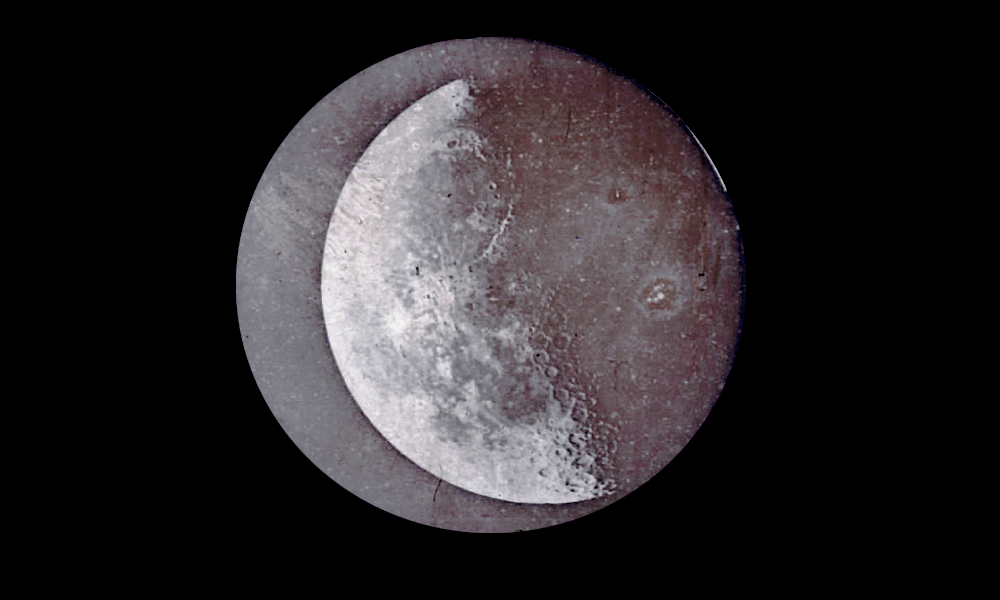
Indeed, the idea quickly proved popular: with a few years everyone from Abraham Lincoln to the Queen of England had posed for the camera. Yet Draper is also remembered for something else: in early March of 1840 he climbed to the roof of New York University, and shot a series of images of the Moon.
Getting it in focus was apparently difficult. Many of the earlier attempts, probably including Daguerre’s lost image, had shown little more than a blur of light against a dark background. But though the details are faint in Draper’s image, the surface of the Moon can be seen, along with its craters, the curves of mountain ranges, and its wide plains or mares.
This is often said to be the oldest surviving photograph of the Moon. There is some debate about that. Draper took many other photos of our satellite, and announced he had succeeded in capturing one several days before this one was taken. But those images have since been lost. This version was likely taken on March 26, 1840, a night upon which the Moon was in its last quarter.
