
The Strange Problem With Red Supergiants
Are the biggest stars vanishing without a trace?
Giant stars are supposed to die in big and dramatic explosions. They run short on fuel, their cores collapse under immense gravitational pressure, and then they blow up. In 2023, we saw this happen in the nearby Pinwheel Galaxy: the star, probably a red supergiant akin to Betelgeuse, exploded and subsequently outshone the light of every other star in that galaxy combined.
Yet every now and then, astronomers notice that a big star has simply vanished. This is quite remarkable. Rather than exploding, it would be as if Betelgeuse switched off one day and calmly blinked out of existence. Instead of shining with the light of a billion suns, it would quietly cease to be.
These disappearances are hard to spot. Unlike supernovae, which are bright and all but impossible to miss, vanishing stars don’t announce themselves. We spot them only by chance, usually when astronomers happen to notice that a bright star is no longer shining where it once did.
One such case came in 2024, when researchers realised a bright star in the Andromeda Galaxy had disappeared. There was no supernova, and instead only a faint glow coming from the place where this star used to lie. A decade earlier it had seemed to be a yellow supergiant, one on the verge of a dramatic death. Yet despite a small flare-up in 2014, nothing else of note has been seen since. The star seems to have quietly faded away.
The only other convincing example was spotted in 2015. It, as before, seems to have been a supergiant star, probably one twenty-five times the mass of the Sun. In 2009 it brightened, but in the years after it too faded away without a supernova. Today it is gone. Like the more recent example, the star seems to have silently slipped away into retirement.
Where are these giant stars going? That they have quietly turned off seems hard to believe, if not physically impossible. Without the radiation pressure coming from within, these stars would collapse. And that implosion should trigger a shock wave that must blow the star apart. A supernova, according to our current understanding of dying stars, would be inevitable.
But there is a possibility they are directly collapsing into black holes. Some theorists think that in a big enough star, one with a compact core, the shock wave could stall. If this happens, the centre of the star forms a black hole. The outer layers are sucked in, and whatever remains slowly fades away. No supernova takes place, and, if one is watching from a distance, the star quietly seems to vanish.
The Problem With Red Supergiants
The fate of a star depends on its mass. Those the size of our Sun will, after a few billion years of life, swell up into red giants, gradually shed their outer layers, and slowly fade into darkness. This happens because they are powered by fusing hydrogen, and when this hydrogen starts to run out they begin to cool and expand, and then – once this process reaches an end – gradually dim.
But when a star is above about eight solar masses, another process kicks in. These stars are big enough to fuse heavier elements, and they can burn helium and carbon, and other elements up the periodic table until they reach iron. Iron is not well-suited for nuclear fusion: the reaction takes in more energy than it releases, and when a star reaches this point, the end is not far off.
But before that, the star expands. As it begins to fuse helium, it swells into a red supergiant – a bubbling cauldron of a star similar to the current state of Betelgeuse or Antares A. The most massive stars can briefly become yellow supergiants. These are extremely bright, very unstable, and rare – indeed, only a few dozen of them are known in the Milky Way.
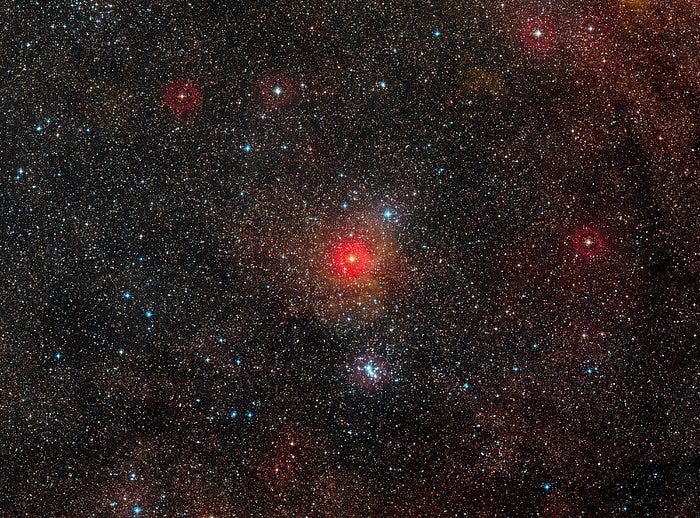
All big stars become a delicate balancing act. On one side they are massive, and all that mass tries to fall inwards and compress the star. But this force sustains immense nuclear reactions in their cores, and this creates a pressure that pushes out and tries to expand the star. The more a star compresses, the more furious the nuclear reactions become, and the stronger the expansion pressure that results.
This can sometimes result in pulsing stars, in which the balancing forces oscillate. At times gravity seems to be winning the battle, and the star shrinks. But this triggers a response from the core, and strengthens the opposing pressure. The star brightens, and then expands again. This cycle can repeat over and over, following patterns that last many years at a time.
Eventually, gravity always wins. At some point, the core of the star fills with iron, the nuclear reactions slow, and the internal pressure stops. The outer layers implode at enormous speed, crash into the core, and trigger a powerful shock wave. This blows the star apart. The inner core collapses, forming a black hole or neutron star, and around it a supernova detonates.
When we spot the flash of light this creates, astronomers swing into action. We cannot yet predict exactly when a giant star might explode. But we do have automated telescopes that detect them almost as soon as they appear. Astronomers then look back at previous observations to work out which star exploded – this is called the progenitor star.
Progenitors are valuable, since they can sometimes tell us what a star was doing in its final years. Yet these studies have raised an odd puzzle: though red supergiants range in mass from eight to twenty-five solar masses, almost all the ones seen to explode are smaller than about twenty solar masses.
The biggest stars, it appears, do not die as they should. This is known as the red supergiant problem.
Failed Supernova and Dust Clouds
Are the biggest stars simply vanishing? If they collapse directly into black holes, with no corresponding supernova, it stands to reason we would not find any progenitors bigger than about twenty solar masses. Above this point the core might become compact enough, the shock waves could stall, and the whole thing could be swallowed by a fast-forming black hole.
Yet, this should still leave some signs. As the debris of the dead star circles the black hole, it should release a lot of energy. We ought to see x-rays flaring out, and this should mark the spot where the star once stood. But surveys have not found any clear signs of this actually happening.
Neither have efforts to monitor big stars revealed much. In one study, astronomers watched millions of big red supergiants over more than a decade. Almost all of them were still there by the end, and only one disappeared in a way that could hint at direct collapse into a black hole. And even in that case, the x-ray signature was missing, and still is, more than a decade after the vanishing act.
Some astronomers wonder if there is something more complicated going on. It could be that red supergiants shed mass before they die. Strong winds blow from within them, and these send clouds of gas streaming out into space. Eruptions can sometimes eject big chunks of stellar material – something like this seems to have happened to Betelgeuse in recent years.
This could create two effects. One is that the biggest stars might shrink drastically before they die. If they lose mass fast enough, then all progenitors might be expected to be below some upper limit, just as observations have seen. But second, is that the dust and gas they expel could make them look fainter than they really are.
If this is the case, then it may confound our measurements. Astronomers normally assume a bigger star shines more brightly than a small one. But if big stars on the verge of death happen to be dusty, then they will be darker, and astronomers will think they are smaller than they really are. Big progenitors could be missing simply because we don’t detect them properly.
As for the two stars that we thought we saw vanish, there might be another story that fits the facts. Emma Beasor, an astronomer based in Liverpool, England, thinks these are better explained as collisions between stars, rather than collapsing ones. In the years leading up to the collision, the two stars would look like a single very bright one. The collision itself would cause a flare, and then in the years afterwards the resulting object would darken, and possibly be surrounded by dust.
There is, then, no shortage of possibilities. The idea that giant stars might collapse directly into black holes is a neat solution, and a seductive one, but we need more data to understand if it is right or not. But even if it turns out to be wrong, the search will still reveal the workings of some of the most violent events in the cosmos.
Read More
How Dust on the Ocean Floor Hints at a Recent Near-Earth Supernova

However big you imagine a supernova to be, the reality is certainly bigger. To put it one way, an exploding star can briefly outshine the combined light of every other star in a galaxy; to put it another, a supernova at the distance of Pluto would hit you with more energy than a hydrogen bomb exploding just outside your front door.
Origins: A Fairy Tale of the Pleiades

Many a night I saw the Pleiads, rising thro' the mellow shade,
When Will Betelgeuse Explode?

One day, they say, Betelgeuse will explode. It promises to be spectacular: th…
Must be star lifting aliens.
Coooooool!