
The Week in Space and Physics: A Private Hubble
On plans to build a new space telescope, Isaacman's tough start at NASA, a possible star around Betelgeuse, and the Roman Space Telescope
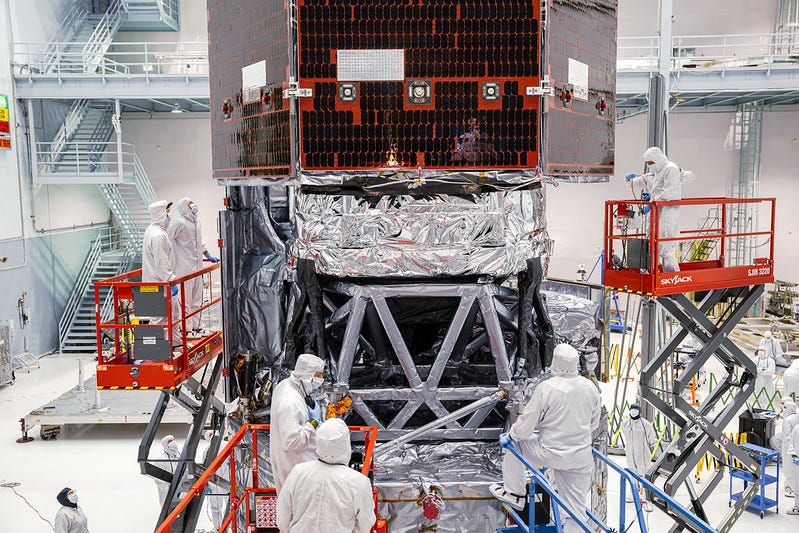
For the past decade, NASA has had a large mirror sitting in a warehouse. In principle, it could one day form the centrepiece of a new Hubble-class telescope. But in reality, money is short. NASA has the technology to build such an observatory, and plenty of ideas for what to do with one, yet sadly the political desire to fund such a project has long been missing.
Could America’s billionaires fill that gap? They have the cash, the rockets, and a few, it seems, also have the will. Last week two of them, Eric and Wendy Schmidt, announced they would fund a set of powerful astronomical observatories. The centrepiece of their investment is a space telescope they call Lazuli, an observatory of greater power than Hubble they hope to place in a high orbit over the Earth.
Eric Schmidt was an early CEO of Google. He is now fantastically wealthy, and he and his wife have set up a series of foundations intended to encourage scientific work. It is one of these, Schmidt Sciences, that has decided to fund the observatories, a project that seems likely to cost more than a billion dollars in total.
Four astronomical centres will be funded. The first, the Argus Array, will study the sky in optical frequencies – those visible to the human eye – and will be suited for spotting rare events like supernovae. Another, called the Deep Synoptic Array, will observe radio frequencies. A third, LFAST, will act as a scalable prototype that could, if expanded enough, gather as much light as some of the largest telescopes now under construction.
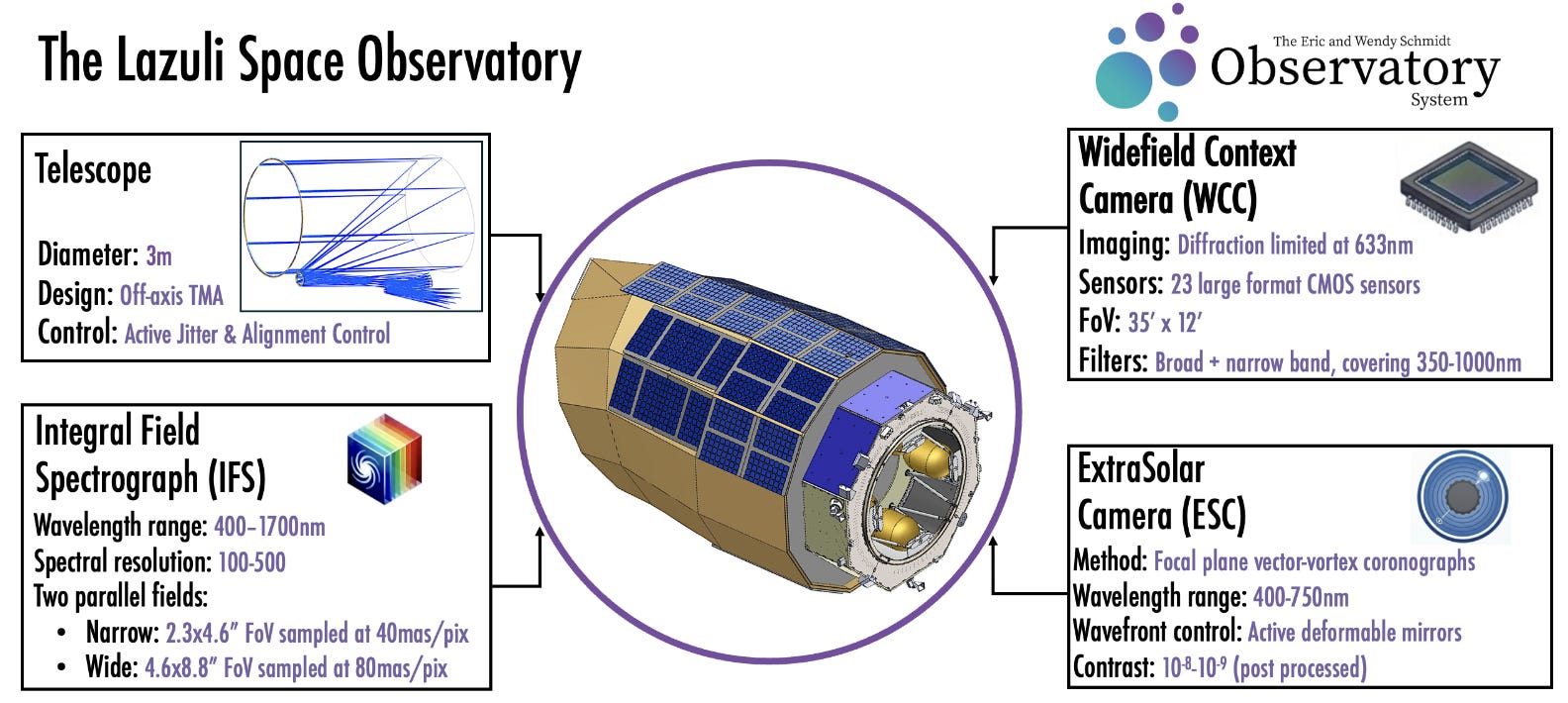
It is the space telescope, however, that has captured the most attention. Schmidt Sciences propose to build and operate an observatory with a bigger mirror than Hubble’s. It will be equipped with more advanced instruments, and will orbit at a much higher altitude. It is, Schmidt Sciences said, a modern realisation of Hubble-like capabilities.
If this announcement were coming from NASA or ESA, it would not be surprising to hear that operations will not start until the late 2030s. But Schmidt Sciences reckon the telescope can be in orbit by 2029. That is fast. And if it can be done, it will be a major boost to the world’s astronomical abilities.
Although it is rare today, historically many observatories were funded by wealthy patrons. A few examples may still be found, but nothing of this scale has ever been attempted by private organisations. Yet in a world where government money can be scarce and in which budgets can be held hostage by politicians, new funding sources and alternative models for astronomy are to be welcomed.
Isaacman Takes Charge at NASA
After a tumultuous nomination process, Jared Isaacman is now in charge of NASA. The billionaire and private astronaut was first proposed for the job at the end of 2024. But he was brushed aside after Donald Trump and Elon Musk had a spectacular, if rather childish, falling out. After they repaired their relationship his name was raised again, and he was confirmed by the US Senate on 17 December.
His start at NASA has been eventful. Last week, as astronauts on the space station prepared for a space walk, one of them made an urgent call to ground controllers in Houston. Exactly what happened is not yet clear, but it appears some kind of medical situation developed. NASA has said it was not an injury and that the astronaut is stable, yet it was serious enough to postpone the planned excursion.
After conferring for a few days, NASA then decided to return the astronaut and crew to Earth early. Details of the medical situation, and the astronaut in question, have not been released – indeed, NASA typically goes to great lengths to protect the privacy of their astronauts, and it may not ever give the full details of what exactly has happened.
Though plans for medical evacuations have been in place since crews first set foot on the station, this is the first time they have been put into action. The early departure of the four astronauts, which should take place on Wednesday, will leave a minimal crew of three onboard the International Space Station.
Alongside that, NASA is moving ahead with plans to launch Artemis II, the first crewed flight beyond low earth orbit since the days of Apollo. Four astronauts will travel in the Orion capsule over a ten day mission that will take them around the Moon. They will not set foot on the lunar surface, but they will become the closest visitors to our natural satellite since 1972.
There are, however, questions about the safety of Orion’s heat shield. Examination of the shield after Artemis I, an uncrewed test flight, found it had behaved in unexpected ways.
Engineers have modified the planned re-entry trajectory to minimise the risk, but some are still concerned about whether it – and the crew – will survive their fiery plunge back to Earth. After examining the data, however, Isaacman declared he was satisfied with the proposed approach. NASA is now working towards a launch window opening on 6 February.
Does Siwarha Really Exist?
Betelgeuse is one of the brightest stars in the sky. At first glance it seems to be alone, but for a long time we have suspected it has a hidden companion. Fluctuations in the star’s brightness show a regular pattern, as if something is tugging on it in a periodic way, just as another star in orbit around it might do.
Yet observations have so far failed to spot any companion. Some measurements have hinted at one – a study last year, for example, claimed to have seen it – but all have been inconclusive. Now, for the first time, astronomers looking at data from the Hubble Space Telescope claim to have found evidence of a wake left behind this companion star.
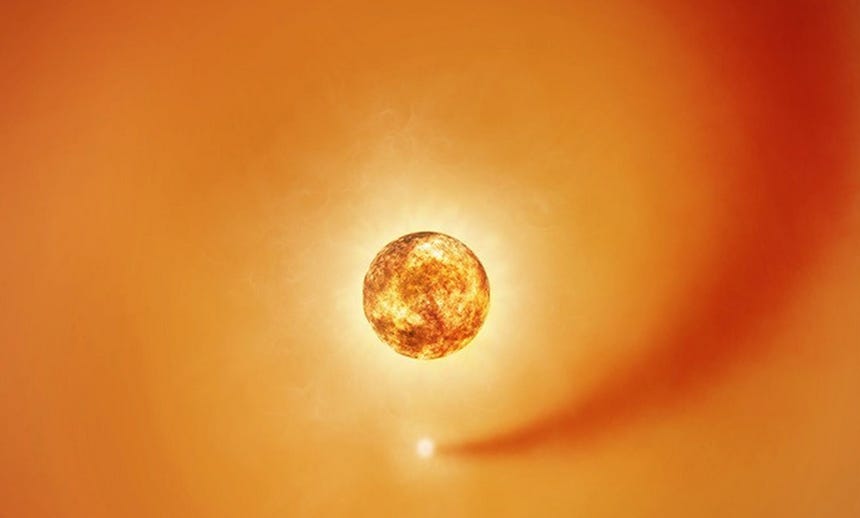
Models suggest the star, which has been named Siwarha, orbits so close to Betelgeuse that it should lie within the giant star’s outer atmosphere. As it moves through this layer it ought, therefore, to leave a trail of disturbance behind it.
After examining Betelgeuse carefully over the past decade, the astronomers say they found multiple signs of such a trail rising and falling over a six year cycle. That matches well with other observations about the periodic nature of Betelgeuse, and should be taken as new evidence supporting the existence of this companion star.
As always, caution is needed. Light from this star has not yet been definitely spotted, and right now the models say it is behind Betelgeuse and cannot be seen. It should re-emerge in 2027. When it does, telescopes are bound to be watching for it. If the growing pile of evidence is correct, someone may be able to claim a discovery by the end of next year.
The Roman Telescope
NASA announced the successful completion of construction work on the Nancy Grace Roman Space Telescope. The final step came at the Goddard Space Centre in Maryland, where engineers connected the inner and outer segments of the new observatory.
Like the James Webb Space Telescope, Roman is designed to study the sky in infrared light. But unlike the James Webb – which often looks deep into small areas of the cosmos - Roman is equipped to study wide areas simultaneously. This will allow astronomers to study swathes of the sky, and so to look for things like supernova, exoplanets, and the effects of dark matter.
The telescope will now go through a period of final testing. By the summer it will be delivered to the launch site, and there the final preparations for lift-off will take place. The launch date itself is still to be determined, but NASA and SpaceX say it could come as soon as October.
Read More
Notes On Learning Hard Things

The number one most read page on my site is a guide to learning physics.
The Biggest Solar Flare of 2025

The Quantum Cat is a reader-supported publication. To receive new posts and support my work, consider becoming a free or paid subscriber.
What Was 'Oumuamua? A Piece of Alien Space Trash? A Dark Comet? Or An Interstellar Iceberg?

At first we thought it was a comet. That made sense. Comets often come from …
The private sector can always do more for less compared to government for the simple reason that cost and efficiency is paramount for business owners and businesses aren't impacted by shifting political winds, either. What's old is new again as many early scientists were actually sponsored by rich patrons. Private space/science ventures brings things full-circle.