
The Week in Space and Physics: The Wandering Black Holes
On lost and hidden black holes, Betelgeuse and its companion, the surface of the Sun, and a solar eclipse.
It sounds like the stuff of nightmares. A rogue black hole emerges out of nowhere, swallows the planets one by one, and then stretches the Sun out into a long stream of glowing dust. We – if we even make it beyond the first moments of such a disaster - have little chance of survival.
Nightmarish though it appears, this may well have been the fate of a recently discovered star in a far distant galaxy. It was only spotted in November last year, when a brilliant flash of light suddenly lit up the galaxy. Over the following months it faded – but when astronomers traced back the event, the conclusion that best fitted was a deadly encounter with a wandering supermassive black hole.
These beasts normally lurk in the centres of galaxies. There they are obvious: they are surrounded by clouds of dust and gas swirling around at tremendous speed and emitting bursts of radiation. In our own galaxy, this radiation signature was first detected in 1933, when pioneers of the radio picked up a strong signal coming from the heart of the Milky Way.
Sometimes, however, they leave their natural homes and begin to wander. This is most likely to happen when galaxies collide. In many cases, the black holes of the two merging galaxies end up spiralling around one another, gradually drawing closer and closer until they combine into a single heavyweight that remains at the centre of the newly enlarged galaxy.
At times, however, the situation can become more complex. Should a third black hole get involved – perhaps because one of the colliding galaxies already hosts a spiralling pair – then one of the black holes can be ejected. Or, perhaps, a small galaxy might encounter a far larger one. Its stars get torn off and stretched out into a long stream. Its black hole is left alone, and then begins a long fall through the larger galaxy.
Either way, the result is a wandering supermassive black hole. Such objects are hard to detect. Alone, they barely emit any radiation. They gather little in the way of dust and gas, and it is only when they encounter and destroy an unfortunate star that they betray their presence. Such catastrophes are called tidal disruption events.
Over the past few years we have seen several possible candidate events. All occurred in other galaxies, and each looked like a sudden burst of radiation created as a star was violently ripped apart. The event of November 2025 – which took place more than thirty thousand light years from the centre of its galaxy – is notable for just how far this black hole seems to have wandered. For reference, we lie about twenty-five thousand light years from the centre of our galaxy.
The dynamics and behaviour of these wandering black holes are still poorly understood. We do not know, for example, if black holes are more likely to be heading outwards, or falling inwards. Fortunately, the new Vera Rubin Observatory is poised to change things.
It has been designed to look for sudden flashes of light in the night sky. Some of these will be stars dying natural deaths. Others will be signatures of a violent encounter between a star and a wandering black hole. Astronomers hope this data will reveal hundreds of such cases – and thus show more about how they behave and how they move.
Betelgeuse and Its Companion
Speculation has been growing for some time that Betelgeuse is not alone.
The star is one of the brightest in the night sky, and is the closest one likely to erupt in a supernova in the near future. Nobody knows exactly when this dramatic event will occur, but it should take place within the next hundred thousand years. The day that it does finally explode, observers here on Earth will see one of the most brilliant events to ever appear in the night skies.
For some time, observations have shown that Betelgeuse fluctuates in brightness. These changes can be extreme – at times it is among the very brightest of stars, at others it drops almost entirely out of the top twenty. Part of this is probably caused by its imminent demise: a sudden darkening a few years ago was triggered by an outburst of dust from the star.
But astronomers also know that Betelgeuse follows a regular cycle of brightening and darkening. This pattern has made some wonder if it has a hidden companion, a fainter and smaller star that is locked in orbit around the dying giant.
In 2024, two separate studies modelled the orbit of this possible star and predicted it would be furthest from Betelgeuse in December of that year. Since that would make it easier to see, a team led by Miguel Montargès of the Paris Observatory decided to use the Very Large Telescope (VLT) in Chile to try to find it.
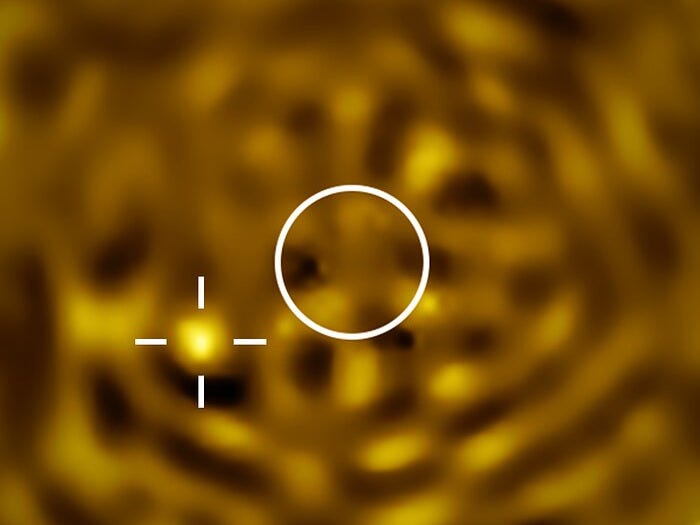
They now say they found something. The images they took quite clearly show a star close to Betelgeuse, in roughly the predicted place. Montargès says it is “more massive than predicted”, which had the fortunate effect of making it brighter and easier to see than expected.
To confirm the discovery, astronomers will want to see the star moving. By next year it should have moved to the other side of Betelgeuse. If it has, new images should show this, and that would finally confirm that Betelgeuse is not alone.
The Surface of the Sun
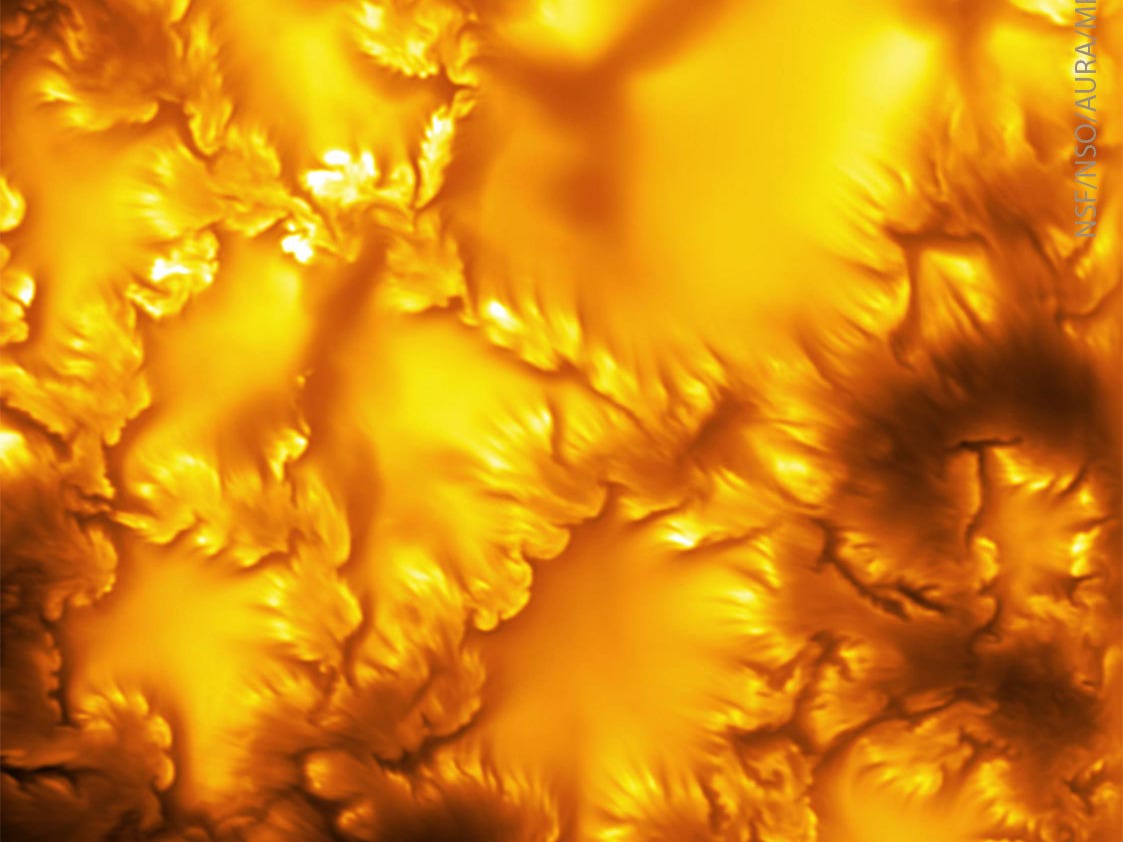
A telescope in Hawaii captured the highest-resolution image of the Sun’s surface ever made (shown as the cover image above).
The picture shows the photosphere of our star, that is, the outer shell from which the Sun’s light shines. This layer often has a granular, boiling appearance, caused by bubbles of hot plasma rising up from below before cooling and falling away. At times, it can be blemished by sunspots, each of which reveals an area temporarily cooler and darker than the rest of the photosphere.
The new image focuses on a region of the Sun close to a sunspot. It shows the surface covered in moving bands and vortices, structures that astronomers think are signs of Kelvin-Helmholtz instabilities. These are created when a velocity shear is present in a moving fluid, for example, when fast- and slow-moving fluids come into contact.
Astronomers had theorised that these instabilities should appear on the Sun’s surface. But this image is the first confirmation they actually exist. They are thought to play an important role in moving magnetic energy around the Sun’s surface, and in transferring heat outwards into our star’s outer atmosphere.
Solar Eclipse
A total eclipse of the Sun will take place on August 12.
The Moon’s shadow will race across the Arctic and Atlantic Oceans, making landfall over Greenland, Iceland, and the Iberian Peninsula. In mainland Spain, it will be the first total eclipse seen in more than a century – the last took place in 1905, though one was seen from the Canary Islands in 1959. Yet it will also be the first of a run of three Spanish solar eclipses that will occur in 2026, 2027, and 2028.
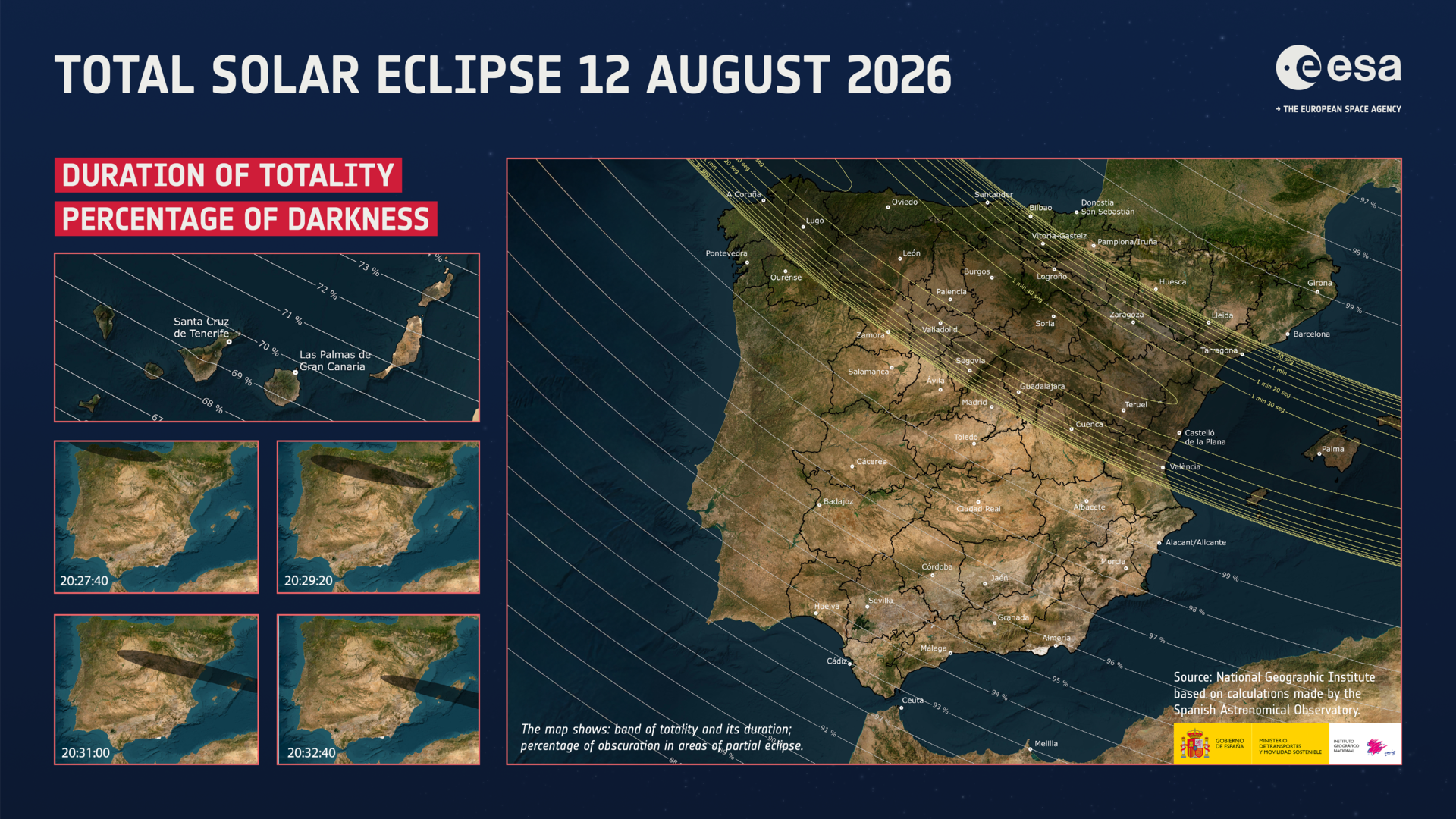
The path and timing of the eclipse offers a few remarkable possibilities. During its early hours over the Arctic, the sudden darkness could allow the aurora to become visible in the middle of the day. As it reaches Spain, the eclipse will accompany the setting of the Sun, giving observers a rare view of a crescent Sun disappearing over the horizon. Those who stick around have a chance to see the Perseid meteor shower, expected to peak during the night of August 12.
Read More
When Will Betelgeuse Explode?

One day, they say, Betelgeuse will explode. It promises to be spectacular: the star will detonate with the force of ten million suns; burning bright enough to be visible across half the known universe. From Earth it will appear to gl…
Proba 3: Shadowing the Sun

This week I’m looking at the Proba-3 mission, launched on December 5. In the next week I plan another article for paying subscribers on the Parker Solar Probe, scheduled to make its closest approach to the Sun on December 24. I’m also hoping to get one more long article out on dark matter before the e…
The Solar Probe: So Simple a Thing As a Star

It is reasonable to hope that in a not too distant future we shall be competent to understand so simple a thing as a star.