
Data Centres In Orbit Are Just As Crazy As You Think
On the latest space hype
America’s billionaires are suddenly obsessed with the idea of building data centres in orbit. Elon Musk has, as usual, taken the lead. In the past month he has merged his AI company with his rocket company, and applied for permission to launch a million satellites into orbit. Within the decade, he says, this company will build a city on the Moon dedicated to pumping out an endless stream of AI spacecraft.
He is not alone. Google is pursuing an AI moonshot, and wants to put prototypes in orbit as soon as possible. Starcloud, a start-up funded by Y-Combinator and backed by NVIDIA, has already put AI chips in orbit, and wants to build a constellation of eighty thousand satellites. Amazon founder Jeff Bezos thinks the first gigawatt-scale data centres will be in orbit by the 2040s.
The question, though, is why anyone thinks this is a serious idea. Working in space is hard. Very few things make economic sense in orbit. Those that do - communications, navigation, and observation – are feasible only because their advantages outweigh the tremendous downsides of launching equipment into the vacuum of space.
Much of the current noise is coming from the rapid build-out of data centres for AI. Training the models behind apps like ChatGPT takes a lot of processing power – we’re taking hundreds of megawatts here, or the demand of a small city – and the difficulty of getting this power supply fast enough is threatening to curtail the race towards ever more intelligent machines.
Building more power stations is the obvious answer, but this takes time and getting the necessary permission to build new plants is a lot of work. For a while it looked like nuclear fusion might be the answer: OpenAI and Google both poured millions into start-ups claiming they could build a working reactor. But progress, as always, has been slower than the hype, and the AI companies have impatient investors to satisfy.
Why not, then, turn to the giant fusion reactor we call the Sun? It has provided us with a steady stream of energy for the past few billion years. The most direct way to access that power is with solar panels, and on paper these can be deployed in such numbers as to provide us and our data centres with all the power we could ever need.
But doing this on the Earth’s surface has some drawbacks. The most obvious is the night – after the Sun sets, solar panels are useless. Yet even when the Sun is shining, its light can be blocked by clouds, and since the Earth wobbles as it spins the intensity of the Sun’s light varies over the course of a year.
So why not put the panels in space? With the right orbit you can ensure they are almost always illuminated. There is no atmosphere to weaken the Sun’s rays, and neither are there any clouds to block them out. Panels can easily be oriented to maximise their exposure, and as a result solar panels can in theory produce much more energy in space than they can on Earth.
Even better, at first glance this energy looks cheap. Solar power is free and almost endless, and once the satellites are in orbit they require little in the way of maintenance. Their numbers can scale almost without limit, with no neighbours to complain or landowners to bargain with.
Into The Great Wide Open
So what’s not to like about endless free energy? Musk in particular seems enamoured with the idea. His constellation, he claims, will propel consciousness into a new age, one in which we convert the entire energy output of the Sun into the musings of an artificial intelligence. Humanity might not survive that – who knows what such a being might think of us – but that does not matter, just as long as the spark of consciousness lives on in this wondrous creation.
Yet there are basic problems with the idea. Much ink has already been spilt on the topic. One is a basic question of thermodynamics: every watt of energy a spacecraft takes in must somehow be later expelled. If you don’t or can’t do that, then it will heat up, and heat quickly becomes a problem for computers. Indeed, most data centres on Earth put a lot of effort into keeping their processors cool.
Fortunately space is cold, enthusiasts say. What they really mean is that the vacuum of space is cold. Astrophysicists have measured its temperature, and found it to be only a few degrees above absolute zero. But the vacuum is also a good insulator, and so heat does not conduct away from spacecraft as it would on Earth. Instead, a spacecraft can only lose heat by radiation, and this is not an efficient process.
Engineers thus put a lot of effort into controlling heat flow in and out of spacecraft. Some deploy enormous heat shields to reflect the light of the Sun away; others are fitted with special devices to radiate heat as efficiently as possible. Inside, they run heat pipes and pump fluids to cool computing devices and to push heat to places where it can be expelled.
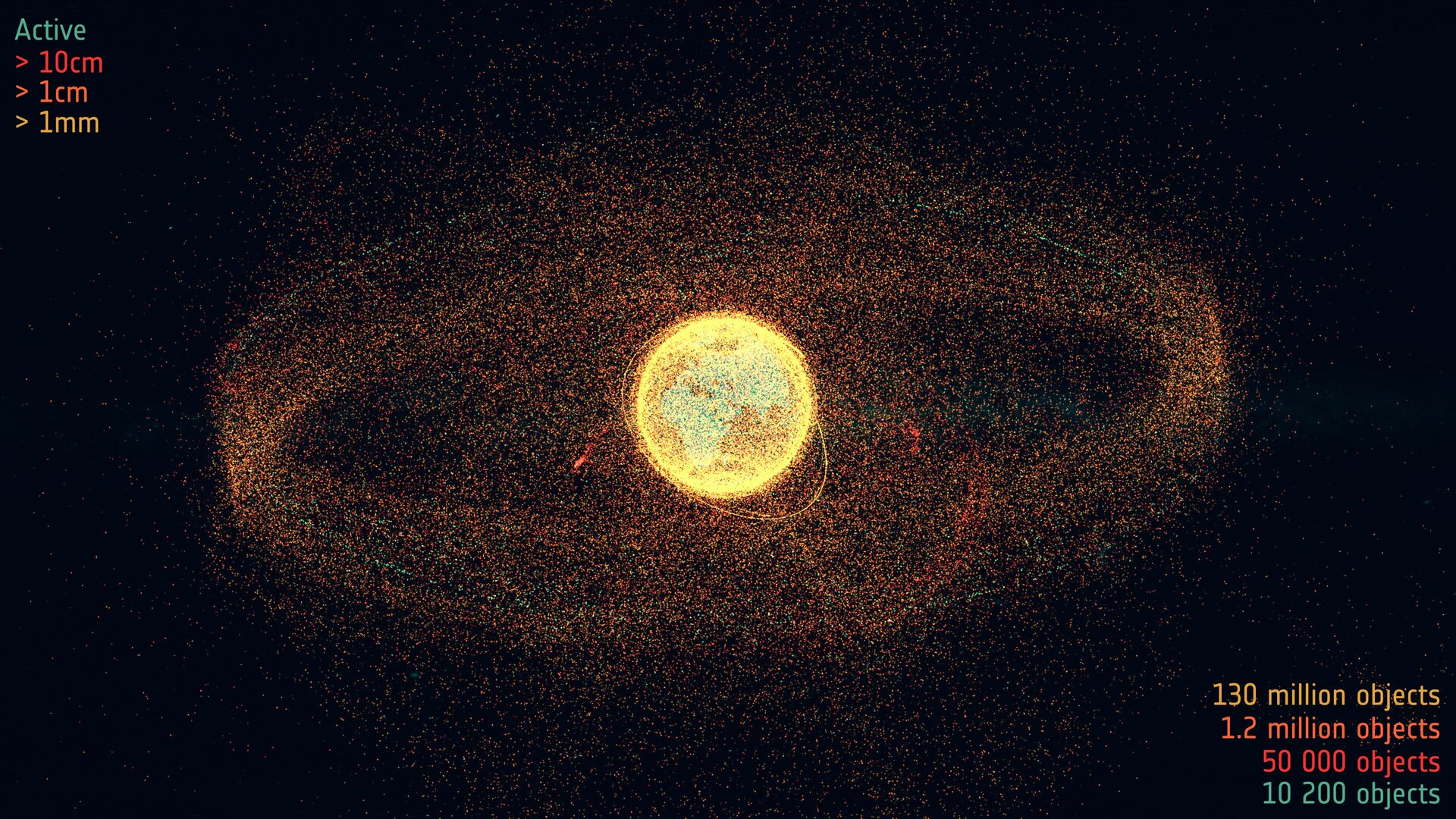
Simply capturing enough solar power is another problem. Each megawatt you need demands at least eight hundred square metres of solar panels1. Such enormous arrays quickly become a challenge to manoeuvre and position. Even worse, the good orbits are full of old satellites, pieces of debris, and micrometeorites. Avoiding collisions becomes imperative, and will become a nightmare task even the smartest AI will struggle to solve.
Yet even if you can solve these fundamental questions – and with enough ingenuity and equipment you can probably get close – you still face issues of radiation, of degrading solar panels, of replacing failed processors, and of keeping your whole system up-to-date with the latest AI chips developed back on Earth.
These are all, in truth, engineering problems rather than showstoppers. But they are each a downside to the dream of unlimited free energy. Addressing them costs money, lofting them into orbit costs more, and pretty soon all that free energy starts to look rather expensive after all.
One Day, But Not Today
In 2012, Popular Science ran an article titled “Why Mining an Asteroid for Water and Precious Metals Isn’t as Crazy as it Sounds”. Back then, asteroid mining was all the rage. The usual suspects rushed to invest, hoping to stake a claim to the minerals of the future. Eric Schmidt and Larry Page of Google poured in cash, as did the director James Cameron. Even countries got involved – in 2016, the Grand Duchy of Luxembourg invested millions of dollars into the concept.
Of course, it went nowhere. The over-hyped start-ups were sold off – one smoothly transitioned into blockchain services – and the idea of mining asteroids now lingers as a faintly embarrassing episode in the history of spaceflight. In many ways the concept was doomed by the technology needed. It could one day be done, perhaps, but it would take a solid decade or two of consistently pushing the frontiers of spaceflight.
Nor did the sums really add up. The minerals investors dreamed of are all already available on Earth. If the demand for them were there, we could extract them more easily and cheaply from the bottom of the sea, or from deep in the Earth’s crust. Both would be far simpler than venturing into the depths of space and landing on an asteroid.
Is history repeating itself? Last week, The Economist ran an article entitled “Data Centres in Space: Less Crazy Than You Think”. It lays out a possible path to building orbiting facilities at lower cost than on Earth. But look closely and the argument is flawed2. It relies on technologies that haven’t been developed, on contradictory assumptions, and on unrealistic input costs.
The only real difference this time may be the deep pockets of Elon Musk. He could, if he wishes to, build orbiting data centres at a loss. With enough money, many of the engineering obstacles might be overcome. Prototypes could be launched. But it still won’t be cheaper than doing it back here on Earth. The sums simply don’t add up.
One day, decades from now, things might look different. Asteroid mining would be viable if we had a use for the minerals in orbit. The hard part is often the transfer between Earth and space – if you never bring the rocks back to the surface, then perhaps a profit is to be had. The same might be true for computing power in orbit. For certain applications, it may one day become cheaper to keep everything in space.
Yet until that day comes, the idea really is crazy. And if you have to keep reassuring people it isn’t, you are probably wrong.
Read More


This assumes the panels are working close to 100% efficiency. In a more realistic scenario you would need more than two thousand square metres of panels per megawatt.
Most obviously, the article argues that launch costs could fall to $20/kg. This is unlikely any time soon, and will not realistically be achieved for the orbits targeted by Musk’s AI constellation. The need for accurate pointing is dismissed by the author – and used as a reason why mass might be saved – but this conveniently ignores the need to point the panels at the Sun, to dodge debris, and to maintain the accuracy needed for inter-satellite laser links.
If you think data centers in the sky are whacked the DoD in the 60s seriously argued that the Russians would break nuclear test ban treaties by testing nukes on the dark side of the moon…
You don’t have to be an engineer working in the technology sector, as I was before I retired, to realize how quickly that fantastic new computer or server you just got becomes an old, antiquated, slow, buggy piece of crap in comparison to what is next available. I haven’t heard of any quick and inexpensive methods for hardware updates in orbit, nor are there any available recycling centers out there. As they say, this isn’t “rocket science” - so whom are they trying to fool?