
The Bold Insanity of Artemis II: America Prepares to Return to the Moon
On the second flight of America's Return to the Moon
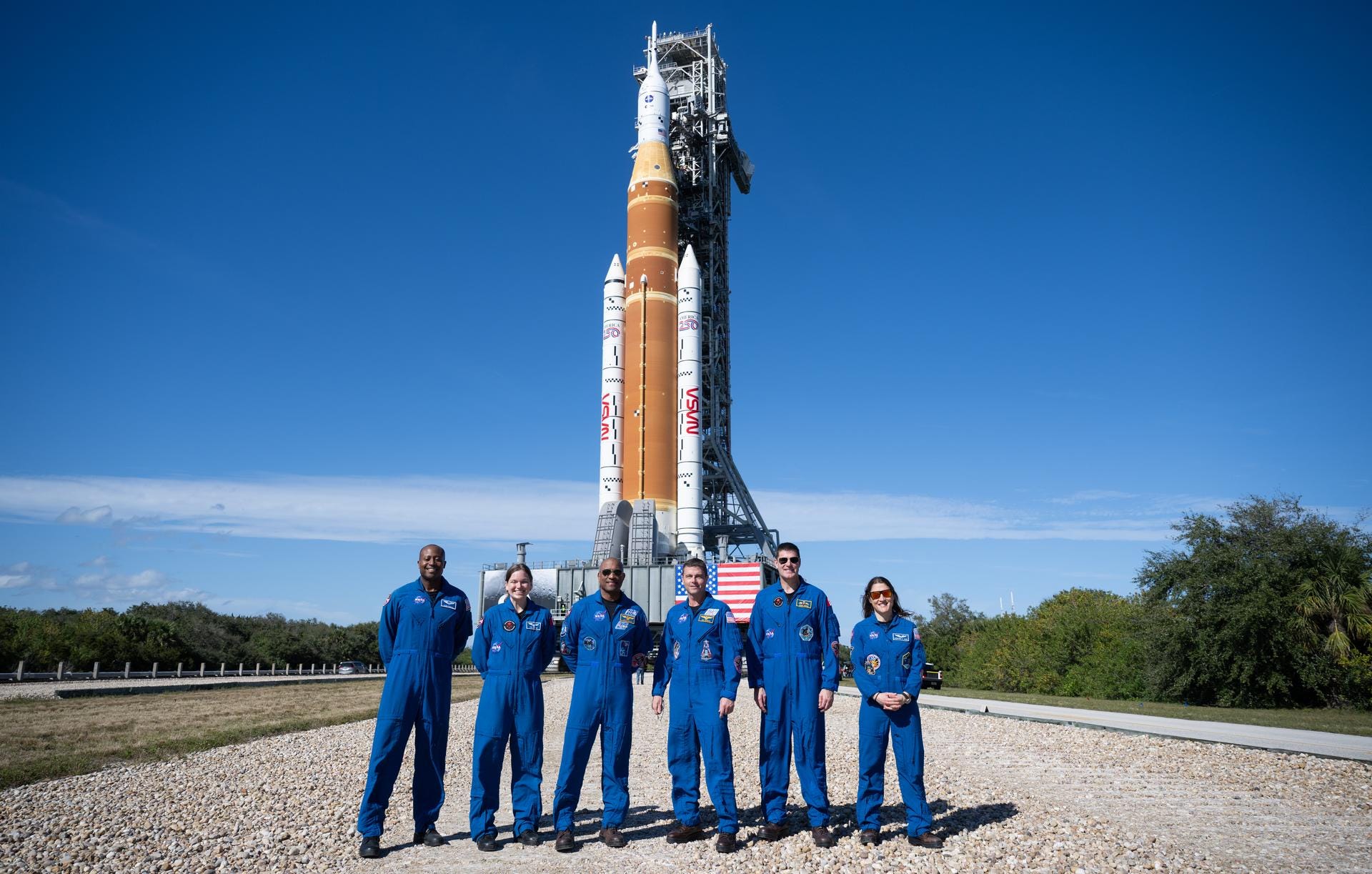
If NASA keeps the schedule, the moment of lift-off will come in early February. Six immense engines will roar to life, each belching out a tremendous cloud of fire and smoke. Eight point eight million pounds of thrust will be the result, and all of it will force a towering structure upwards, hurling two thousand tonnes of metal and fuel up, up into the sky.
What an acceleration the four people atop this tower will experience! In sixty seconds the engines will have forced them past the sound barrier. A minute later the solid boosters have gone, peeling away and falling back towards the ocean thirty miles below. The rocket burns on, the speedometer races higher, and then – eight minutes and three seconds on the clock – the whole thing falls silent.
That will be enough. By then the capsule will be in orbit, moving fast enough to reach an altitude greater than any astronaut has ventured in the past fifty years. The rocket – price tag two billion dollars – will be spent. It separates, falls back, and plummets towards the floor of the Pacific Ocean.
The capsule flies on, and within an hour it and its crew will reach their record-setting apex. At that point, if all has gone well, another set of engines will fire, this time raising its orbit to an altitude above that of the geostationary belt of satellites. From there the astronauts will be able to view the Earth as a solitary disk hanging in the sky, and they will become the first humans to do this since 1972.
From then on, things slow down. The burn towards the Moon takes place about twenty-four hours after launch. The journey towards it takes another four days. On the sixth day of the mission, the crew will travel beyond the record set by Apollo 13, and become the most distant travellers from Earth in all of history. A few hours later, the capsule will fly slowly over the lunar surface, offering its crew a view from the height of a few thousand kilometres.
Then, the irresistible laws of Newton will pull them home. After another four days of flight they will hit the atmosphere, briefly bounce off it, and then plunge, hurtling through its upper layers at a terrifying four hundred miles per minute. Fortunately, the capsule should be able to take it. The air will slow them, the heat shield will protect them, and within a few minutes they will be descending gently towards the ocean under a canopy of parachutes.
The whole thing is quite mad.
The Shadow of Apollo
The closest precedent to this mission is Apollo 8. Launched in December 1968, that flight took three astronauts – Frank Borman, Jim Lovell, and William Anders – around the Moon. They became the first men to fly into deep space, and the first to see the far side of the Moon with their own eyes.
Artemis II will not be an exact replica of that mission. Apollo 8 stayed and orbited the Moon ten times. The crew of Artemis II are following a simpler trajectory, and will merely loop around the Moon without trying to enter orbit. But the objectives are similar: like Apollo 8, Artemis II will test the ability of the Orion capsule to support life and to carry astronauts far beyond the Earth.
Of the four astronauts on board, three are American – Reid Wiseman, Victor Glover, and Christina Koch – and one is Canadian – Jeremy Hansen. The Americans are all experienced astronauts, having each flown to the International Space Station. But for Hansen it will be the debut of a lifetime: his prior experience is as a fighter pilot in the Royal Canadian Air Force, and he has never been to space before.
During the flight, these astronauts will conduct tests to prepare for future missions. While still in orbit around the Earth they will take the capsule through a series of manoeuvres called “proximity operations”. These will replicate actions the spacecraft would need to do to dock with another object – such as a lunar lander – and will allow engineers to gather data and experience for future missions.
Throughout the rest of the flight, the crew will evaluate the life support systems built into Orion, test its communications systems, and practice taking shelter from solar storms. All of this will be vital for the safety of future crews heading towards the Moon.
Heat Shields and Quarantines
One final test will come as the capsule falls back through the atmosphere. After the re-entry of Artemis I, engineers noticed alarming holes had formed in the capsule’s heat shield. Analysis showed that gases had built up within it, but then hadn’t been able to escape as models had predicted. Instead they had expanded under the heat of re-entry, and the resulting pressure had cracked and broken the shield.
To prevent this happening again, engineers have modified the re-entry trajectory. In Artemis I, Orion first “skipped” off the atmosphere, making a shallow plunge that slowed the capsule but wasn’t enough to bring it all the way down. It was during this period that gas built up. When the capsule then did make its final plunge, this gas heated and expanded.
In Artemis II, the capsule will still make this first shallow dive. But in an effort to reduce the gas build-up, engineers have made this portion of the flight shorter. That means Orion will have more speed to lose in its final fall, and that implies a faster and hotter re-entry. Briefly, indeed, the crew will reach the fastest speed ever attained by humans. But it should, engineers say, be safer this way.
If all goes well, Artemis II will pave the way for more ambitious flights in the future. The Artemis program, as it currently stands, envisions a moon landing before 2028, a space station in lunar orbit by 2030, and a series of missions to the lunar surface throughout the following decade. Much work remains to be done for any of this to happen, but Artemis II is an essential step towards these dreams of future exploration.
The launch window for lift-off opens on February 6. A handful of dates are available in early February, but if the rocket hasn’t gotten off the ground by February 11, the window closes until March 6.
Delays are likely1. Artemis I was delayed multiple times as engineers worked issues on the rocket. This time, with astronauts sitting on top, they are likely to be more cautious still. The crew themselves add constraints: they cannot wait in the capsule for more than a few hours, and they must take time to rest and prepare themselves for flight.
But whenever the lift-off comes, the march towards the Moon has already begun. In mid-January the rocket was rolled out to Launch Pad 39B at the Kennedy Space Center. On the 23rd, the crew entered a pre-flight quarantine. After years of training, their moment is almost upon them.
Read More
Artemis I: A Guide to NASA's New Moon Rocket

Last time America went to the Moon, in 1972, half a million people turned up to watch. Things didn’t exactly go smoothly. Moments be…
Starship II: The Return to the Moon

This article is the second in a series on SpaceX’s Starship rocket. Parts of this series, including this article, will initially be available only for paying subscribers. If you are not already a subscriber but would like to support my work and help me spend more time researching and writing articles,
The World According to Aristotle

As nature therefore makes nothing either imperfect or in vain, it necessarily follows that she has made all these things for men
NASA has already announced a delay until February 8, due to cold temperatures at the launch site.
What a vividly poetic description of the upcoming mission! Well done, sir. 🚀🌙
Katy Perry wasn't available?