
The worlds of astronomy and espionage can seem, well, light-years apart. One deals with the messy realm of human affairs, with seduction and threat, with cunning and guile. The other observes the heavens, divines the movements of the planets, and watches as the stars dance over timescales too long for us even to imagine.
When it comes to space telescopes, however, the two fields suddenly have much in common. The National Reconnaissance Office, or NRO, one of America’s secretive spy agencies, maintains a fleet of advanced telescopes in orbit. They point not up, but down, observing the Earth in great detail.
Hubble, one of the greatest astronomical observatories, was almost certainly based on the KH-11 series of satellites. That relationship was never made explicit, although the similarity in design, shape, and size is a little too obvious to ignore. Sadly, astronomy has not kept up with the spies. The KH-11 is by now on at least its fifth iteration, but we still only have one Hubble.
That may soon change. In 2012, the NRO donated two telescopes to NASA. Both were the result of an effort launched in the 1990s to develop new and improved optics for spy satellites. After that project ran billions of dollars over budget, the effort was abandoned. By the early 2010s, the technology was deemed obsolete for the purposes of espionage, and the NRO thus decided to hand them over to astronomers.
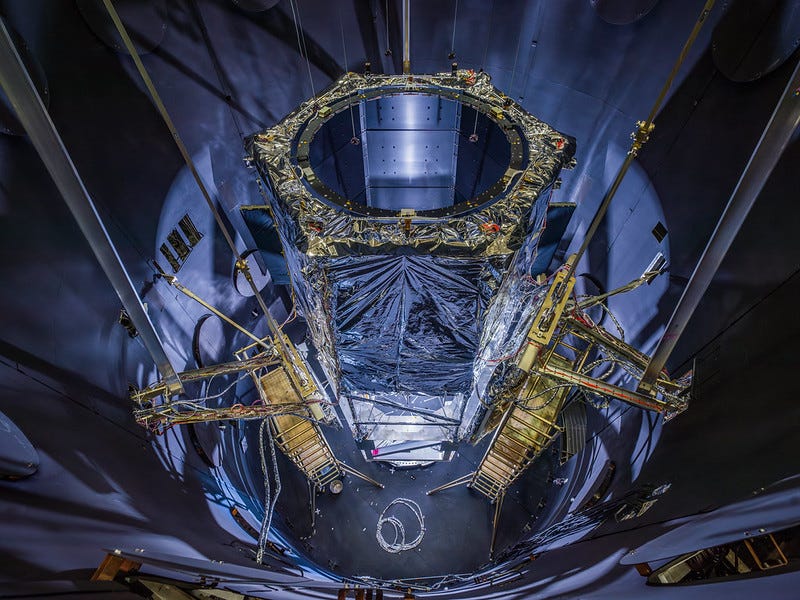
Each carries a mirror 2.4 metres across, similar in size to the one used by Hubble. But thanks to improved technology, they weigh less than a quarter as much, making them far cheaper to put into orbit. The debate about what to do with them quickly settled on one obvious project: WFIRST, an infrared telescope that astronomers had started sketching out a year earlier.
Initial designs had called for a mirror 1.3 metres wide. With the new donation, however, engineers could construct something that looked much more like Hubble. The result is a new observatory with Hubble-like resolution, able to take images of about the same quality and sharpness as the old observatory. But thanks to the design of its optical system, it can see much more of the sky, capturing one hundred times more sky than Hubble.
More than a decade after that donation, though, NASA has no clear plan for the other mirror. Various ideas have emerged. Astronomers could use it to study the Earth’s outer atmosphere, or to zoom in on asteroids and other faint objects in the Solar System. They could even send it to Mars, where it could map the planet from orbit and turn its gaze towards the Kuiper Belt. The possibilities are exciting – but the money, sadly, seems short.
The Nancy Grace Roman
After a decade of work, WFIRST – now renamed the Nancy Grace Roman Space Telescope – is almost ready for launch. Engineers completed construction and testing last year. The telescope has since been delivered to the launch site, loaded with fuel, and is scheduled for lift-off on August 30.
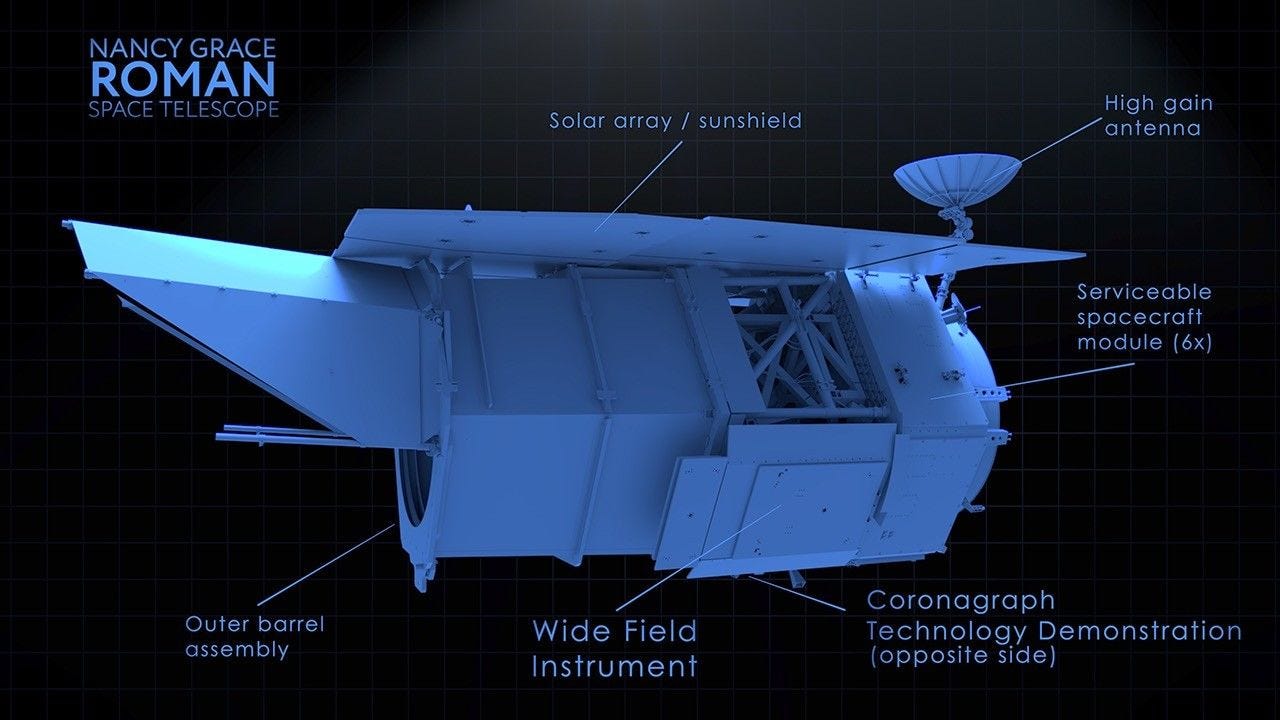
The original name of this new observatory was the Wide Field Infrared Survey Telescope. Like the James Webb Space Telescope, it is designed to detect infrared light. That makes it especially useful for studying cool objects like planets and brown dwarfs. But unlike Webb – which is able to peer deep into the cosmos – Roman has a wide field of view.
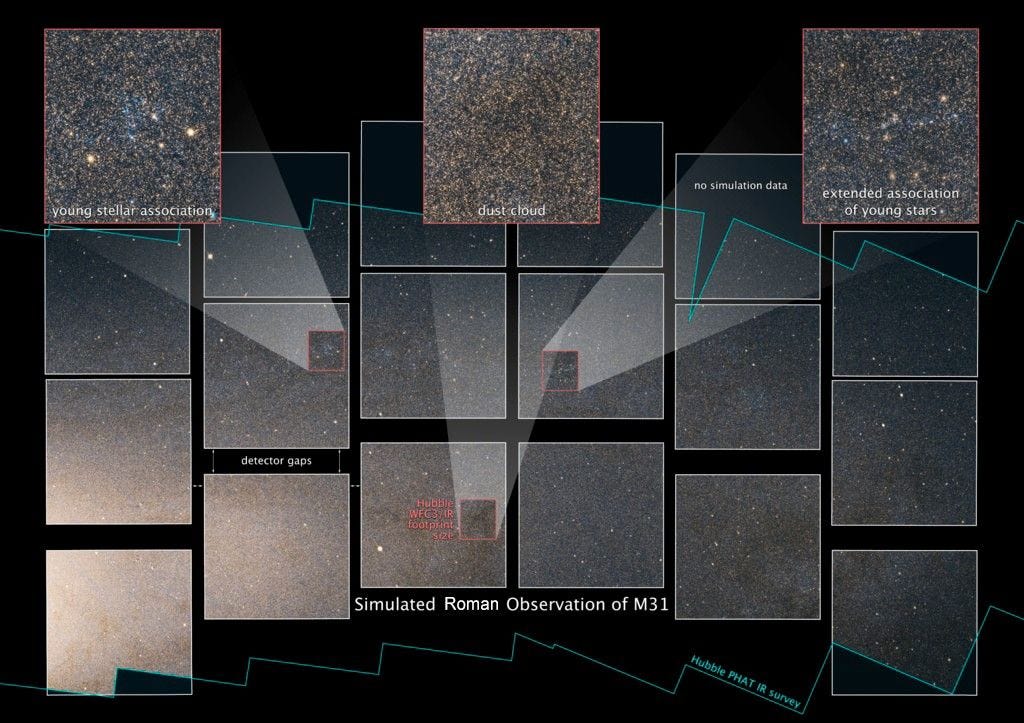
That means it can observe more of the sky in one go. Astronomers have fitted the telescope with a three-hundred-megapixel camera. This is able to make images as sharp as those of Hubble but with one hundred times the area, thus generating much more data. Whereas Hubble downlinks about twenty gigabytes per day, Roman should send back almost one and a half terabytes.
For its first five-year mission, astronomers have planned three campaigns for the new observatory. In the first, the ‘High Latitude Wide Area Survey’, Roman will look up out of the disk of our galaxy towards the deeper cosmos (hence the ‘high latitude’ part of the name). This should give the telescope a clear view of millions of galaxies scattered throughout the universe.
The images it takes will add to those of Euclid, another space observatory dedicated to mapping distant galaxies. By looking at how invisible mass is distorting the shapes of these galaxies, the pair will help researchers infer the distribution of dark matter across the universe.
Roman’s second campaign, the ‘High Latitude Time Domain Survey’, will narrow the telescope’s focus to a smaller region of space. Once again, this will lie away from the heart of the galaxy. Roman will return to this region repeatedly, creating a timelapse of how it changes. Astronomers hope to capture the events leading up to supernovae, to watch as neutron stars collide, and to track the final encounters of stars and black holes.
The third campaign - the ‘Galactic Bulge Time Domain Survey’ - will swing the telescope towards the centre of the Milky Way. Once more, it will repeatedly capture images to study how it changes over time. This effort that could reveal a hundred thousand new planets, as well as thousands of neutron stars and stellar-mass black holes.
In this work, Roman will be aided by its coronagraph. This is an instrument designed to precisely block the bright light of a star. With its aid, the observatory can capture the far fainter light coming from planets or rings lying close to those stars. Roman is not capable of spotting Earth-like planets, but it should be able to see worlds the size of Jupiter orbiting far away stars.
Alongside these three big campaigns, Roman will be available for general-purpose astronomy. Whenever something exciting and unexpected happens, Roman will be ready to study it. Hubble, in the past, has captured interstellar comets, peered at stars showing signs of possible engineering projects, and imaged the aftermath of violent explosions. Roman will do much of the same.
Beyond the Stained Glass
“Looking through the atmosphere”, Nancy Grace Roman once wrote, “is like looking through a piece of old stained glass”. The dusty, turbulent layer of air above us blurs the light of the stars. This can be beautiful: the motion of air gives starlight its warm twinkle. But this comes at a cost for astronomy. The twinkling of the stars puts a limit on how well we can know them from the surface of the Earth.
Astronomers have some clever solutions to this problem. They build observatories in places with thin air, like mountaintops, or with cold, stable air, like Antarctica. They put telescopes on aircraft and hot air balloons. They measure disturbances in the atmosphere by using laser beams, and so correct for the distortions introduced by moving air currents.
But the best solution, as Oberth and Spitzer realised early in the twentieth century, is to ascend above the atmosphere. In the 1960s, as astronauts raced to the Moon, NASA calculated that the Saturn V could carry a large mirror into orbit. Once in space, it would be freed of the constraints of Earthly astronomy, and offer the first view of the stars as they really are.
Unfortunately, things turned out to be more complicated than simply getting it off the ground. Technology had to advance, money had to be found, and politicians had to be persuaded. Throughout the 1960s and 70s, Nancy Roman pushed NASA to take the idea seriously, and encouraged Congress to fund the project. Eventually those efforts bore fruit: Hubble, the first large space telescope, was completed in the 1980s and launched in 1990.
Since then, it has been joined by half a dozen other big space telescopes. Gaia mapped the stars; Euclid is studying the galaxies; Chandra searches for X-rays coming from violent events. Webb, with its six-and-a-half-metre mirror, is perhaps the greatest of them all. It has peered deeper into the cosmos than ever before and revealed we know far less than we thought we did about the early epoch of the universe.
The Nancy Grace Roman Space Telescope, named for the woman who helped make the idea of space observatories a reality, is the latest to join this club. Our growing capabilities, including a new generation of giant observatories on the ground, allow these telescopes to work together, instead of in isolation.
Webb, like Roman, is an infrared observatory. But where it has a narrow and deep view, Roman can go wide. The two can thus work together, just as Euclid – an optical observatory – will work with Roman to map the shapes of galaxies and trace the presence of dark matter. Even the ageing Hubble – in some ways a sister craft to Roman – can see light that Roman cannot, and can thus produce a more complete view.
Roman’s work will begin at the end of August. After launch, the telescope will slowly make its way out to a point one million miles from Earth. During its first three months in space, operators and scientists will commission the telescope, calibrate its instruments, and ready it for the serious work of astronomy. And then, far above the stained glass of our atmosphere, Nancy Grace Roman will see the stars as they really are.
Read More
Euclid: The Secrets of the Dark Universe

The first images from a new telescope are often spectacular. By and large they show the things we’ve come to expect from…
How Gaia Mapped The Milky Way

In 1138, the Ceutan geographer al-Idrisi set out to map the world. This was no easy task. Few maps of any practical kind then existed, and those that did depicted more dragons and demons than coastlines and cities. Only seafarers had charts of any accuracy, but even these were fragmented and limited in scope.
The Most Powerful Telescope in History

The world has been here before. In 1990, after years of delays, millions of dollars of funding and decades of planning, Hubble was finally ready for launch. It promised to give an unprecedented view of the universe, to reveal for the first time details of distant stars and galaxies,