
The Week in Space and Physics: A Shadow of a Planet
On the search for exoplanets, black hole stars, SpaceX's dream of orbiting data centres, and Artemis II
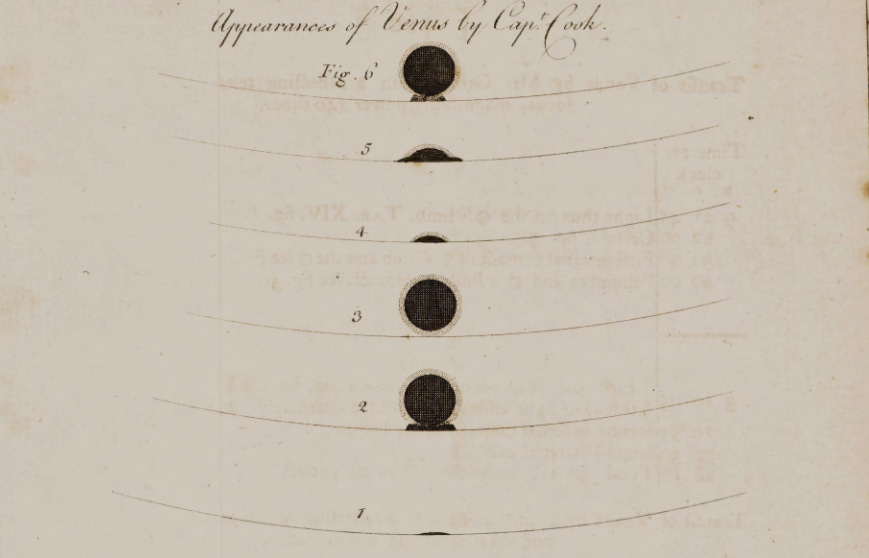
In 1768, the Royal Society of London dispatched the vessel Endeavour on a voyage of discovery. The mission was one of exploration. Cook was to boldly go into the unknown Pacific Ocean, explore the strange lands of Terra Australis, and stop on the isle of Tahiti to make observations of the Sun and of Venus.
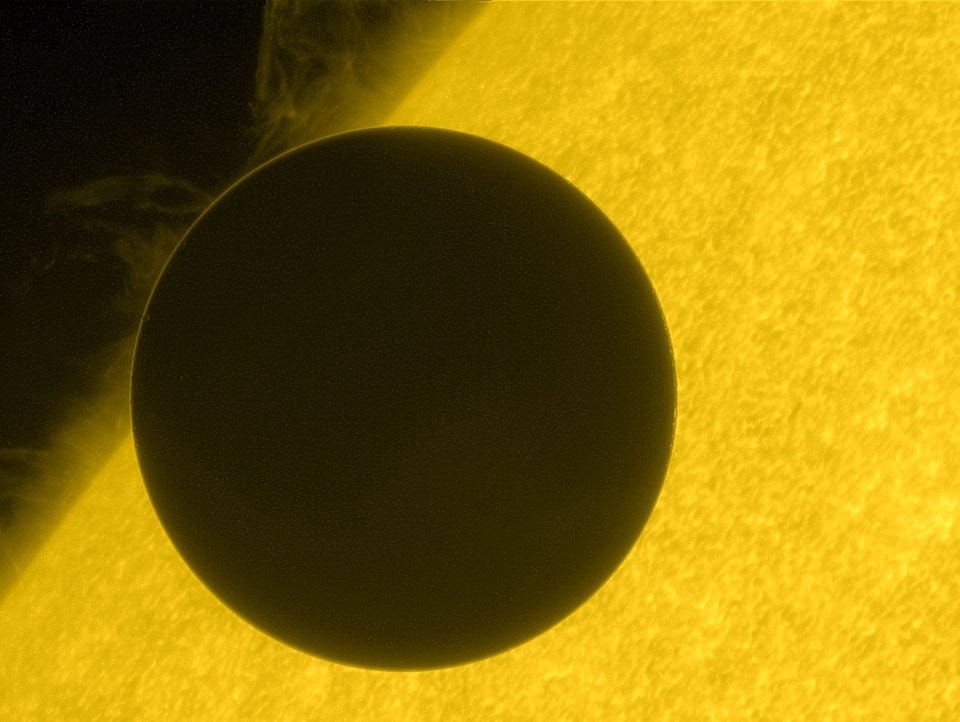
His target was the transit of Venus, a rare event in which the planet crosses the disk of the Sun and for a few hours appears as a dark shadow against the brilliant background of our star. Accurate measurements of this transit would allow astronomers to determine the distance to the Sun. But to get the best data, observers had to be scattered across the world.
The results were good: with them in hand, scientists calculated the solar distance to within one percent of the actual value. Cook, meanwhile, went on to achieve daring feats: he became the second European to reach New Zealand, the first to land on the eastern coast of Australia, and then narrowly escaped a wreck on the Great Barrier Reef on his way back north.
Today, transits of Venus are little more than an astronomical curiosity. The last occurred in 2012, the next will not come until 2117. But transits around other stars are pursued with vigour. Indeed, today we have telescopes in orbit dedicated to searching for them, and for the resulting discovery of an exoplanet.
These telescopes are not powerful enough to directly see the shadow of these distant worlds. But they can detect a slight darkening in a star’s light, and since this follows a characteristic pattern – a sharp dip, followed some hours later by an equally sharp rise - it has proved a reliable method of hunting for new planets.
The easiest planets to spot in this way are the biggest - those the size of Jupiter, say. And since repeated transits help confirm that a planet is really there, the method also favours worlds that orbit close to their stars and frequently pass in front of them. Hot Jupiters – big planets swinging around their stars every few days – were thus an early discovery of the transit method.
But the most interesting exoplanets are those that look like Earth, that orbit stars that shine like the Sun, and that sit at roughly the same distance from them as we do. Few planets like this have been found. For such orbits transits come at best once a year, and it can take half a decade to gather enough data for a discovery. Even worse, such planets are small, especially when seen at a distance of several dozen light-years, and the slight darkening of their transits is hard to detect.
Nevertheless, a team of Australian astronomers recently claimed a discovery. Their world, named HD 137010 b, is slightly bigger than ours and orbits slightly closer to its star. That star itself is cooler and older than ours, and as a result this planet is probably cold. But it may be warm enough for life to exist on its surface, and that, as always, is a fascinating discovery.
The team have seen only one transit of this planet, and so the data they have remains unconfirmed. But they seem sure the world really is there. Indeed, they wrote that there is nothing “other than a planetary transit that can reasonably explain the event”.
More data will surely come in time. And it is, perhaps, worth remembering that the years can bring a lot of progress. In the transit of 1769, the Pacific Ocean and the lands of Australia remained unknown to men of science. By the transit of 2012 we had satellites in orbit around Venus. Where might we be the next time that planet passes in front of the Sun?
Black Hole Suns?
The James Webb’s little red dots continue to puzzle astronomers. Hundreds of them have been spotted in the early universe. All appear to be ancient, existing only in the first two billion years of cosmic history. And as far as we can tell, they are small objects, each measuring no more than a few hundred light-years across. Yet all somehow shine with an intense brightness.
No theory had predicted them, but most astronomers reckon they must be some kind of black hole. Unfortunately the facts there don’t quite add up: the matter swirling around a black hole should emit energetic radio and X-rays, but none have been observed coming from the little red dots.
A recent discovery, however, seems to point to a possible solution. In a paper led by Raphael Hviding of Heidelberg, a team of astronomers describe a strange object that looks something like a little red dot. It is, however, emitting X-rays, and so it also matches our expectations about what a black hole should be doing.
Does this object represent a late-stage red dot? Astronomers have paired the idea with another that suggests early black holes were surrounded by dense clouds of dust. These clouds might have been thick enough to obscure the X-rays coming from within, and would instead have glowed hot.
That would have made them look a bit like gigantic stars. But instead of being powered by nuclear fusion, they would have been heated by gas and dust falling into a inner black hole. That could have allowed them to grow far bigger than any stars we see today, to the point where they may have spanned dozens of light years.
Black hole stars like these could not have lasted forever. At some point the black hole would have emerged from the cocoon of surrounding gas, and when this happened they might have looked something like the object studied by Hviding and his colleagues.
All this is still very speculative. Astronomers are only tentatively sketching out the story of these objects and how they might have evolved over time. Hviding’s object could still turn out to be just another black hole, albeit one with a strange set of properties. And if so, the little red dots might one day be revealed as something else entirely.
A Million Orbiting Data Centres?
SpaceX requested permission to launch and operate a million satellites in Earth orbit. The application came with grandiose language. SpaceX, the application said, wants to build a constellation of data centres that together will be the “first step towards becoming a Kardashev II-level civilization”.
Such a civilisation, according to a scale devised in the 1960s, is one capable of using the full power output of its star. Humanity, needless to say, is nowhere close to such a thing, and even this new constellation will not bring us much closer.
Elon Musk instead sees the project as an opportunity to dominate the future of artificial intelligence. The constellation, he said in a press release, would be built by launching a Starship every hour, would enable factories on the Moon, and help create a “sentient sun”.
Alongside the constellation, SpaceX also announced a merger with Musk’s xAI, the company behind the controversial Grok chatbot. Musk now values the combined company at over one trillion dollars – a valuation he seems certain to pursue in a stock market offering later this year.
Indeed, the problems with orbiting data centres are so big – they are tough to cool, expensive to launch, and impossible to maintain – that it is hard to imagine this constellation will ever be fully built. Instead, it is probably better seen as an effort to capitalise on the bubble of AI spending and investment as SpaceX prepares to go public.
Artemis Delayed
The launch of Artemis II has been delayed until March. Last week NASA went through a two-day-long Wet Dress Rehearsal, a test in which the rocket was fully loaded with fuel and operators proceeded through simulated countdowns to check their readiness.
Prior to the test, NASA was hoping to proceed to the point thirty seconds before launch. In reality they fell short of that goal, with the simulated count terminating five minutes before lift-off. At blame were leaks in the rocket’s hydrogen fuel supply, which suddenly spiked during the countdown and forced a halt.
Orbital mechanics mean the next launch attempt can only come in early March. Before then, NASA will need to do another wet dress rehearsal – so far, however, there has been no official decision about when that might happen.
Don’t be surprised if further delays happen. Artemis I faced multiple issues over the eight months it took to get off the ground. That was an uncrewed mission. This time, with four humans sitting on top of the rocket, NASA is bound to be even more cautious.
Read More
The Bold Insanity of Artemis II: America Prepares to Return to the Moon

If NASA keeps the schedule, the moment of lift-off will …
The World According to Aristotle

As nature therefore makes nothing either imperfect or in vain, it necessarily follows that she has made all these things for men
Starship: The Most Ambitious Spacecraft Ever Built

At first everything looked good. The rocket lit its engines right on schedule, and lifted slowly off the launch pad…
Fool me once (I thought Musk really wanted to go to Mars) not gunna fool me twice. I vacillate between admiring Musk - Starlink is awesome and the one time I rented a Tesla (by accident) was pretty great. But the destruction of Twitter and grok/mecha hitler, xAI it's all supremely manipulative, polarizing and just careless.
I suppose all the great industrialists were also giant egomaniacs at the time and now we view them through the rosy lens of history.
Thanks for staying on top the news and for keeping is abreast of the latest developments… gotta take a look at those little red dots…
PS:
about those orbiting data centers, etc… I thought we already are a Kardashian-level civilization… did I say that right?