
The Week in Space and Physics: Atoms For Space
On the possibilities of nuclear propulsion, a vanishing star, the shape of Jupiter, and Artemis II.
In the 1950s, the American government poured millions of dollars into studying something called nuclear pulse propulsion. The name only hints at the insanity of the idea: the pulse came from the detonation of atomic bombs, and the propulsion came from placing a spacecraft in just the right spot to surf the nuclear shock wave out towards the stars.
Papers on the subject painted exciting visions of the future. If only the technology were pursued, they said, Mars could be reached within a decade and the moons of Saturn would be settled by the 1970s. A chain of a million fusion bombs could blast a spacecraft towards Alpha Centauri and humans – travelling at a decent fraction of the speed of light – could then cross the interstellar gulf in mere decades.
Of course, the lethal doses of radiation involved were problematic, as were the bone-shattering accelerations astronauts would experience. No one really found a solution to those concerns, and estimates anyway showed the whole thing was fantastically expensive. After almost a decade of study, the idea was quietly shelved in 1965.
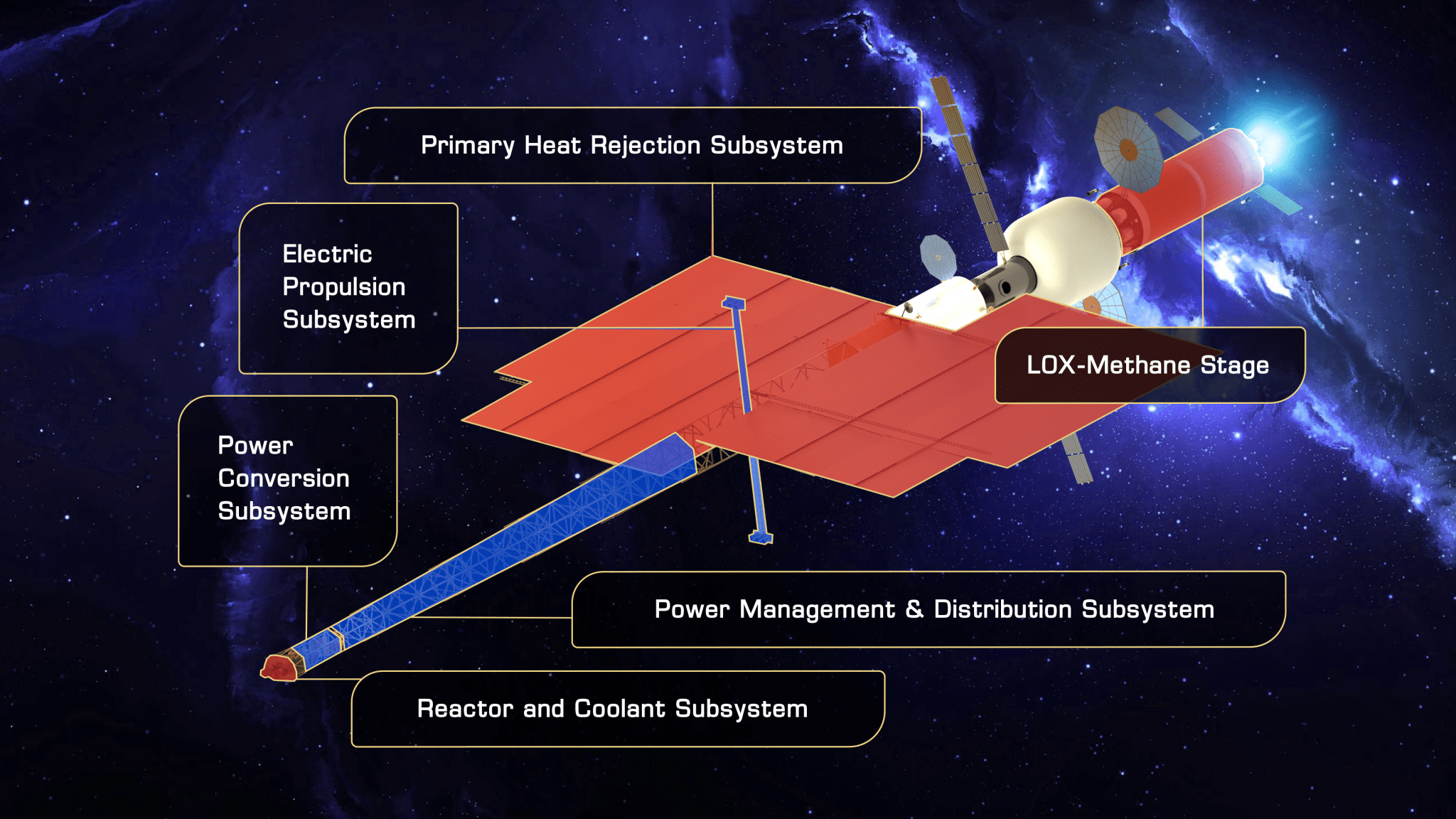
But in recent months, nuclear-powered spaceflight has once again come into fashion. Today’s ideas are, thankfully, more realistic. Instead of atomic explosions propelling interstellar travellers, dreamers imagine reactors powering electric motors. In place of violent pulses, probes would be gently accelerated by the flow of ions streaming behind them.
On paper, these dreams look pretty good. Electric propulsion systems have been in use for decades now, and though low-powered, they have already sent spacecraft to the Moon and kept interplanetary probes on course. They are lightweight - especially when compared to chemical rockets - and can provide a small but steady thrust over long periods of time.
A nuclear reactor could supercharge them. With it as a power source, an electric system would have more power and run for far longer, allowing to us to propel big spacecraft deep into the solar system. If we want to get serious about exploring the outer planets, then nuclear electric propulsion might be the key technology with which to do it.
Jared Isaacman, the new head of NASA, is a big fan of the idea. In Project Athena, his leaked plan for reshaping the agency, he argued that NASA should go all in on developing it. This would start by flying a one hundred kilowatt demonstration mission, perhaps one that heads to Mars. A more powerful version would follow, and this would prove the concept for human crews and eventual missions to other worlds.
If he can pull all this off, it would be something well worth doing. NASA would be investing in a new technology, one that opens doors for future exploration. Armed with nuclear-powered probes, we could put orbiters around Pluto and Uranus, send a big spacecraft to Jupiter and its moons, fly closer to the Sun than ever before, and even venture beyond the edges of the solar system. It would, in other words, help create a new vision for space exploration. And that is exactly the kind of thinking NASA needs.
The Mysterious Disappearance of a Star
One of the brightest stars in the Andromeda Galaxy seems to have vanished. Until 2014 it was probably a red or yellow supergiant, perhaps something like the nearby star Betelgeuse. But in that year it suddenly flared up, and then, in the years after, quietly faded away. Today it no longer seems to shine where it once did.
What happened to it? Big stars don’t typically blink out of existence. Instead they burn brilliantly, and when they run out of fuel they explode dramatically. If this star, named M31-2014-DS1, had died, we would expect it to have done so in a supernova, and that would have been so bright it would have been impossible to miss.
Perhaps, a team of researchers at Columbia University suggested, it had simply collapsed into a black hole. Yet that too would be unusual. When big stars exhaust their fuel they can indeed implode into a black hole. But that implosion almost inevitably triggers a sudden burst of neutrinos and a shockwave that sparks a supernova.
Some models do suggest this process could occasionally fail. Instead of exploding outward, in this case the star would simply collapse. Its core would become a black hole and whatever remains would swirl dangerously close to its outer edge. From a distance the star would simply seem to vanish, just as we have seen in the Andromeda Galaxy.
The problem, though, is that this process should still release a lot of X-rays, and none of these have been seen. It is possible, says Emma Beasor of Liverpool John Moores University, that they are being hidden by a cloud of gas and dust. But it is also possible that something else has happened here.
She thinks the event is better explained by a collision between two stars. As they spiralled towards one another they would have appeared deceptively bright, and after the collision the resulting star would have dimmed. Clouds of dust might have been thrown up too, and this would have further darkened the object.
As usual, more data will be needed to settle the dispute. If we spot X-rays coming from the site of this vanished star then the failed supernova idea is probably the true one. But if we don’t, and we see signs that a faint star still lingers, then perhaps the collision theory is closer to the truth.
The Shape of Jupiter
No planet is perfectly round. Some deviations are obvious: the Earth has mountains and troughs; the surface of Mars is pockmarked by craters. But others are more subtle. When precisely measured, most planets are wider than they are tall, a detail known in geometry as their oblateness.
This happens because planets spin, and as they do some of their mass is pushed farther out at their equators than at their poles. The faster a planet spins, the greater this degree of flattening. Earth, as a result, is about forty kilometres wider than it is tall. That isn’t much, yet it is enough for the point furthest from the Earth’s centre to lie not at the peak of Mount Everest, as logic might dictate, but rather at the top of Mount Chimborazo, a mountain much closer to the equator.
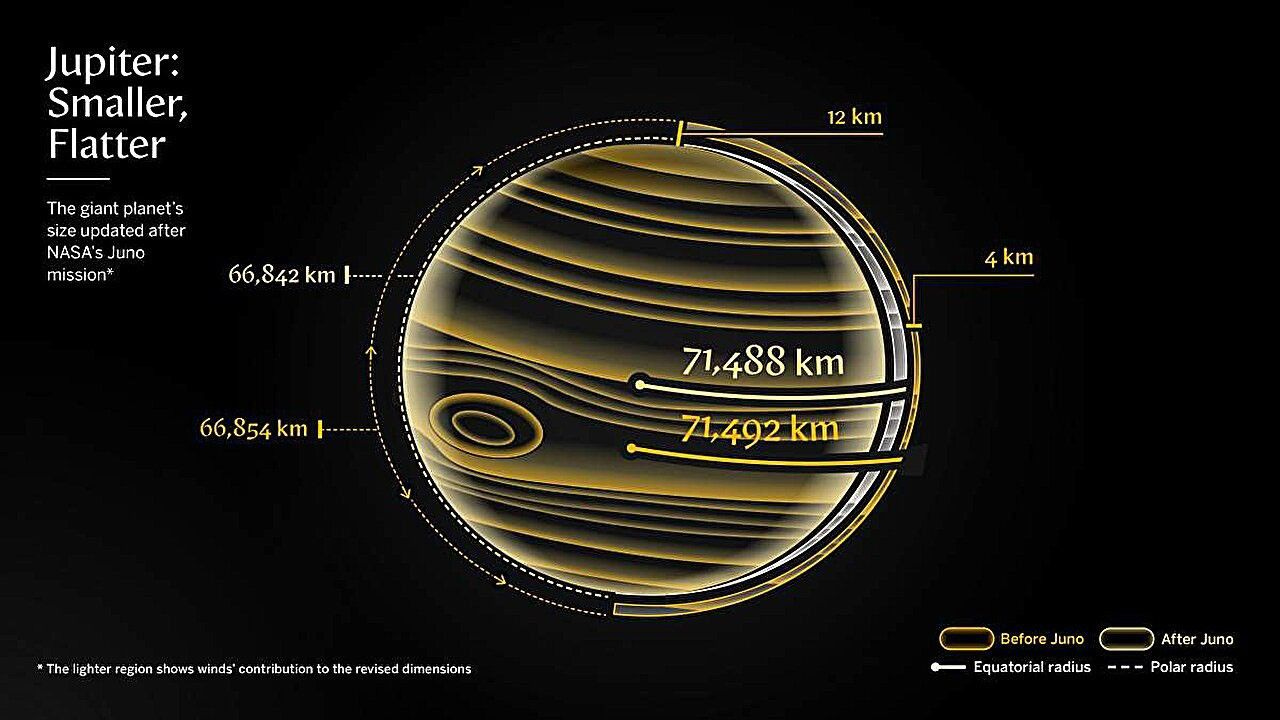
Jupiter – made mostly of gas – has no mountains. But it does spin once every ten hours, and this is fast enough for its equator to bulge significantly. Measurements taken in the 1970s by the Voyager and Pioneer probes found it to be about seven per cent wider than it is tall, a difference that adds up to more than a thousand kilometres and that creates a noticeable flatness.
Since those observations are now decades old and were based on few readings – the two probes collected just six measurements – researchers recently used another probe, Juno, to repeat the study. They found Jupiter to be slightly smaller than previously thought, with a radius about twenty kilometres less. It is, though, still flat: the planet measures 71,488 kilometres from centre to equator, but only 69,886 kilometres from centre to pole.
Artemis II: Delayed Again
NASA has once more delayed the lift-off of Artemis II. On Friday last week, things had looked good. Operators had spent the week running through a dress rehearsal of the launch countdown, and had successfully reached a point twenty-nine seconds before lift-off. The hydrogen leaks that had forced the abandonment of a previous rehearsal seemed to have been solved.
But on Friday night a new issue emerged. According to NASA administrator Jared Isaacman, engineers could not get helium to flow through the rocket as intended. This is not an easy thing to fix – indeed, the rocket will need to be removed from the launchpad, and rolled back into an assembly area.
This rules out any launch attempt in March. The position of the Moon means lift-off can only come in the first half of the month, and NASA can’t get the rocket back on the pad before then. The next opportunity will only come in early April.
Read More
The Bold Insanity of Artemis II: America Prepares to Return to the Moon

If NASA keeps the schedule, the moment of lift-off will …
The World According to Aristotle

As nature therefore makes nothing either imperfect or in vain, it necessarily follows that she has made all these things for men
Did We Invent Mathematics? Or Did We Discover It?

The safest general characterization of the European philosophical tradition is that it consists of a series of foot…
I remember pulse propulsion from The Three-Body Problem! here i thought Liu Cixin was brillant (and he probably is ) but also knows his history. Also TIL planets have fat middles. All in all it’s shaping up to be a good day.