
The Week in Space and Physics: Finally, an Exomoon?
On the discovery of an odd exomoon, the landing site for the next moon mission, a hunt for aliens, and Starship.
As a reminder, last weeks article So Simple a Thing as a Star is available for download in PDF and EPUB formats. You can buy access here.
Exomoons are strange beasts. They shouldn’t be, of course. The galaxy is full of planets, and those planets should have moons just like those found in our solar system. There are probably billions of these perfectly normal moons (‘exomoons’) scattered across the sky.
Unfortunately, they are hard to spot. Normal moons are small, faint, and all but invisible across the vast spans of interstellar space. This means that the handful of possible exomoons that we may have seen are weird creatures. Almost all contenders are gigantic, more like twin planets than true moons in orbit around a larger world.
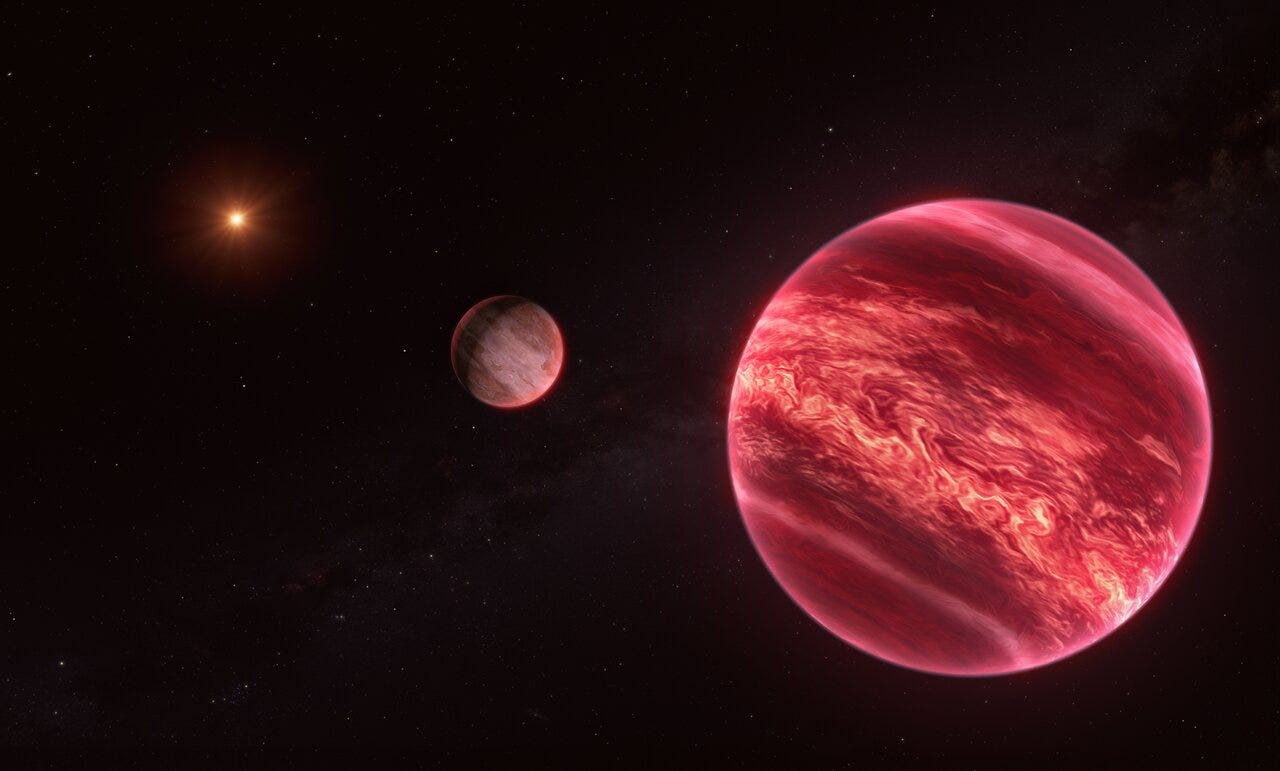
None of these possible moons have been confirmed. Most claims of discovery rely on faint pieces of evidence, and could be explained in other ways. But a new study, released by the European Southern Observatory, claims to have found plausible evidence of something that could be called an exomoon in a star system almost seventy light-years distant.
Like the others, it is an odd object. It is found in a system called CD-35 2722. This system is dominated by a small star, one about half the mass of the Sun. Around this star orbits a brown dwarf, an object that is too small to shine like a star, but also too big to be considered a normal planet. In some ways, these dwarfs can appear as failed stars – above all, they lack the mass to sustain nuclear fusion.
The leader of the study, Kevin Hoy, discovered another object orbiting this brown dwarf. It seems to be quite big; indeed, Hoy says it is at least as big as Jupiter. That makes it far bigger than anything we could normally consider a moon. Yet this system makes these definitions hard. The ‘moon’ is clearly in orbit around a bigger ‘world’, itself in orbit around a star.
In our solar system, “defining things like moons is simple”, says Alice Zurlo, a collaborator on the project, but in this system things are “much more complicated to describe”. Whether we are willing to call it a moon or not, this strange system at least seems to be unique among those we have observed.
Future exomoon discoveries are likely to be just as bizarre. Our telescopes are only capable of picking out the very largest of them. The next one we discover could be the size of Neptune or Saturn, and could be spotted in orbit around a world bigger than Jupiter. Just as in the strange case of CD-35 2722, whether we can call such gigantic companions true moons is up for debate.
In many ways, the paucity of true exomoons is a shame. The moons of our solar system – Europa, Titan, and Enceladus among them – are some of the most dynamic and exciting places we know beyond Earth. If we are going to find life in the cosmos, an exomoon would not be a bad place to look.
A Return to Tranquility Base?
Tranquility Base lies almost exactly on the equator of the Moon. Mission planners chose the site, the famous landing place of Apollo 11, as an easy spot to leave the first footprints beyond Earth. Its equatorial site made it easy to reach, and its terrain was free of risky cliffs or deep craters.
The other Apollo landings targeted sites scattered across the near side of the Moon. Yet all remained close to the equator. No spacecraft – not even a robotic one – targeted the lunar poles until 1998, when the Lunar Prospector was deliberately crashed near the Moon’s South Pole.
Since then, however, interest in the southern pole has been rising. In 2009, LCROSS confirmed the presence of water ice near the pole, though it was not until 2023 that the first spacecraft – Chandrayaan-3 – successfully landed in the region.
Both America and China now believe the lunar south pole is the key to building a long-term base. Though the region is challenging – it is rocky, strewn with craters, and awkwardly placed for communications – it does hold plenty of water. The two nations are, therefore, planning for future crewed visits to the southern pole.
In July, however, astronaut Victor Glover called for a rethink. He was one of the four who flew on Artemis II, and thus part of the first crew to get anywhere close to the Moon in half a century. He believes the return to the Moon should start with a flight to the equator. It is easier to reach, he says, safer for landing, and has much better lighting conditions.
Since NASA is trying to accelerate plans to land on the surface, the equator would seem like a better initial option. If America’s politicians want to see a flag and footprint on the Moon as soon as possible, they will have better odds of success if they choose an easy landing site. The poles may be better for a sustained presence, but they are far harder, and far more likely to cause delays.
Technosignatures in White Dwarfs
In the far distant future, the Sun will swell up into a red giant, consume the inner planets, and then gradually fade into a white dwarf. The remnants of our world, along with any technology we might have left behind, will eventually fall upon this dwarf star. When they do, they will create a faint but long-lasting signature of our presence here.
Studies of white dwarfs elsewhere in the galaxy have found many signs of the worlds that once orbited them. These are called ‘polluted’ white dwarfs, and they often have traces of metals like silicon in their atmospheres, as well as elements like carbon that came from destroyed planets.
This, a recent paper in The Astrophysical Journal pointed out, could give us a way to hunt for the signs of ancient alien civilizations. If such a civilization had long ago emerged around a Sun-like star, and if that star had eventually died and consumed their homeworld, traces of their technology may still be visible in the resulting white dwarf.
To test their idea, they examined almost seven hundred white dwarfs, looking for any deviations from what might be naturally expected. They found nothing significant. A few stars, however, seem worthy of further study: we cannot yet say if they were once home to aliens, but they do at least show signs of something unexpected going on.
SpaceX, Starship, and Stock Prices
SpaceX launched Starship for the thirteenth time. After a false start – the first launch attempt ended with a dramatic last-second abort – the second attempt passed smoothly.
The initial abort was caused by engine problems. Six of the rocket’s thirty-three Raptor engines had failed to start properly, and two, SpaceX said, had to be replaced. That led to a delay of a week, after which SpaceX delayed another day due to weather. But when the count did again reach zero, Starship lifted smoothly off the pad.
Overall, the test flight went well. Starship deployed some test satellites and demonstrated the relighting of an engine in space. That may pave the way for Starship’s first orbital flight within a few months – finally allowing SpaceX to move beyond the suborbital trajectory every test flight has followed so far.
The success, however, had little impact on SpaceX’s ailing stock price. After joining the stock market on June 12th, the company briefly reached a value close to three trillion dollars. Today, investors value it at less than half that price.
Read More
All Those Exoplanets Have Moons, Too

Eliminate the impossible, as Sherlock Holmes once said, and the truth, no matter how improbable, lies in whatever remains. Good advice for detectives — and, it turns out, for astronomers. Astronomy is often little more than piecing together scattered clues, carefully eliminating possibilities and arriving at an improbable truth.
The Solar Probe: So Simple a Thing As a Star

It is reasonable to hope that in a not too distant future we shall be competent to understand so simple a thing as a star.
An Atmosphere and a Puzzle Beyond Neptune

For most of its known history, nobody has cared much about 2002 XV93. It is a small world lying somewhere close to the orbit of Pluto, one presumably covered in a grey and gritty kind of ice, and a place considered so unremarkable that no one has bothered to give it a…