
An Atmosphere and a Puzzle Beyond Neptune
On the discovery of a faint layer of gas in the frozen outer solar system
For most of its known history, nobody has cared much about 2002 XV93. It is a small world lying somewhere close to the orbit of Pluto, one presumably covered in a grey and gritty kind of ice, and a place considered so unremarkable that no one has bothered to give it a proper name.
Yet as of last week, 2002 XV93 is suddenly famous. It is, according to a recent discovery, one of the most distant places in the solar system known to host an atmosphere. Truth be told, it is not much of an atmosphere. The small rock measures only a few hundred kilometres across, and the layer of gas surrounding it is at least ten million times more tenuous than the air around our planet.
But that is at least something. And its presence defies our expectations about what the worlds beyond Neptune should look like. All those known to us are icy, frozen objects. Most are small. A few are big enough to be notable: Pluto, for example, was long a member of the exclusive club of planets. Eris is slightly more massive than Pluto, and others – Haumea, Makemake, Sedna – measure more than a thousand kilometres across.

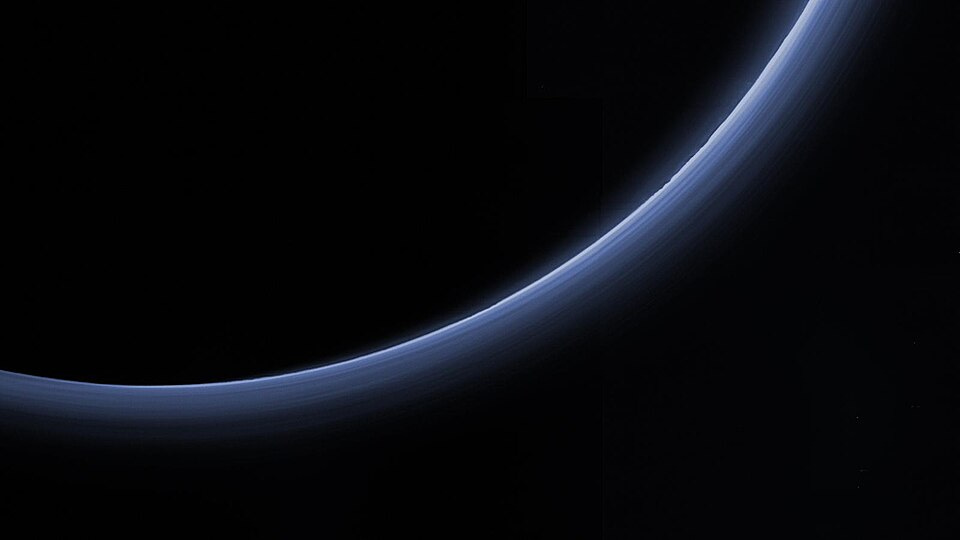
Some of these larger places do have atmospheres. That of Pluto, for example, is a thin layer of nitrogen that appears as a bluish haze stretching over its surface. Traces of methane have been found around Makemake. But others are more elusive. Eris and Sedna, though both large, show no sign of an atmosphere.
That may be because they are much further away – roughly twice as far as Pluto – and thus extremely cold. Any atmospheres these two dwarf planets did possess have surely escaped or condensed into ice. Over the next few centuries, Eris will swing inwards towards the Sun and gently warm. As it does, this ice may sublimate, and the frozen world might regain a thin and temporary atmosphere.
But this should really be the limit. Smaller worlds, those less than about a thousand kilometres across, are not expected to maintain any kind of atmosphere. They lack the gravitational strength to hold on to a layer of gas. If they ever had any, it should thus have long ago escaped into space or frozen to their surfaces.
Yet 2002 XV93 seems to differ. It measures about five hundred kilometres (three hundred miles) across, and so should fall into the category of small, insignificant places unworthy of carrying around a layer of gas. The question is thus twofold. Does it really have an atmosphere? And if it does, how did such a small world manage to keep it?
A Stellar Occultation
The story of 2002 XV93’s atmosphere begins on January 10, 2024. On that day, the small world passed briefly in front of a star in the constellation Auriga, thus creating a kind of mini-eclipse. Astronomers call such events stellar occultations, and they happen whenever a planet or something else in our solar system crosses in front of a more distant star.
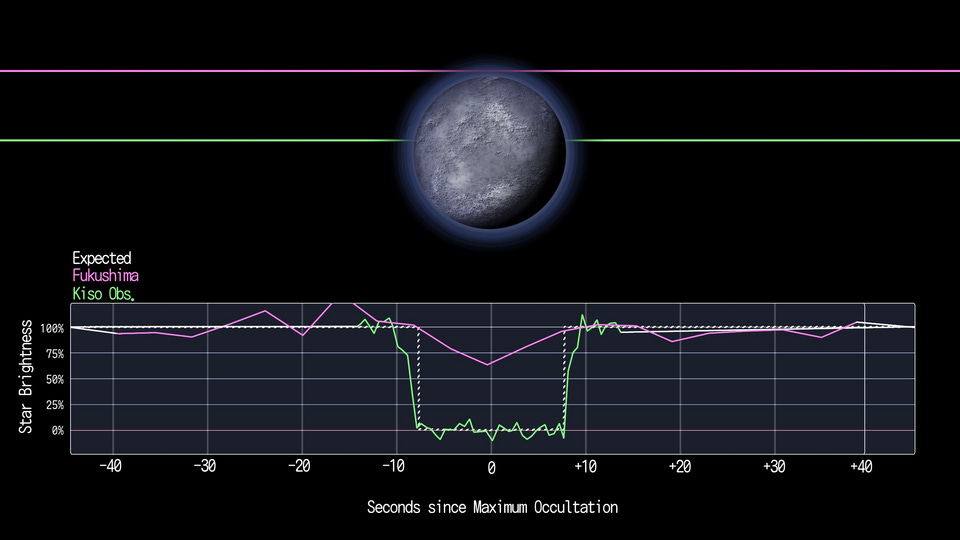
Occultations can reveal surprising details about these objects. As a world starts to move across a star, it darkens the light coming from it. If the world lacks an atmosphere, this darkening will be abrupt, caused by the sudden passing of a solid surface between us and the distant star.
But if the body is instead surrounded by gas, the starlight will fade more gradually. The atmosphere may bend and filter the light, changing its colour in response to the gases present there. As the occultation ends, and the world moves on, this pattern will play out in reverse.
Careful study of exactly how the brightness of a star varies during an occultation can thus reveal whether a world has an atmosphere or not. As an example, it was thanks to this technique that astronomers knew Pluto had an atmosphere well before New Horizons arrived and took photographs. By comparing multiple occultations spread over many years, they could even watch this atmosphere expand and contract with the changing seasons.

The 2024 occultation of 2002 XV93 was observed from Japan. A team led by Ko Arimatsu of the National Astronomical Observatory of Japan set up three stations to take measurements of the event. Though they expected to see a sharp pattern, one more resembling that of the airless Eris rather than that of Pluto, the occultation instead showed the brief signs of a layer of gas.
The results, Arimatsu said, came as a surprise. When they analysed the data, they found it showed signs of a thin but clearly present atmosphere. It is tenuous and has a pressure at least five million times lower than that on Earth at sea level. Indeed, to reach a comparable pressure in our atmosphere you would have to ascend hundreds of miles into our faint and rarely visited exosphere.
A World of Ice Volcanoes?
The fact this layer exists at all is hard to explain. 2002 XV93 is so small that even a slight atmosphere should have been lost into space within a few centuries. That we can still see it today suggests something must have recently refilled it, and this tells us this small world is more dynamic than it at first appears.
Some objects beyond Neptune do show signs of atmospheres coming and going. Unlike the Earth, these worlds can follow eccentric paths: Pluto, for example, swings in and out along its long voyage around the Sun. At its closest, it passes within the orbit of Neptune. At its most distant, it is almost twice as far away.
This leads to drastic changes in temperature. Whenever Pluto moves towards the Sun, as it was doing until 1989, it warms up, its ices sublimate, and its atmosphere grows. As it moves away, as it is now doing, it begins to cool again, the gases in the atmosphere condense, and the layer of gas fades away.
Eris, which follows an even more eccentric orbit and is currently much further away, will likely show a similar pattern as it draws closer to the Sun over the next few hundred years. But there is no real sign the same is happening on 2002 XV93: indeed, measurements have found no traces of the kinds of ice on its surface from which an atmosphere could emerge.
Instead, Ko Arimatsu and his team think there are two better possibilities. One is that the world has experienced a recent collision. This would have thrown up a cloud of dust and ice and allowed a temporary atmosphere to form. It will eventually be lost, but it might well stick around for a few decades or centuries.
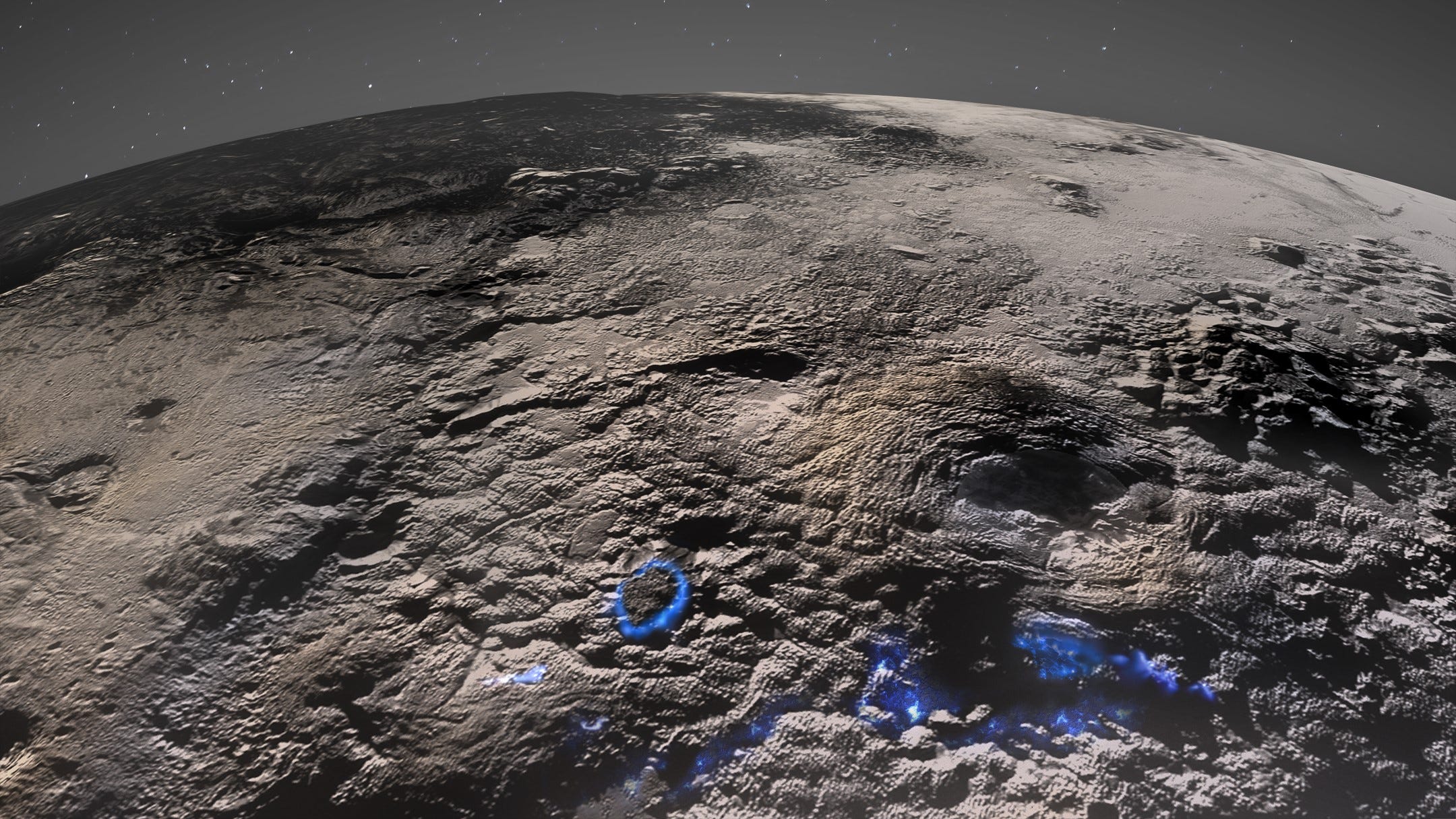
Alternatively, 2002 XV93 may be home to the phenomenon of cryovolcanism. Though it has a solid and frozen surface, underneath it may have a partially liquid layer. If something is heating this – possibly the tidal force of an unseen satellite, or perhaps a series of small impacts - then this layer could remain liquid. At times, it may be bursting outwards, forming a kind of ice volcano.
We have seen things like this on Pluto. Data sent by New Horizons showed signs of recent eruptions, and its images showed massive features that may have been formed by such volcanic events. We have no clear evidence of anything like this happening on 2002 XV93, but its thin atmosphere offers a hint that volcanoes might be erupting there too.
Whatever the answer is, one thing is clear. The worlds of the outer solar system – from its giants like Pluto and Eris, to its minnows like 2002 XV93 – are far more interesting than they at first appear. They are dynamic worlds, subject to forces and processes so alien and so familiar to us on Earth. They are worthy of attention – and in the case of 2002 XV93, a proper name as well.
Read More
Seizing The Light: The First Photographs Of The Heavens

In 1839, Louis Daguerre took the first photograph of the Moon.
A Nuclear Ship For Mars: Making Sense of Space Reactor Freedom

The way NASA tells it, Space Reactor Freedom sou…

I enjoyed this, thank you! I have a friend I have regular chats with who was a project scientist on New Horizons and she was very excitedly telling me about this on a call. Good to read all the fascinating details here.
I say: "Animula".