
Reflections on Placing Mirrors in Space
On plans, new and old, to put mirrors in orbit
In the world of The Lord of the Rings, the morning star bore the name of Eärendil. Song and legend told that he had been a great mariner, that he was born half-man, half-elf, and that after he had ventured into the lands of the godlike Valar, they had sent him and his ship to eternally sail the heavens.
The tale has similarities to ancient myths about the stars. At times the gods sought to protect: the Pleiades, it is often told, was once a group of seven girls fleeing mortal peril. At other times, they punished: Orion, the Greeks said, was a hunter condemned for his arrogance and placed into the heavens only after he was killed.
According to Tolkien, Eärendil should have been slain for daring to set foot on the forbidden lands of the Valar. Yet as he had acted not for himself, but on behalf of both men and elves, they chose to spare him. Instead, they sent him and his ship into the great ocean of the sky. On his forehead was placed one of the Silmarils, a brilliant jewel shining with the magical light of Valinor, and it was said he would always return to our skies to mark the rising or the setting of the Sun.
The legend was inspired by a collection of Old English poetry, among which there was a reference to Earendel, the brightest of angels. In his letters, Tolkien argued that Earendel, the brilliant herald of the rising Sun, was a clear reference to the morning star1. Today we call that star Venus; in Old England they may have called it Earendel; in Middle-earth they knew it as Eärendil.
Soon, a new Eärendil may appear in our skies. This time it will not be the morning star, but instead the herald of something far more terrible. Eärendil-1, a satellite now being built by an American company called Reflect Orbital, is designed to outshine Venus, to reflect the light of the Sun onto the Earth below, and to briefly turn night into day.
If it works, and if Reflect can raise the money, the satellite will be followed by thousands more. By 2035, Reflect Orbital projects they will have fifty thousand satellites in orbit, and together they will have the power to banish darkness over any corner of the planet and at any hour of the clock.
Their website spells this mission out in noble terms. Putting an end to the night will help humanity generate energy from sunlight, aid rescue workers struggling with poor lighting, and reduce the need for artificial street-lighting.
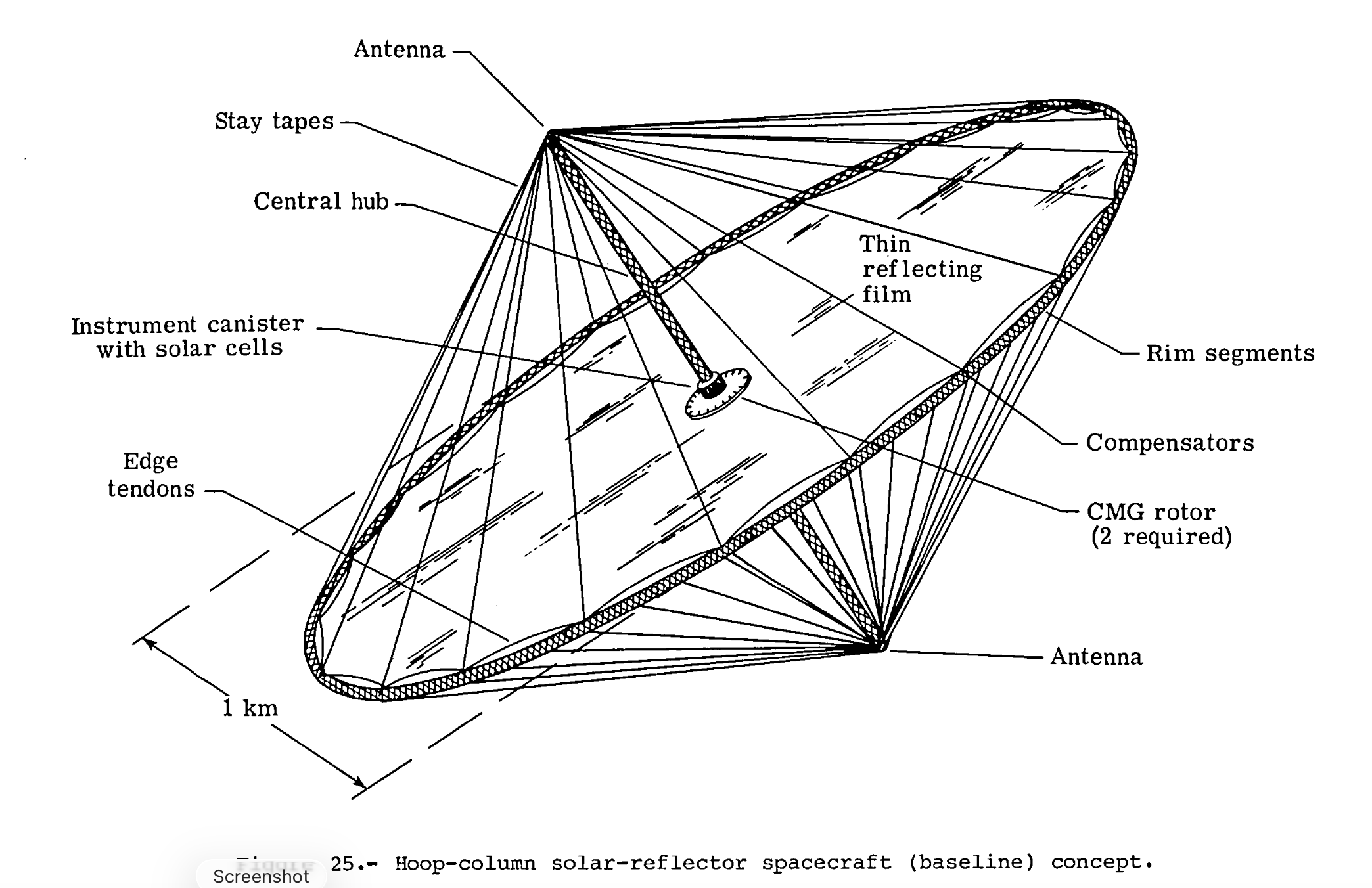
They will achieve all this by using gigantic mirrors. Eärendil-1 will carry a folded-up reflective sheet. Once the spacecraft reaches orbit, this sheet will unfurl like a sail, creating a mirror measuring eighteen metres (sixty feet) across. From the Earth’s surface, the spacecraft will appear like a bright and fast-moving star, reflecting enough sunlight to cast shadows on the ground.
Reflect say they can steer the Sun’s light to a circle measuring five kilometres, or three miles, across. Inside this circle the satellite will appear as a bright star; outside it will fade into obscurity. But because the satellite is moving fast, it will be able to illuminate the area for no more than a few minutes. To extend the coverage, Reflect will need more satellites – and this is the reason why they want to launch fifty thousand of them over the next decade.
It is said that Archimedes, the great engineer of Syracuse, once arranged a series of mirrors to reflect and focus the Sun’s rays onto the ships of an invading Roman navy. The goal was to set them ablaze, halt the invasion, and save the city. That may have worked for a while, but eventually the Romans decided to approach the city at night, opened its gates with the help of a traitor, and put Archimedes to death after the citadel fell.
Two millennia later, as the German scientist Hermann Oberth contemplated putting mirrors in orbit, military matters were still at the top of everyone’s minds. By focusing the Sun’s rays, Oberth wrote, a ray of heat could be directed onto enemy cities. The idea was absurd, naturally, but after the Second World War, claims emerged that both Germany and Japan had been secretly working on ways to make it a reality.
Oberth also saw civilian applications in the idea. He thought an orbiting mirror might open up shipping routes during the long Arctic nights, or be used to alter the weather. Others imagined using them to cool Venus, or to make Mars habitable. In the 1980s, Vladimir Syromyatnikov, a Soviet scientist, proposed using a mirror to help Russians work in the frozen northern winters2.
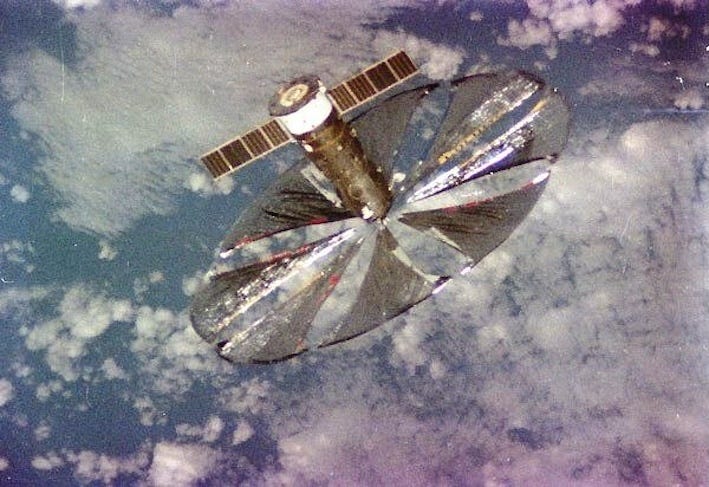
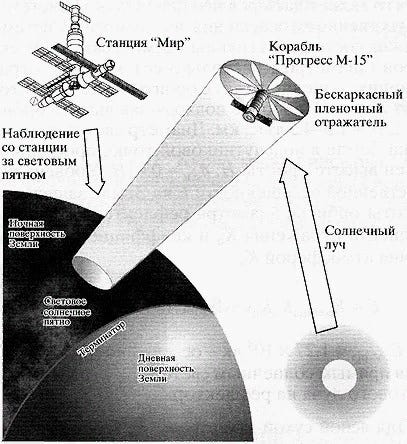
As with Eärendil-1, the benefits seemed enormous. Syromyatnikov thought space mirrors could extend the Russian agricultural season and perhaps be used to carve channels through polar ice sheets. In 1992, a prototype mirror – Znamya-2 – was sent to the Mir space station. In February 1993 it was deployed, the mirror unfurled, and a beam of light swept over Europe and Russia.
The night was unfortunately cloudy. But those who saw the beam reported it briefly shining as bright as the full moon. From space, cosmonauts reported seeing a faint circle of light race over the Earth’s surface at tremendous speed. The test was a clear success, but a short-lived one: within a few hours the mirror had fallen back to Earth and burned in the atmosphere.
A second effort followed in 1999. Znamya-2.5 held a far bigger mirror and was supposed to shine ten times brighter than the full moon. But soon after it was deployed, it snagged on an antenna. Efforts to free it failed, leaving the mirror crumpled and ripped. With the situation beyond salvation, Znamya-2.5 was instead jettisoned and left to burn up as it fell.
The partial success of Znamya proves the feasibility of Eärendil-1. Of course, operators can always run into unexpected problems: new spacecraft often fail, unfurling a giant mirror – as Znamya-2.5 discovered – is not a straightforward task, and no one has ever steered an orbiting mirror before. But the basic concept is, at least, sound.
Yet, just because we can do something doesn’t mean we should. The launch of Znamya-2.5 sparked outrage from astronomers. The bright lights cast by orbiting mirrors could render their work impossible, they complained. Messing with the night could cause unexpected problems, others warned, and would impact everything from animal life to human psychology.
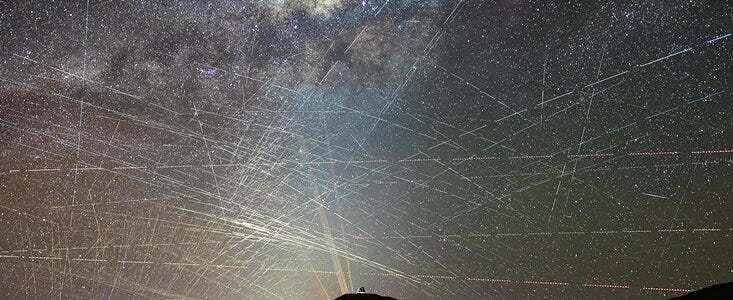
The same concerns have been raised again. A recent study by the European Southern Observatory found that Reflect’s plans would put an end to ground-based astronomy. Space observatories are powerful, but expensive and far from able to replace what we do from the Earth’s surface. Should Reflect succeed, it would kill astronomy as we know it.
Neither does the economic case look convincing. Reflect Orbital pins much on its ability to let solar power farms run into the night. Yet the amount of solar energy they can reflect onto the Earth is small, and the mirrors cannot focus well enough to direct all that power onto solar panels. Most of what they will deliver will be lost; whatever does get through is unlikely to be enough to bother collecting3.
That makes it unlikely Reflect will ever earn enough in the way of profits to build, launch, and operate their full constellation. But Eärendil-1 is still likely to fly. The spacecraft has been authorised by the American government. A launch on a SpaceX rocket could come in the next few months.
“All that is gold does not glitter”, Tolkien wrote. Eärendil-1 may prove the truth of this. The technology can work. The economics, and the morality, are far less likely to shine. After all, who really wants a giant flash light shining upon their house from the heavens?
Read More
The Solar Probe: So Simple a Thing As a Star

It is reasonable to hope that in a not too distant future we shall be competent to understand so simple a thing as a star.
A Nuclear Ship For Mars: Making Sense of Space Reactor Freedom

The way NASA tells it, Space Reactor Freedom sounds simple.
Data Centres In Orbit Are Just As Crazy As You Think

America’s billionaires are suddenly obsessed with the idea of building data centres in orbit. Elon Musk has, as usual, taken the lead. In the past month he has merged his AI company with his rocket company, and applied for pe…
In the poem, Earendal symbolises John the Baptist. Just as the morning star heralds the coming dawn, so John heralded the coming of Christ.
There was an attempt to mark the 500th anniversary of Columbus’ trans-Atlantic voyage by sending a regatta of solar sails to Mars. When the effort failed, the engineers behind the Soviet entry switched their efforts towards reflecting sunlight instead of sailing to the planets.
Estimates suggest you would need thousands of mirrors working together to reflect enough sunlight for solar panels to work well. The laws of orbital mechanics also dictate that the mirrors will be moving fast and need to constantly repoint to steer the reflections correctly.