
The Week in Space and Physics: A Space Station Emergency
On air leaks in space, the quest to build the most accurate clock, black hole winds, and a search for alien signals.
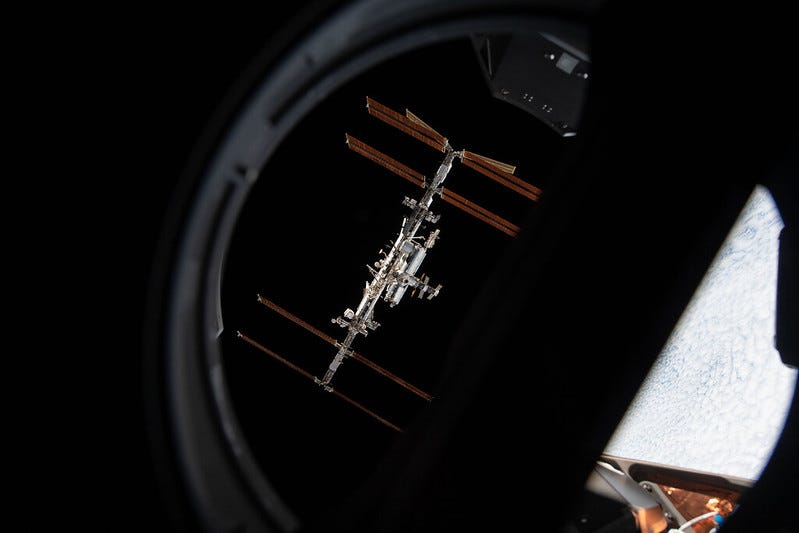
For a few hours, it seemed close to the nightmare scenario.
On June 5, mission control in Houston directed the astronauts on board the International Space Station to take emergency shelter. In a moment of high drama, five of them entered a docked Dragon capsule and began preparing for a fast and unexpected return to Earth. At fault was an air leak. The station was losing air through an ageing module, and the risks were deemed so serious that NASA ordered immediate action.
The module at fault is known as PrK. It is a small tunnel that connects the key Russian Zvezda module with a docking port. Typically, this port is used to dock the Russian Progress capsule, and the tunnel is used to transfer cargo in and out of the docked spacecraft.
But for several years, the tunnel has been causing problems. Leaks were first found in September 2019, at which time they seemed to be small and manageable. But over time they have worsened. Cosmonauts have repeatedly patched cracks with sealant, but this has not solved the problem.
To reduce the impact, the tunnel is usually closed and left unpressurised. But when cosmonauts need to access the Progress capsule, they must repressurise it. When they do, other precautions are taken – including closing other interior hatches in the station to reduce the risks of air loss.
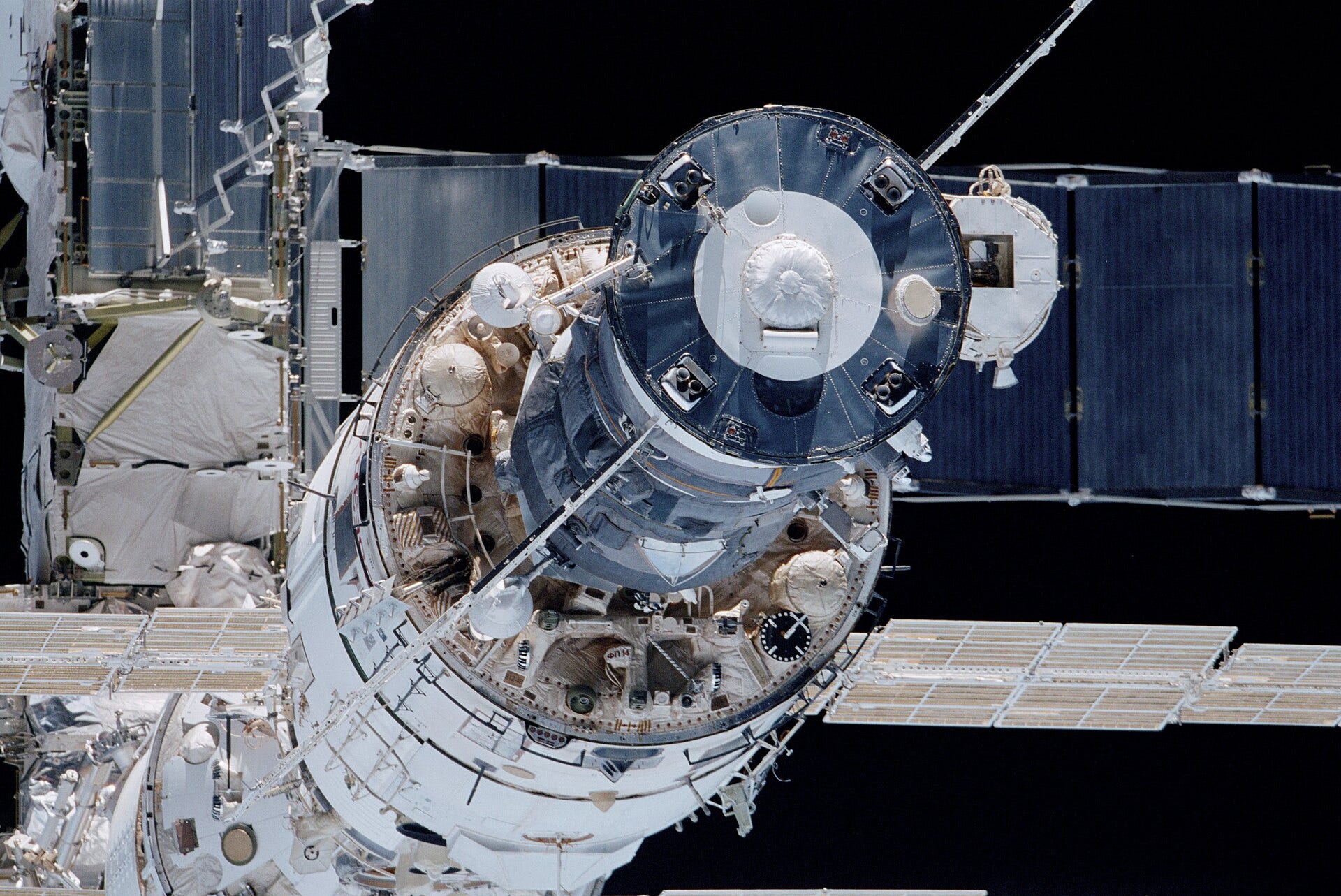
As cosmonauts worked in the tunnel in early June, however, they noticed an increase in the rate at which air was escaping the module. In the past, such leaks have been fixed by using a sealant. This time, however, they apparently elected to make a more radical fix. Details are sparse, but it seems two cosmonauts were planning to cut into the structure of the module to better access the leak.
As they prepared for this, the other five astronauts on board – three Americans, one French, and one Russian - took shelter inside Dragon. Controllers apparently feared a catastrophic outcome: one in which the leaks rapidly spread, the tunnel split open, and air rushed out of the station. If that had happened, Dragon would have departed. The other two cosmonauts would have escaped on a Soyuz capsule, and for the first time in two decades the station would have been abandoned.
Fortunately, however, the situation lasted only two hours. Roscosmos later said the structural repair work had been paused and the situation would be evaluated. According to more recent reports, Roscosmos has now decided to permanently close the tunnel instead of attempting the potentially dangerous repair.
Still, the event is a warning sign. The station is ageing. NASA has hinted at wanting to continue operations on the station into the 2030s, at least until the point at which a smaller replacement is available. An early abandonment of the station would sharply cut the spaceflight programs of both America and Russia. Indeed, the only remaining station would be Chinese, and that would add to the sense that America is ceding influence in space to its geopolitical rival.
For now, operators and astronauts must deal with issues as they arise. Alongside the air leaks, controllers are now dealing with problems in the station’s robotic arm. The Canadarm, they say, will need a spacewalk to get it functioning properly again.
The First of the Nuclear Clocks
The best clocks on Earth are so accurate they would not have erred by a single second in all the years since the Big Bang.
We can do better. All clocks need some kind of reference frequency to count out the passing of time. In the past this took the form of the Earth’s rotation, the swing of a pendulum, or the resonant vibrations of a crystal of quartz. Today, we use more sophisticated means.
In modern atomic clocks, the frequency is determined by electrons inside an atom. The laws of quantum physics tell us these electrons can only occupy a set of fixed energy levels. To jump from one level to another, an electron needs to receive a precise amount of energy, and this can be given by incoming radiation of a precise frequency. From this, we can obtain a natural frequency that can be used to count the seconds.
In theory this approach can track time almost perfectly. In practice, however, the world is messy and disturbances are unavoidable. This places a limit on the accuracy that can be obtained, and means that although an atomic clock could have almost perfectly counted the seconds since the Big Bang, it cannot do so forever.
Yet clocks that rely not on electrons, but on the protons and neutrons of the atomic nucleus, might do better. Like electrons, these can jump between energy levels. But they are more sheltered, which means they are less affected by external disturbances. A nuclear clock, one based on the atomic nucleus, could be more accurate than one based on electrons.
Of course, things are harder in practice. Only atoms of thorium-229, a rare isotope of a radioactive element, have proven suitable for clocks of this kind. They can be made to jump by use of a laser, though one of a difficult kind to build and control.
Recently, two teams – one in China, one in Europe – announced they had built the first nuclear clocks based on thorium-229. Although each team took a slightly different approach, they each produced clocks of similar quality. Together, they are the first to demonstrate the idea, and so prove that nuclear clocks are indeed possible.
They are not yet more accurate than the best atomic clocks. But these are early days. Future improvements should build on these initial advances, and eventually allow for even more precise counting of time than is possible today. That, researchers say, will allow us to probe reality even more closely, and perhaps to cast light on some of the deepest mysteries of time and space.
Black Hole Winds
At the heart of the Milky Way lies a supermassive black hole known as Sagittarius A*.
Like most such beasts, this black hole is surrounded by a cloud of gas, dust, and stars. Much of this is trapped in orbit around the black hole, spiralling slowly towards the point at which it will be consumed. Yet as matter falls it heats up, and this heat drives winds blowing away from the black hole.
These winds are an inevitable side-effect of how black holes feed. They cannot cease, but they can vary in power. When black holes go on a feeding frenzy, their winds strengthen into powerful jets, as seen in galaxies like Centaurus A. In galaxies like our own, where the black hole is consuming matter at a sedate pace, the winds should be gentler.
Until now, however, the winds of Sagittarius A* were missing. This is partly because the dust and gas around the black hole obscure our view of the surrounding region. Over the past five years, however, Mark Gorski and Lena Murchikova of Northwestern University have made careful observations of the gas in the centre of the galaxy.

With these measurements they were able to map out the region around the black hole. That revealed a gap, a cone-shaped region which seems to have been swept clear of gas. The reason, they say, must be the winds coming from Sagittarius A*.
If so, this is the first clear evidence of our black hole’s winds. More observations should tell us how fast the wind is blowing, and perhaps how it has changed over time. That should give insight into how much matter the black hole is consuming, and whether it has gone through periods of activity in the recent past.
The Silent Interstellar Comet
As far as we know, the comet 3I/Atlas is an extraordinarily old lump of dust and ice. It is remarkable for its origin: the comet was born around a distant star, and has since spent much of its life traversing the vast gulfs of interstellar space.
This alone is astonishing. Yet some imagine the comet to be something more: in particular, the astronomer Avi Loeb has spent a considerable amount of time wondering if 3I/Atlas is in fact a relic of alien technology. There is little evidence for this. 3I/Atlas looks like a comet, acts like a comet, and moves like a comet.
It also shows no signs of trying to communicate with us or anyone else. After the comet was first discovered, the SETI institute began monitoring it for signs of radio signals. Yet, as they reported earlier this month, they detected nothing. Whatever else 3I/Atlas might be doing, it is not sending messages via radio.
Of course, aliens may have access to technologies far beyond our knowledge. Yet in the absence of any compelling evidence at all, we should conclude that 3I/Atlas is what it appears to be: a remarkable but completely natural comet.
Read More
How to Destroy a Space Station

For my paying subscribers there is a bonus article this week: Black Holes, Colliding Galaxies and a M…
The Mysterious Origins of the Third Interstellar Comet

Three weeks ago, a robotic telescope in Chile spotted a comet moving …
An Atmosphere and a Puzzle Beyond Neptune

For most of its known history, nobody has cared much about 2002 XV93. It is a small world lying somewhere close …
Great article! You should write an article about supervoids, there is not much content out there explaining them
Harrowing!