
The Week in Space and Physics: Artemis II Returns
On Artemis II, the strange darkening of Mars, Voyager, and the fundamental nature of the quark.
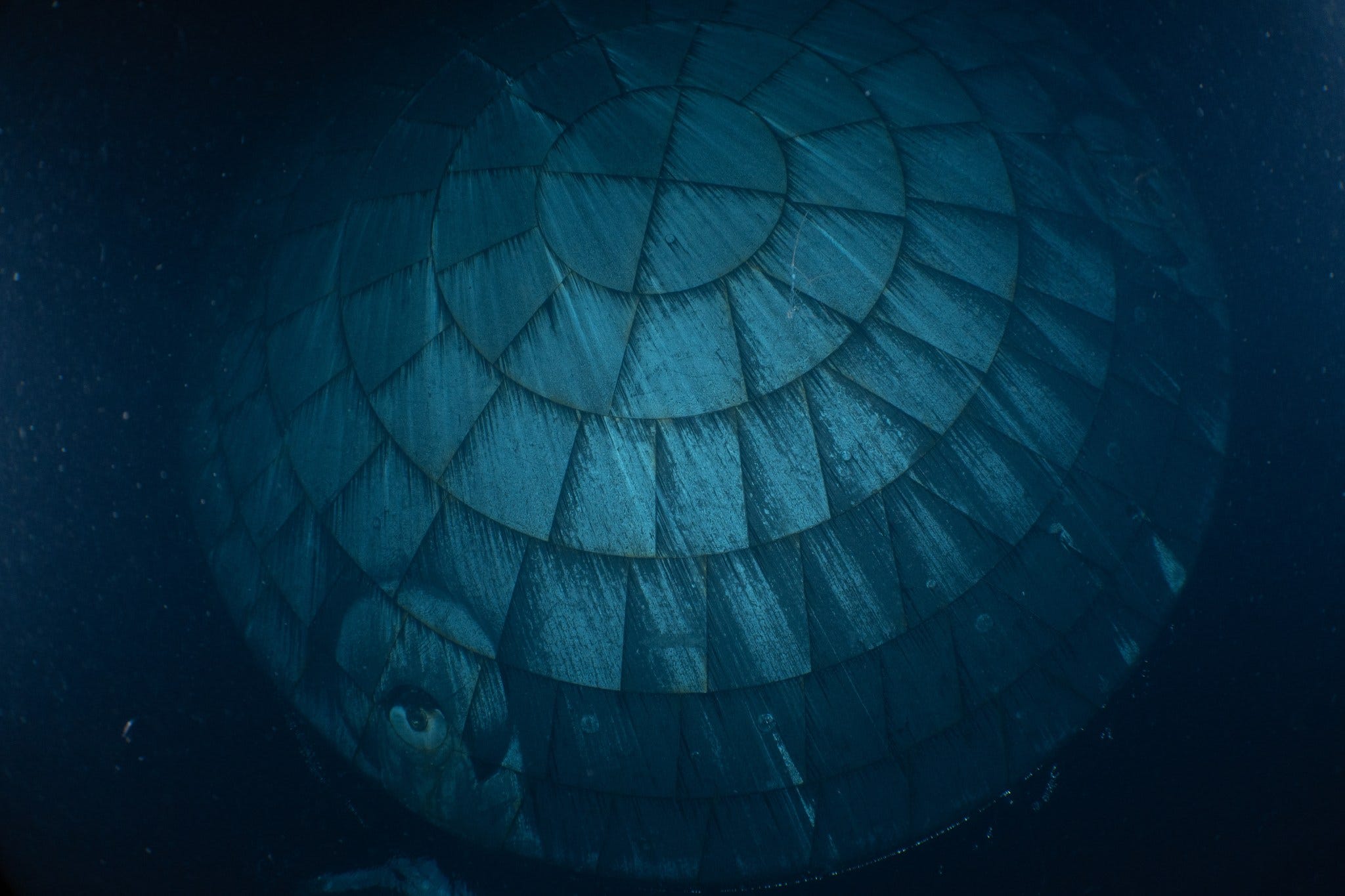
After travelling further into space than any human before them, the crew of Artemis II returned safely to Earth on April 10th.
Their voyage lasted ten days, and covered a distance of almost seven hundred thousand miles. At their apex, they were more than a quarter of a million miles from Earth. As they passed over the Moon, they ventured closer to our natural satellite than anyone since 1972.
The moment of greatest peril, though, came in the final minutes of their mission. Their Orion capsule, named Integrity by the crew, hit the outer atmosphere at a speed greater than twenty-four thousand miles per hour. Humans have rarely travelled this fast. Only the Apollo missions, as they too returned from the Moon, have reached similar speeds.
Before launch, some concern had been raised about the ability of the capsule’s heat shield to protect the crew from the dangers of re-entry. In Artemis I, the uncrewed first test flight, this shield did not perform as expected. Later analysis showed it had been damaged during its plunge through the atmosphere.
In an effort to avoid a repeat, NASA engineers redesigned the trajectory the capsule follows during re-entry. They also tested the heat shield on the ground – though, of course, nothing we can do in a lab is able to recreate the reality of falling through the atmosphere at thirty-five times the speed of sound.
Fortunately, the shield seems to have performed as expected. Images taken of it after splashdown appear to show it in good condition, with little of the charring and erosion seen after Artemis I. That is good news. More work, of course, is needed. NASA will now study all the data obtained - including from observation aircraft - and subject the shield to a series of tests to better understand how it behaved.
As they do this, however, attention will surely turn to Artemis III. Until recently, this mission was supposed to take humans to the lunar surface for the first time in decades. For this, NASA was relying on SpaceX to provide a lander in the form of Starship. But progress has been much slower than hoped, and Starship simply won’t be ready to support a landing in time.
Instead, Artemis III will now remain in Earth orbit. Instead of going to the Moon, astronauts will practice docking with the lander. If SpaceX can get Starship into orbit and show sufficient control for a safe approach, the Orion capsule should dock with Starship. That would prove the technical ability of both vehicles to work together. But it would also allow operators and astronauts to get experience in what promises to be a challenging operation.
NASA has also introduced a bit of competition. Blue Origin has been working on its own lunar lander, which Orion could, if the lander is launched in time, use as a docking target as well. That, if successful, would give NASA an alternative way to reach the Moon before the decade is out.
The Darkening Waves of Mars
Until the 1960s, astronomers were convinced that the surface of Mars was periodically swept by ‘waves of darkening’. These would come and go with the seasons, and would spread from the polar regions towards the equator. Nobody knew what was causing these waves, but most theories held that they were somehow linked to seasonal shifts on the red planet.
A paper from 1966 paper summarised the two most common explanations. The first, and favourite, held that the warmth of the Martian spring was melting the polar caps and putting moisture into the air. This sparked waves of plant growth, which from Earth we saw as a wave of darkness spreading around the planet.
The other, more boring suggestion argued that seasonal changes in temperature caused wind patterns to shift. These winds would at times blow clouds of dust off the surface, revealing darker underlying rocks. When winds calmed, the dust would settle and Mars would seem to become brighter again.
When spacecraft first arrived at Mars, it became clear that the first theory was utterly wrong. The Red Planet does not have plant life, and it does not show a seasonal shift in colour as vegetation grows and dies. Indeed, since the dawn of Martian exploration, we have barely noticed any kind of annual change in the colours of Mars.
Yet, over a longer scale, Mars’ surface does show some shifts in colour. Mars’ Utopia Planitia – a vast basin that may once have held a small sea – has gradually become much darker over the past few decades.
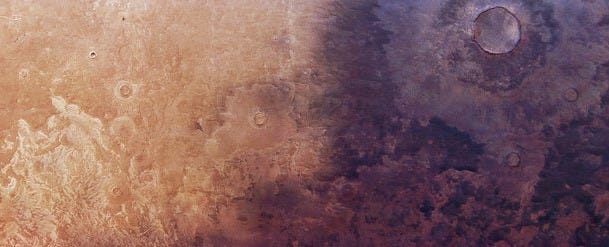
A comparison of photographs taken by NASA’s Viking orbiter in 1976 and by ESA’s Mars Express in 2024 shows this change clearly. Places that were once tan in colour are now black, and this darkness seems to be spreading.
Researchers do not know for sure why this is happening. But it is probably caused by dust blowing in Mars’ thin air. Either, ESA says, black volcanic ash is being blown by the wind and covering tan areas with darker material; or winds are blowing tan dust off previously covered areas, and so revealing the underlying darker rocks.
Voyager
After travelling for almost half a century, the Voyager 1 probe now lies more than twenty-five billion kilometres from Earth. It is the most distant man-made object in the universe, and, remarkably, it is still sending data back to us.
Voyager owes this longevity in part to the nuclear batteries that supply it with energy. These are based on a core of plutonium, and convert its radioactive decay into electrical power. But over time the plutonium is decaying, and as it does, the power generated is also decreasing. This will eventually mean the end of Voyager. Sometime in the coming years the power output will fall below the level needed to operate its radios, and contact with the probe will be lost.
Until that moment, however, operators are doing what they can to keep the spacecraft running. NASA has developed a plan for switching off Voyager’s scientific instruments one by one, a process that balances the risk of running short of power with the desire to return valuable data for as long as possible.
At the end of February, however, operators noticed a sudden drop in Voyager’s power output. Out of caution, they decided to switch off a device called the LCEP, an instrument that measures levels of charged particles around the probe.
Only two other scientific devices remain operational on Voyager 1. NASA has plans to reconfigure all of Voyager’s electrical systems sometime next year, which they hope will cut power use and extend the remaining life of the probe. It might even, NASA said, allow mission control to turn the LCEP back on.
Are Quarks Fundamental?
Until 1899, physicists thought atoms were the fundamental building blocks of nature. Their name reflects that: the word atom comes from the Greek atomos, meaning ‘indivisible’. But then J. J. Thomson discovered the electron, and the search for fundamental particles shifted to the next level down: the world of electrons, protons, and neutrons.
Later, in the 1960s, physicists realised yet another layer existed. Protons and neutrons, it turned out, were not fundamental, but were made from quarks. Today, this is where things remain: all atoms, as far as we know, are made from various arrangements of quarks and electrons.
Might there still be another level down? At the Large Hadron Collider at CERN in Switzerland, researchers have probed the structure of the quark to see if it, too, is made of some more fundamental particle.
These experiments collide protons at high speeds. In the aftermath of these impacts, the proton breaks apart into quarks. By studying how these quarks move, physicists can work out whether they act as point-like particles, or whether they have some internal structure.
In a paper published recently, researchers said these experiments have found no signs of any deeper layer of nature. Quarks appear to be point-like, or at least smaller in size than one hundred billionth of a nanometre.
Upgrades to the Large Hadron Collider should soon allow researchers to probe even smaller scales of nature. If there is another layer at the bottom, those experiments may soon spot hints of its presence.
Read More
The Strange Problem With Red Supergiants

Giant stars are supposed to die in big and dramatic explosions. They run short on fuel, their cores collapse under immense gravitational pressure, and then they blow up. In 2023, we saw this happen i…
The Bold Insanity of Artemis II: America Prepares to Return to the Moon

If NASA keeps the schedule, the moment of lift-off will …

Watching the live feed of the Artemis II coming back to Earth, I was impressed by how quickly the capsule went from 8,000 MPH to 24,000 MPH. The crew who fell to Earth!