
The Week in Space and Physics: The End of The Night Sky
On the destruction of the night sky, the oldest crater on Earth, ancient quasars, and the start of a great sky survey.
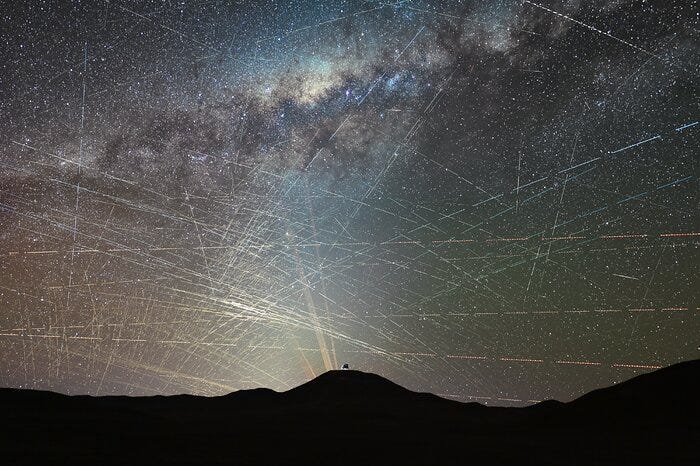
Until the moment Sputnik launched in 1957, the night sky remained a wilderness untouched by the hand of Man. People who looked up, and who did so far enough away from the glare of city lights, could see pretty much the same sky as every other human had since the dawn of consciousness.
Since that day, however, things have changed. Sputnik itself was not that bright, but its rocket booster was, and for a few days it shone as bright as a first magnitude star. Today there are tens of thousands of artificial objects orbiting our world, and on any clear night the impact of our work can clearly be seen.
Some hail the progress this has brought. The majority of active satellites now in orbit belong to the Starlink constellation, a massive piece of infrastructure that provides Internet connections across the world, as well as aiding the espionage and military capabilities of the United States. But it has come at a price.
The night sky is no longer a pristine wilderness. Astronomers have suffered, as satellites leave bright trails across their images. Debris, in the form of abandoned satellites and rockets, is gradually building up in orbit. The risks of a collision, or of parts of a falling satellite hitting and killing someone, are rising.
This loss looks certain to continue in the coming years. More Starlink satellites will be launched, especially if SpaceX masters their Starship rocket. Musk has said he wants to launch a million data centres into orbit to power AI. Amazon has started building a huge constellation of their own. China is doing the same, and many others have announced plans.
One of the brightest objects in the sky is now not a planet or a star, but BlueWalker 3, a satellite aiming to provide cellular phone service from space. Reflect Orbital, an American startup, hopes to soon deploy gigantic mirrors in orbit. If they succeed in this rather nonsensical idea, they will create objects that shine as bright as the full Moon.
All this, the European Southern Observatory recently warned, will mean the end of the night sky. Instead of a heavens full of stars and wonder, we will see only a sky shaped by our own hands. In the place of planets, we will see satellites beaming data and turning night into day.
For astronomers, the prospect is frightening. Major astronomical projects, including the Vera Rubin’s ten-year survey and the European Extremely Large Telescope, may be for naught. If the sky holds more than about one hundred thousand satellites, ESO calculates, then astronomy as we know it will become impossible.
It is troubling that much of this change is coming about without proper discussion. The American government has recently approved the launch of Reflect Orbital’s bright satellites – a decision that will be felt by people across the planet, not just in America. They did not consider the impact such giant mirrors will have on the world, nor accept responsibility for the consequences of their actions on the night sky.
The Oldest Impact Crater On Earth
Some of the oldest rocks on Earth lie in the Pilbara region of Western Australia. It is here that we have found the earliest signs of life on our planet, in the form of mineral deposits and other structures probably created by organisms living more than three billion years ago.
The extreme age of this region makes it a good place to look for evidence about the early Earth. One debate surrounds the origin of the continents: many geologists think they were created by immense plumes of molten rock and heat welling up from the interior of the planet. But a team led by Tim Johnson at Curtin University thinks the energy to form them instead came from massive asteroid strikes.
To find evidence to support this idea, they headed to Pilbara in search of ancient impact craters. They found one in May 2021, in a region called North Pole Dome. There is no actual crater there, at least not any more, but they did find signs that the local rocks had experienced an impact shock. In part, this evidence came in the form of geological structures called shatter cones.
They concluded the impact had happened in the distant past, probably more than three billion years ago. But an alternative study, led by a group from Harvard, later reached a different conclusion. They agreed there had been an impact, but thought it had happened much more recently. The asteroid responsible, they found, could have struck the Earth ‘just’ four hundred million years ago.
Now, the Australian team has hit back. They carried out a more detailed analysis of the rocks at the site of the crater, and examined the crystals within them. Some showed an age of 3.4 billion years, and were probably formed along with the rocks. But others showed signs of having experienced a sudden shock, like an impact, and these were dated to about three billion years of age.
Alongside this, they found another mineral, apatite, that forms when heat drives water through fractured rock. As with the shocked crystals, this was dated to an age of about three billion years. Together, the two pieces of evidence suggest we really are looking at the oldest known impact crater on Earth.
Euclid’s Ancient Quasars
The European Space Agency announced the discovery of the earliest known quasars in the universe. They were found by the Euclid Space Telescope, an observatory dedicated to the study of distant galaxies and to the hunt for dark matter and dark energy.
Quasars are, in essence, extremely active galaxies. Their inner black holes are consuming vast amounts of gas and dust and other material, and this creates a furious disc of material swirling around their centres. The result is a hot and bright galactic core, one visible across extraordinary distances.
Indeed, many quasars are far away and are visible as they were billions of years ago. But spotting the oldest quasars has so far been challenging. They are distant, which makes them appear faint, and they can look more like stars than galaxies.
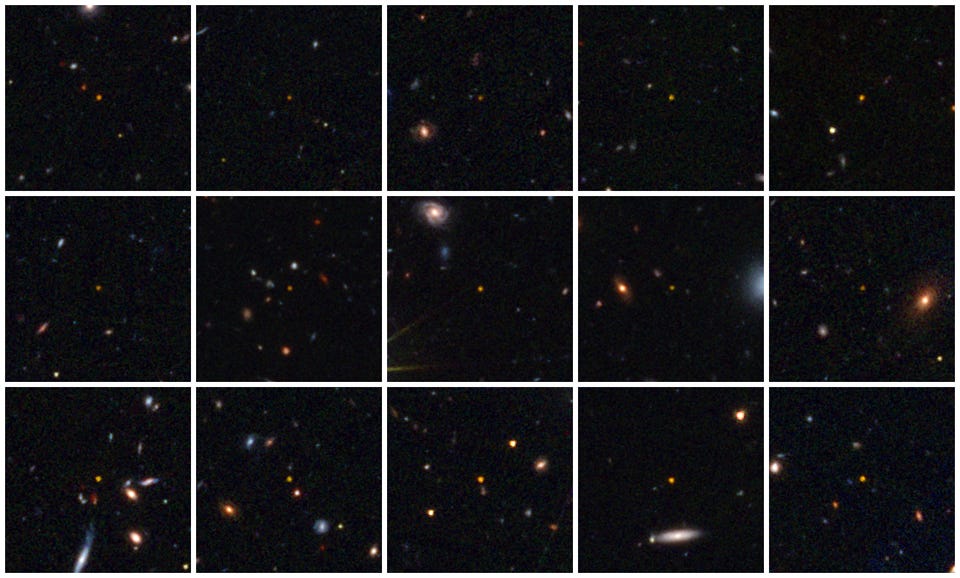
The Euclid Space Telescope, however, spotted thirty-one of the oldest quasars known. Some were formed in the first billion years after the Big Bang. They seem to be dusty objects, filled with stars forming at a rapid pace.
It is possible the James Webb Space Telescope has seen even earlier quasars, or perhaps objects that eventually evolve into quasars. Since it launched, Webb has spotted dozens of ‘little red dots’ in the early universe. Astronomers are still divided about what they are, but one theory holds that these are primitive galaxies with active central black holes.
If so, the work of the two telescopes may be helping to close a gap in our understanding of how quasars came to be. Many questions, of course, still remain. Astronomers have plenty to learn from these new observations of the early years of the cosmos.
The Greatest Survey Begins
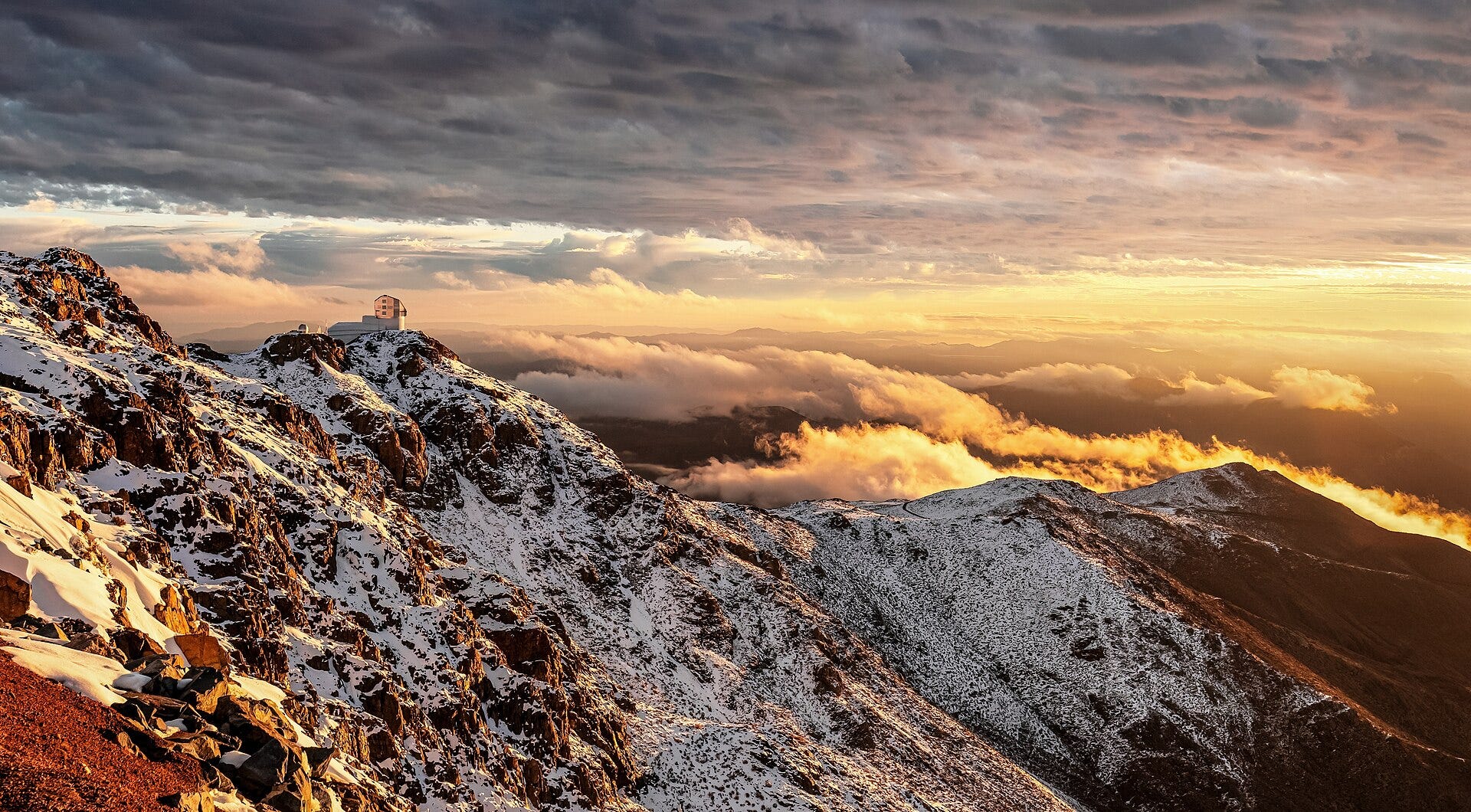
The Vera Rubin Observatory began an ambitious ten-year project to survey the night sky. The Legacy Survey of Space and Time, or LSST, aims to create a time-lapse of the heavens, showing how celestial objects change over both long and short time periods.
Vera Rubin is equipped with the world’s largest camera. It weighs three metric tons and can capture 3200 megapixels. All that power will be dedicated to the survey, and it should help the observatory spot countless objects that have so far been missed. The observatory, astronomers hope, will discover millions of asteroids and comets, search for a possible ninth planet, and hunt for traces of dark matter and dark energy.
Construction work on Rubin, built on top of a mountain in central Chile, came to an end in November last year. Since then, operators have been conducting engineering tests and optimising the quality and performance of the telescope and its instruments. They have now decided that both are good enough to start the real scientific work.
Tip Jar: $5 | $10 | $20 | Other
Read More
Why Is the Earth Coated in the Dust of a Supernova?

Paid subscriptions are still on sale this week! With 50% off the normal Substack fee, you can get a year-long subscription for just $30. That’s only $2.50 a month.
The Atom and The Void

The first principles of the universe are atoms and empty space; everything else is merely thought to exist.
How Stable Is the Solar System?

Ask any favour, Helios promised, and I will grant it. He soon regretted his rash oath; Helios was tasked with driving the Sun across the sky, and Phaethon - his son - demanded the right to do the same. In vain he sought to recant his promise; even Zeus, he argued, would not dare traverse the turmoil of t…