
The Week in Space and Physics: The Best Way To Alpha Centauri?
On swarms of interstellar probes, what polar space dust can tell us, Artemis III, and the race to save Swift
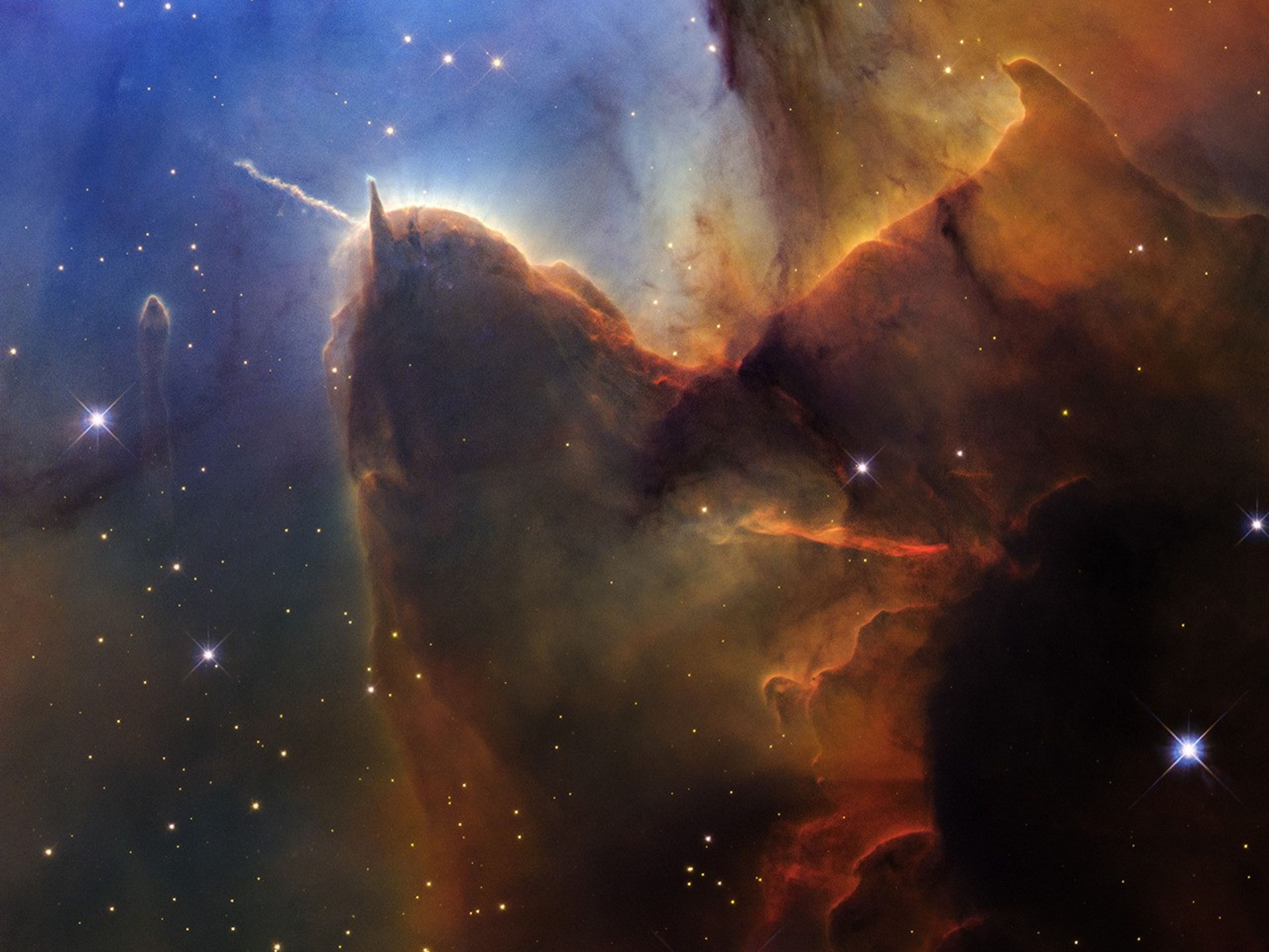
The stars are far, almost unimaginably so.
In 1970, as the crew of Apollo 13 fell back towards Earth, they briefly hit a speed of almost twenty-five thousand miles per hour. This is the fastest humans have ever travelled. Even Artemis II, returning from the Moon in April, fell about a thousand miles per hour short of this record.
Had the Apollo 13 capsule been capable of maintaining this speed, it could have looped around the planet in an hour, returned to the Moon in less than half a day, and then gone on to cross the orbit of Mars within a few months. But even at this rate, it would still have taken more than one hundred thousand years to reach Proxima Centauri, the closest star to our own.
As a result, dreams of interstellar travel are often just that. Indeed, there are few technologies that might allow us to span the gulfs of interstellar space. Yet the idea is not completely out of the question. There are a handful of stars within a dozen light-years of Earth. Crossing such a distance is just about feasible, at least according to the team behind Breakthrough Starshot.
They reckon that rather than sending a single big spacecraft, we might be better off sending a swarm of tiny ones. Thousands of these could be launched together. Each would deploy a light-sail, a device that uses the slight pressure of sunlight to create a small but steady acceleration.
This would not normally be fast enough to reach the stars. But Breakthrough Starshot thinks we could accelerate probes faster by using laser beams in place of sunlight. Fire these at small and lightweight spacecraft, they say, and we could get them to a reasonable fraction of the speed of light. Of course such speeds are dangerous - even minor collisions would obliterate a probe - but numbers can compensate for these risks.
To study how such a mission might work in practice, a team led by Marshall Eubanks of Space Initiatives looked at what a swarm of one thousand small spacecraft could do. They imagine accelerating them towards Alpha Centauri at twenty percent of the speed of light. At this rate, they could reach the star system in about twenty-one years.
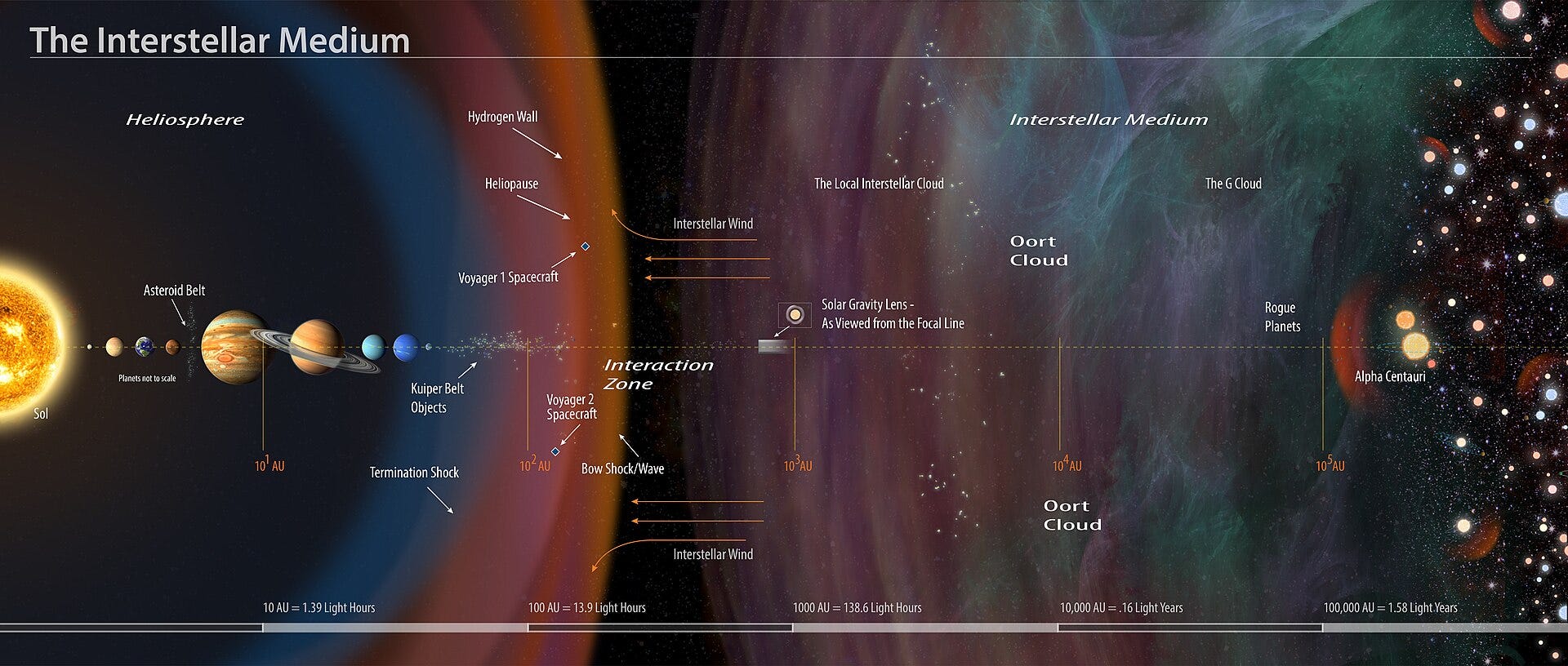
As they flew through the outer solar system and into interstellar space, however, they would already begin sending back valuable scientific data. At first, they might hunt for planets and dwarf worlds hidden at the edge of the solar system. Later, they could map out the density of interstellar dust, hunt for primordial black holes, and even probe fundamental theories about gravity and about space and time.
The probes would still be travelling at high speed as they reached Alpha Centauri, and would have limited capacity to decelerate. But they would be able to image the planets around the three stars found there, and could look for moons and other objects. Instruments could scan these worlds, image their surfaces, and look for signs of life or other interesting processes.
All this, they conclude, is not only possible to do, but may be the only reasonable prospect for interstellar travel in the coming century. The benefits would be astonishing: swarms could visit half a dozen nearby stars, fly out to rogue planets, and explore the most distant regions of the solar system. But the challenges of making this real should not be understated. At the very least, it will take far more money than anyone has so far seemed willing to venture.
The Clouds of Interstellar Space
Every day, several tons of dust fall upon our planet. Most of it comes from the solar system, in the form of tiny fragments of passing comets, the debris of ancient impacts, and the leftover material from the birth of the planets. But some comes from further afield.
As the solar system moves through the galaxy, it periodically passes through clouds of interstellar dust and gas. About fifteen of these clouds are scattered around us at the moment , and as our system moves through them, it is sweeping up some of the dust they contain.
Bits of this dust eventually make their way to Earth. Although much of it is then simply incorporated into our world, some of it builds up in layers at the bottom of the ocean or in the polar ice sheets. And there, as a recent study found, it can act as a tracer for the history of our star’s long voyage through the galaxy.
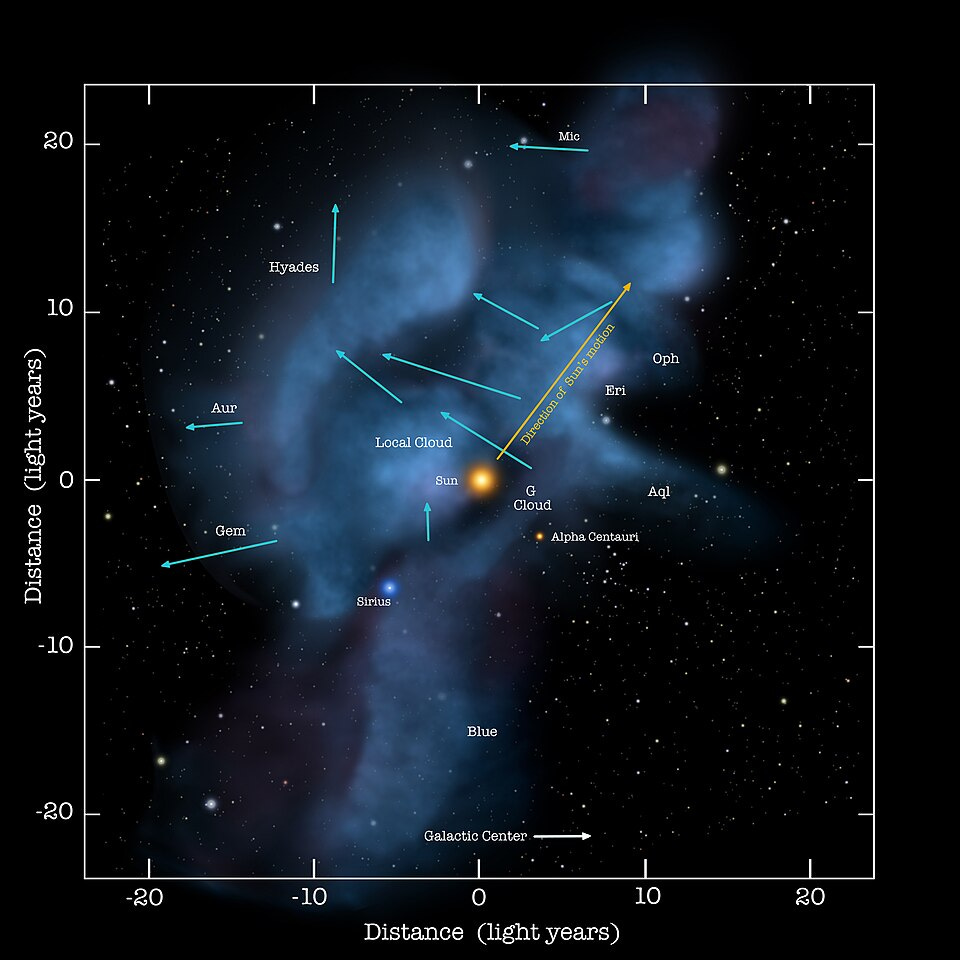
The study, led by Dominik Koll of the Australian National University, analysed polar ice formed between forty and eighty thousand years ago. They found that the amount of cosmic dust falling on Earth seem to have increased since that time, possibly because we have recently entered an interstellar cloud.
That would fit well with ideas about our solar system’s recent trajectory. It is currently in the ‘local interstellar cloud’, and probably moved into this cloud sometime in the last hundred thousand years. We are currently heading towards its edge, and at some point in the next few millennia we should enter the nearby ‘G-Cloud’.
Much more work remains to be done. Other sources of dust have been found on the Moon, as well as in oceanic sediments. Together they paint a history of several supernovae erupting in our region of space over the past few million years, and tell a story of how we have moved between the clouds and bubbles sculpted by these violent events.
Getting all of this together into a single cohesive narrative will take time. But once complete, it will reveal the history of our long cosmic journey.
Artemis III
After this year’s successful flight around the Moon, NASA is moving ahead with plans for the third Artemis mission.
Originally, this was supposed to put astronauts on the lunar surface, and would have been the first time anyone had set foot on the Moon in more than five decades. But although NASA now has a rocket and a capsule, it does not have a lander ready to take crews to the surface and back.
NASA was relying on SpaceX to provide this lander. Under contracts awarded in 2020 and 2021, SpaceX was supposed to develop their Starship system to support lunar landings. But progress has been slow, and Starship still isn’t capable of getting anywhere close to the Moon.
With Artemis II complete, NASA has been forced to recognise this reality. Instead of going to the Moon, then, Artemis III will remain in a low orbit around the Earth. To salvage some value from the mission, NASA will practice docking the Orion capsule with Starship. In future missions this step will be crucial, as the two spacecraft are supposed to meet in lunar orbit to allow astronauts to transfer from one vehicle to another.
But in what may be a subtle warning to SpaceX, NASA is also hoping to demonstrate docking with a second lunar lander. This one, being built by Blue Origin, could provide an alternative route to the Moon, and give NASA a backup option if Starship simply is not ready in time.
Saving Swift: A Race Against Time
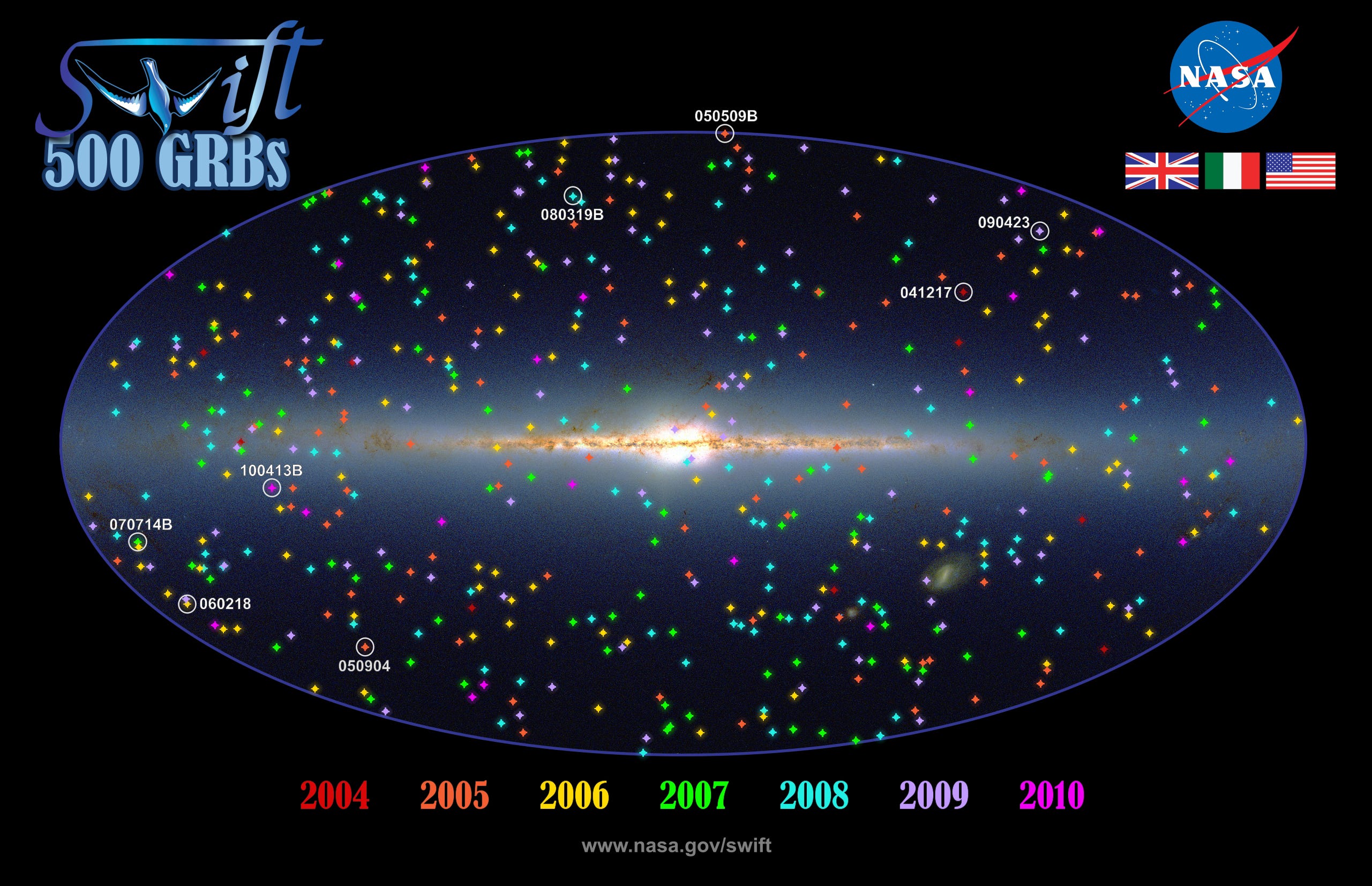
Since 2004, the orbiting Swift Observatory has been studying the mysterious Gamma Ray Bursts that appear in the distant universe. Although the mission was supposed to last just two years, it is now approaching its twenty-second anniversary in space. In that time, it has carried out more then eight hundred thousand measurements.
Unfortunately, Swift is also on the verge of death. It was originally launched into an orbit six hundred kilometres high, but over the last two decades the atmosphere has dragged it back down. It has now fallen below an altitude of four hundred kilometres and if nothing is done, it will make a fiery re-entry in the next few months.
Last year, however, NASA partnered with a company called Katalyst Space Technologies. Together they have built a spacecraft that could grab Swift and then boost it into a higher orbit. That would save the telescope, and give it another few decades of life.
NASA recently announced this new spacecraft has completed tests on the ground. It will now move towards a launch – possibly as soon as early June – and then start a race against the clock to raise Swift before it falls too low into the atmosphere.
If this works, it would demonstrate an important ability to grasp and raise the orbits of falling satellites. Swift is not the only one of NASA’s telescopes that is in peril of re-entry: Hubble, launched in 1994, is now losing altitude at a rapid rate. If nothing is done, it will burn in the early 2030s. Katalyst’s mission, if it is a success, may offer a way to prolong Hubble into the 2040s and beyond.
Read More
An Atmosphere and a Puzzle Beyond Neptune

For most of its known history, nobody has cared much about 2002 XV93. It is a small world lying somewhere close …
A Nuclear Ship For Mars: Making Sense of Space Reactor Freedom

The way NASA tells it, Space Reactor Freedom sou…
How Dust on the Ocean Floor Hints at a Recent Near-Earth Supernova

However big you imagine a supernova to be, the reality is certainly bigger. To put it one way, an exploding star can briefly outshine the combined light of every other star in a galaxy; to put it another, a supernova at the distance of Pluto would hit you with more energy than a hydrogen bomb exploding just outside your front door.
In the swarm-ship approach it would still take 5-ish years for signals to return from any spacecraft that make it to Alpha Centauri right? So 21 years to get there + comms lag of another 5 to see what they see?
Inserting an intermediate mission into the Artemis schedule is the wise thing to do. Going straight to the Moon without a test of the craft/docking procedure is a bad idea. If all goes smoothly, we should push for Artemis IV ASAP: we don't want the Chinese to catch us unaware the way the Russians did with Sputnik and Yuri Gagarin.