
The Week in Space and Physics: Voices From The Moon
On the race back to the Moon, the Snowball Earth, a hellish exoplanet, and a new view of Mars.
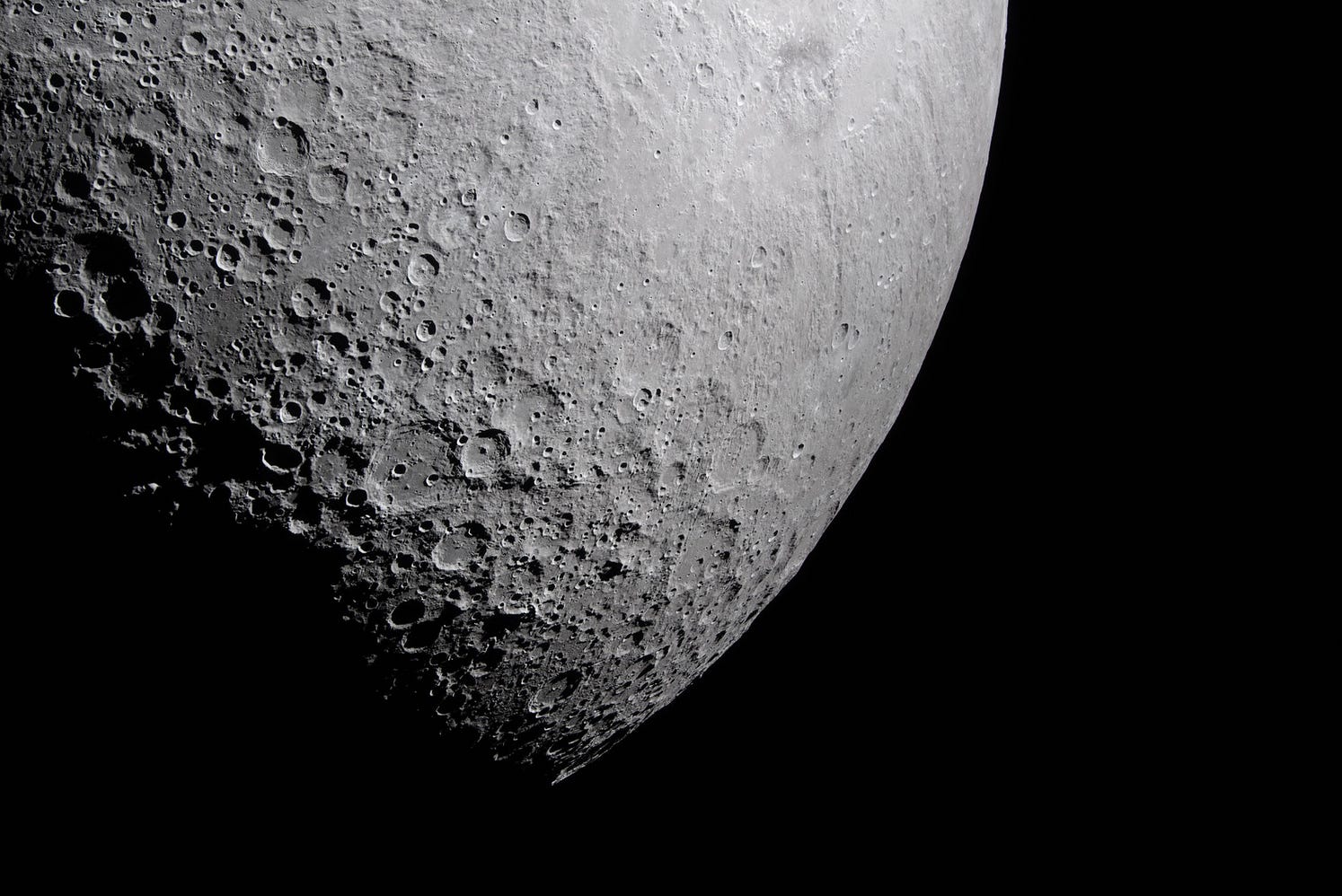
“The next time the world tunes in to watch astronauts fly around the Moon”, NASA boss Jared Isaacman said on May 19, “they will be taikonauts”.
China has not yet announced any such mission, which would likely replicate either Artemis II or Apollo 8. But it is not really in doubt that such a mission is coming, and that it may happen soon. Over the past few months, China has conducted tests of both its crew capsule, Mengzhou, and of its Long March 10A booster, the rocket that will propel astronauts towards the Moon.
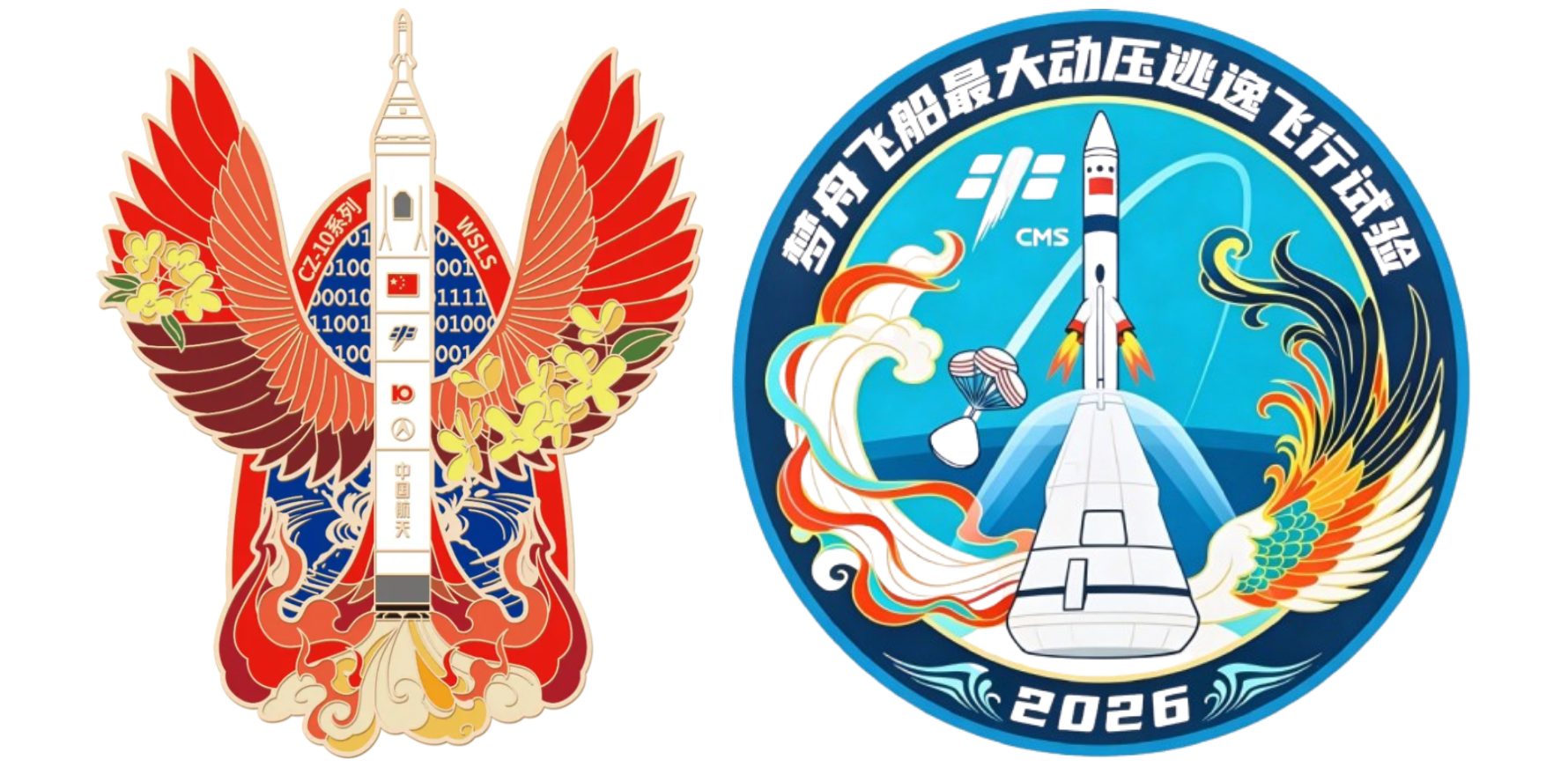
For American politicians, the possibility that China might beat America back to the lunar surface is of deep concern. Isaacman has responded to these worries by pushing NASA to move faster and to start building out a base on the surface. America, he has said, “will never again give up the Moon”.
Artemis IV, the mission which might see Americans leave footprints on the Moon for the first time since 1972, is now scheduled to take place in 2028. If it launches on time, or at least before 2030, America has a good chance of beating China to the lunar surface.
Unfortunately, the past month saw two big setbacks in America’s efforts to do this. First was the twelfth launch of SpaceX’s Starship rocket. NASA plans to use this as a landing craft, the vessel that will take astronauts on the final leg of the trip to the surface and back. SpaceX, however, has struggled to get Starship ready in time.
May’s flight was supposed to change things. Over the past few months, SpaceX’s engineers have built an improved version of Starship, one they call V3. It is supposed to fix many of the issues that bedevilled the previous version, and so clear the way towards attempting a Moon landing.
Yet the test flight showed only mixed results: during ascent the rocket suffered from failed engines, and SpaceX was unable to steer the booster back to its target splashdown point. As the upper stage, ‘the ship’, flew on, it too suffered from engine problems. SpaceX abandoned some of their planned tests, though they did manage to demonstrate the ability to deploy dummy satellites. The ship at least made it back through the atmosphere in one piece, and came to a partially controlled ‘landing’ before it toppled into the ocean.
The next test flight may do better. But it is inescapable that things are not going as well as hoped. After twelve flights, SpaceX appears stuck, doomed to endlessly repeat the same suborbital trajectory with mixed results. To get to the Moon they need to break out of this loop. If it wants to get there before China, Starship almost certainly need to reach a proper orbit sometime this year.
In recent months, NASA seemed to be building a backup plan. This would have used a lander built by Blue Origin, a company owned by Amazon founder Jeff Bezos. But last week Blue suffered a major setback of its own. While their New Glenn rocket was undergoing tests in Florida, it suddenly and dramatically exploded in an enormous fireball.
The surrounding launch facilities have been badly damaged. How much this will set things back remains unclear – but it is clearly a serious blow. It would be a surprise if Blue Origin is able to launch again this year. As a result, it may not just be the next voices from the Moon that are Chinese. The next footprints may be too.
The Snowball Earth
Our world has not always been blue and green. For a while it was purple: the earliest photosynthetic life might have used retinal instead of chlorophyll, and this would have given the planet a purplish tinge. Later – during a long stagnant period geologists have nicknamed the Boring Billion – other creatures may have turned the oceans a milky black.
Around six hundred million years ago, some scientists think the Earth became a snowball. Ice sheets would have crept outwards from the poles, and eventually covered almost the entire planet. The equator would have been as cold as Antarctica is today, and even if it wasn’t frozen, the tropics would at least have been covered in an icy slush.
In theory, this kind of frozen world is perfectly stable. Ice reflects sunlight and heat, and this forms a feedback loop that keeps the planet cold. Global ice sheets may have emerged on multiple occasions, stuck around for millions of years, and only receded as something – volcanoes or meteor impacts perhaps – created enough warming to knock the world into a different stable climate.
Since then, however, the ice sheets have either vanished completely – as they did in the Jurassic period – or stuck around the poles, where they are found today. For some reason, Snowball Earths don’t seem to happen any more.
There are two possible explanations as to why not. One theory suggests that something has changed, and thus made global glaciation impossible. But others argue that supporters of the Snowball Earth are simply wrong, and that our planet has never frozen over entirely.
In a recent study, Erica Bisesi of the Astronomical Observatory of Trieste tested the first idea by modelling the conditions that may have prevailed on the Earth during such a snowball scenario. The last time it happened, she points out, the landmasses were fused into a single supercontinent named Rodinia that straddled the equator. Plants and trees had not yet emerged, so this continent was bare and rocky.
That would have made the Earth more reflective. The Sun was also cooler in the past, and half a billion years ago our planet would have received about five percent less heat than it does today. Together, these two factors would have made the world colder, Bisesi says, and more susceptible to falling into a snowball state.
But when that state ended, and the Earth warmed again, the temperature shift may have provided the spark for a more radical change. As the ice sheets melted, the flow of sediments and nutrients they sent into the warming oceans would have allowed life to flourish. Perhaps, some have wondered, the last time this happened it helped spark the Cambrian Explosion, the moment when life rapidly became much more complex.
That, Bisesi says, tipped the scales. As the continents began to be covered in vegetation, they reflected less sunlight. A darker planet absorbed more heat, and that may have been enough to prevent it from ever freezing over again. Once the world turned blue and green, in other words, it may have been just stable enough to stay that way.
Webb Images a Hellish Landscape
A group of astronomers led by Sebastian Zieba of Harvard reported using the James Webb Space Telescope to directly measure the surface of a distant world. Their target, a planet called Kua’kua, lies about fifty light years away. It orbits a red dwarf, a star fainter and cooler than our own, and it is slightly larger than the Earth.
It is not, however, a nice place. Measurements reported in 2019 showed it to be an airless and hot world. Its orbit lies close to its star, and it is tidally locked – which means one side of the planet is forever turned towards the star, while the other perpetually stares out into space. This starward side is extremely hot, soaring to about 1500 degrees Celsius.
Since it has no atmosphere, telescopes like the James Webb can directly measure properties of its surface. Zieba and his team did this, using the telescope to study the rocks and minerals scattered across its terrain. These observations showed it to be a barren place. Its surface is ancient, covered in volcanic regolith, and has likely suffered under billions of years of impacts and stellar radiation.
This means it looks more like Mercury, or perhaps the Moon, than like Earth or Mars. That, given the extreme conditions of Kua’kua, was not unexpected. But other worlds could still offer surprises. The presence of different minerals and rocks can reveal how active a planet’s geology is. And the more dynamic a world is, the more interesting it will be - and the greater the potential for it to host some kind of primitive life.
Psyche Swoops Past Mars
On May 15, NASA’s Psyche probe swung past Mars. The Red Planet is not the spacecraft’s ultimate destination: it is designed to study 16 Psyche, one of the largest asteroids in the belt between Mars and Jupiter. But to get there it needs energy, and it thus used this brief visit to Mars to gain acceleration through a gravitational assist.
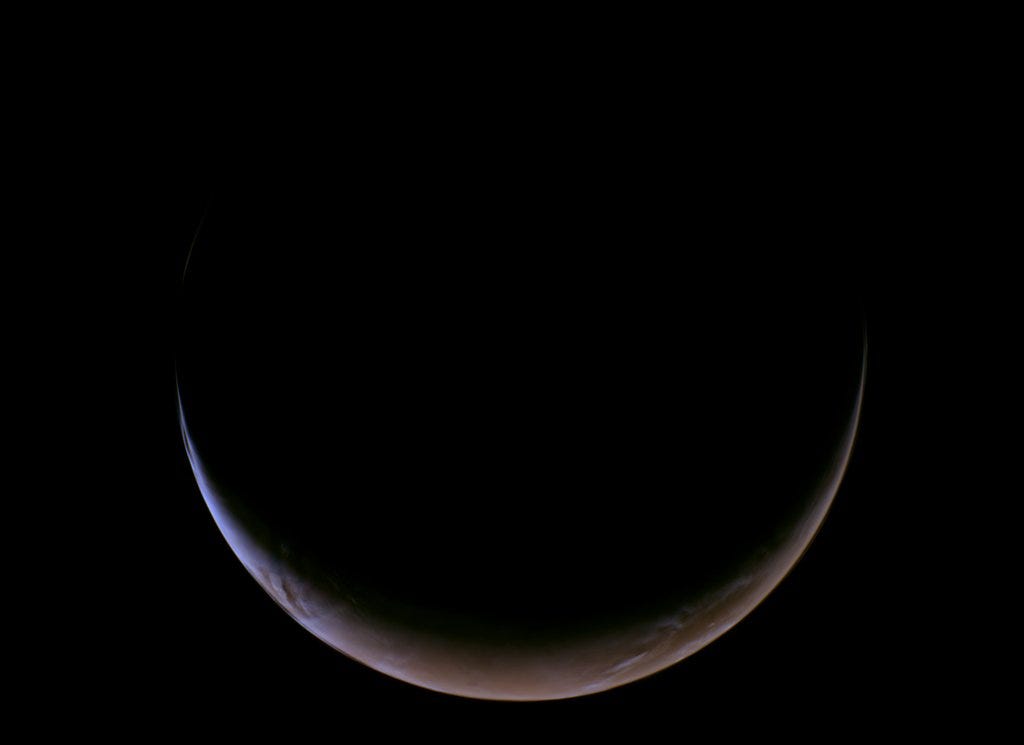
Psyche approached Mars from the opposite direction of the Sun. This gave it a view of the planet that we rarely see. In the images it sent back, the Red Planet appears as a crescent, the Sun is almost exactly behind it, and only a sliver of the world is illuminated.
Psyche’s operators used the encounter to test out the instruments and cameras on board the spacecraft. All seems to have gone well, and the team say they captured thousands of observations of Mars. Their next milestone will come in 2029, when Psyche finally reaches its namesake in the asteroid belt.
Read More
An Atmosphere and a Puzzle Beyond Neptune

For most of its known history, nobody has cared much about 2002 XV93. It is a small world lying somewhere close …
Starship II: The Return to the Moon

This article is the second in a series on SpaceX’s Starship rocket. Parts of this series, including this article, will initially be available only for paying subscribers. If you are not already a subscriber but would like to support my work and help me spend more time researching and writing articles,
Seizing The Light: The First Photographs Of The Heavens

In 1839, Louis Daguerre took the first photograph of the Moon.
We in the USA shouldn't lose hope: we overcame the Apollo 1 disaster in January, 1967, didn't fly again until October, 1968, and were on the Moon by July, 1969. We've overcome challenges before but I will admit that we are lacking the sense of urgency we had back then, too.