
The Year in Space and Physics
A look back at the trends and news of 2025
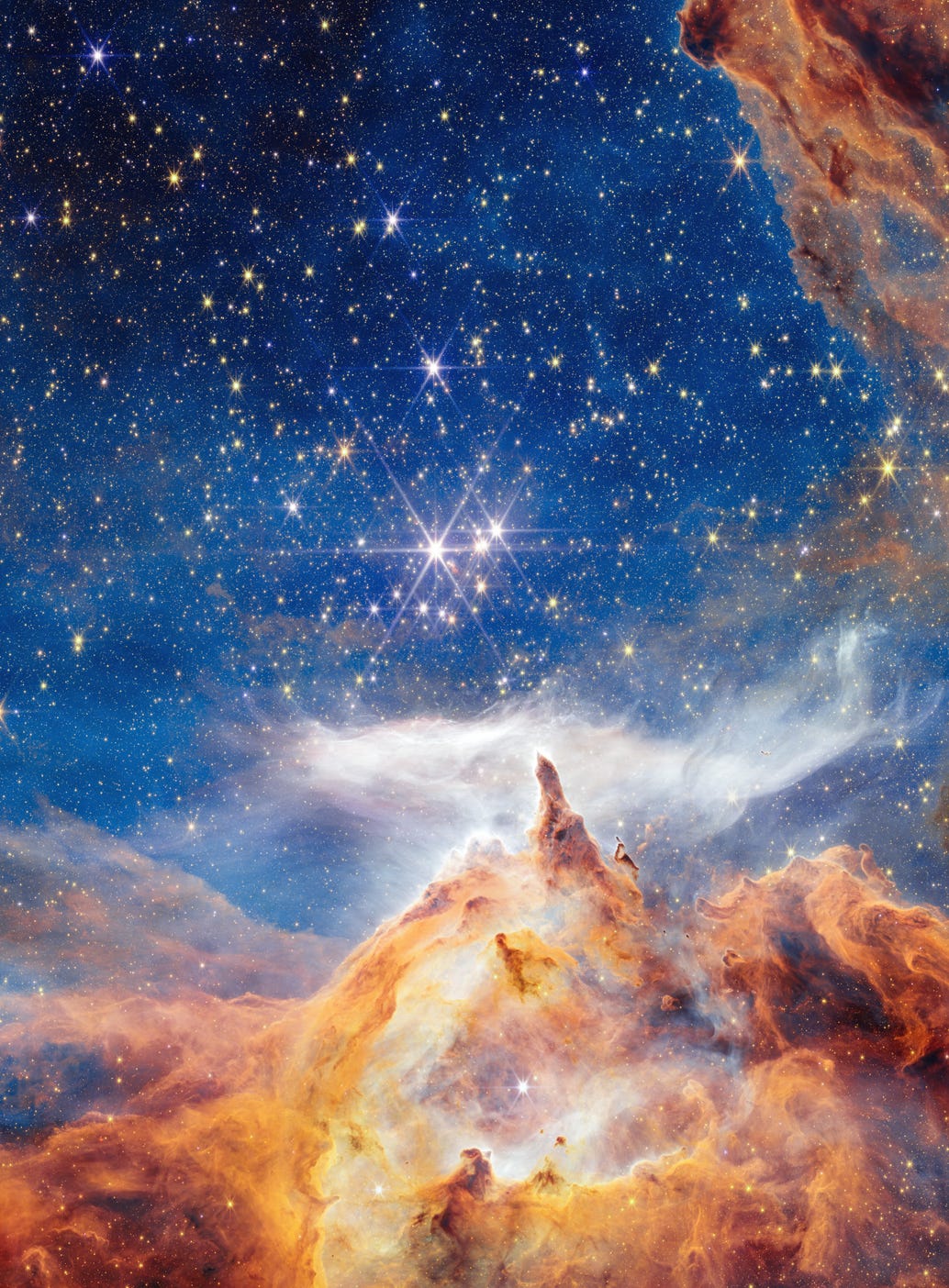
I spent some time, this summer, in the valley of the Vézère in southwestern France. People have lived there for a long time. Caves, of which there are dozens in the rocks and cliffs of this valley, show the traces of inhabitants stretching back over four hundred thousand years. In many there are ancient works of art: paintings of mammoths, of constellations, and, in a few rare cases, of humans themselves.
As I stood there, looking up at the cliffs and caves, trying to imagine the long-gone world these people lived in, another story came to my mind. In his book Wind, Sand and Stars1, Antoine Saint-Exupéry wrote of plateaux he had flown over and landed on in the Sahara Desert. These, he says, were made of hard limestone, formed from the slow accumulation of sea shells over the ages.
That, amid the dry sands of the desert, was strange enough. But having landed on them, he noticed something else. Scattered across the brilliant white surface of these plateaux were hard black pebbles. Each was heavy and cast in the shape of a tear drop. They had, he realised, fallen from the heavens: a long slow rain of rock; each plateau a sheet stretched under the stars and slowly gathering their dust.
“We are living on a wandering planet”, he notes in that book. And so we are. Things are vaster than we imagine, tied together across spans of space and time that humble our self-importance. The discoveries of science and the work of engineers cannot protect us from this; our only defense, indeed, is to look up and wonder.
Life Beyond Earth
“Year after year”, H.G. Wells wrote in 1896, “...there recurs the question as to the existence of intelligent, sentient life on the planet Mars”. Things have not changed. More than a century later we still speculate about life on Mars, though admittedly few today think that sentient beings might one day be found there.
Back then, scientists thought Mars might be rather Earth-like, with changing seasons, vegetation, and regular rainfall. Today we know it is not – Mars is a dry, dead place, one that has seen little change in the past three billion years. Yet we also know this was not always the case. Once Mars really was Earth-like, and had flowing water, seas, and a thick warm atmosphere.
This means it could also have been alive. And this year, researchers announced the discovery of a tantalising hint of this long-gone world. A rock examined by the Perseverance rover shows plausible signs of ancient biology, they said, and contains a mix of minerals that on Earth would be a sure sign of life.
For now, though, this remains speculation. The researchers called the signs a “potential biosignature”, and cautioned that a closer look would be needed to confirm their origin. That means we either need to get the rock back to Earth – for which budgets are sadly tight – or send people to Mars to look at it directly. Neither seems likely to happen any time soon.
Other researchers have focused their attention on worlds far beyond the solar system. The James Webb telescope has been studying the Trappist system, a collection of seven rocky planets a few dozen light years away. In theory some of them could have the right conditions for life.
So far, however, Webb’s data has been discouraging. Its studies of the innermost planets of the system have found them to barren worlds more akin to Mercury than Earth. Yet data from the outer planets – including those thought to be most habitable – is still to be released. Next year might, then, bring an exciting discovery of a world with a thick atmosphere and warm temperatures.
Studies are also ongoing of K2-18b , a world that shows hints of life. Its atmosphere, according to studies released last year, contains traces of dimethyl sulphide. On Earth, this gas is made by life – and so its presence on an alien world is intriguing. But other researchers again urge caution: the evidence is still weak, and even if the gas is there, we have no clear proof it is being made by living creatures.
Vera Rubin and Interstellar Comets
The second half of the year brought a rare visitor to the solar system. Comet 3I/Atlas was spotted by telescopes on July 1st, heading rapidly towards the inner planets. Astronomers soon realised it had come from interstellar space, and so this comet was distinguished as only the third object known to have visited from the stars.
Analysis showed 3I/Atlas was probably billions of years old, and likely older than the solar system itself. Although its origins remain unknown, we believe it ultimately came from a far distant and very ancient star system. At some point it was hurled out towards the stars, and it has since spent several billion years wandering the galaxy alone.
Its encounter with the solar system was a rare event for both the comet – at least a million years have passed since it last came so close to a star – and for us. Astronomers wasted no time in studying 3I/Atlas. Telescopes watched as it flew through the solar system, swung past Mars, and then passed on the other side of the Sun. It is now heading back out into interstellar space, and should once again cross the orbit of Jupiter next year.
After that, however, interstellar comets may become a more regular sight. Dozens of them are probably transiting through the solar system right now, but since most are faint and hard to see, we simply don’t spot them. The new Vera Rubin observatory in Chile will change that: it is designed to survey the whole southern sky in unprecedented detail, and will allow astronomers to find millions of objects that have so far been missed.
This bonanza of discovery may open the possibility of getting a close-up view of an interstellar comet. Europe is working on the Comet Interceptor, a spacecraft that will launch by the end of the decade and that will then wait for a suitable target to come along. An interstellar comet, ESA has said, would be a tempting object for it to examine. And with Vera Rubin, we should have plenty of options to choose from.
A New Race to the Moon?
Once again, NASA failed to land humans on the Moon.
No surprise, you might think – after all, were they really trying? But as recently as 2023, NASA’s stated goal was to return to the lunar surface by the end of 2025. Deadlines have, of course, slipped. NASA’s new goal is to reach the surface by 2027, though even this relaxed target seems hard to meet.
This much delayed schedule has raised concerns that China will get there first. Indeed, they might. In recent years China has made rapid strides in its space program. It has built a space station, tested reusable rockets, and mastered the art of landing and taking off from the surface of the Moon. It still needs a Moon rocket and a lander capable of carrying astronauts, but work on both seems to be well underway.
With all this, China hopes to put an astronaut on the lunar surface by 2030. That gives NASA some room to delay further – but fears are rising in Washington that America simply won’t make it in time. There is, acting NASA administrator Sean Duffy said this year, a new race afoot, and America needs to move faster if it wants to win.
The coming year should make the state of things clearer. NASA wants to launch Artemis II in February. That mission, if it succeeds, will carry astronauts around the Moon for the first time since the 1970s. Alongside that, SpaceX hopes to make progress with Starship, the spacecraft that the crew of Artemis III will use to descend to the surface.
If both projects go well, America has a good chance of reaching the Moon this decade. But if not, then China will look like the favourite, and the wisdom of declaring a new space race will surely be questioned.
The Shifting Balance of Science
It is not only in space that the balance of power seems to be shifting. In recent years China has invested in scientific facilities. The world’s largest single-dish radio telescope is nestled in the hills of Guizhou, one of its most advanced X-ray lasers is in Shanghai, and there is now also a powerful neutrino observatory buried under a mountain in Guangdong.
Although metrics of scientific output are hard to compare, the investment in new world-class facilities shows that China is serious about its scientific research. And it comes as a stark contrast to the current policies in the United States, which have led to sharp reductions in research funding.
This is not, to be clear, a new trend. The collapse of the famed Arecibo telescope in 2020 was preceded by cuts in its budget for maintenance. Lack of funds also ruled out the construction of any replacement observatory. American scientists have been trying to find money for two large new telescopes for years – and now, with cash still short, it seems likely that one of them will move to Europe instead.
The result of all this will not be a sudden halt to American science. Indeed, in many ways America is still the world’s scientific superpower: there is nothing else like the James Webb Space Telescope, and much of the research behind the AI revolution took place in the United States. But the balance of where scientific progress is made is shifting.
This is a matter of consequence. Physics is not just a subject of academic curiosity. It is the field from which much of the modern world has emerged: without the work of Carnot and Kelvin we would not have perfected the steam engine; without the discoveries of Maxwell we would not have mastered electricity; without the theories of Einstein we would not have built the atomic bomb.
This, very deliberately, is not a political newsletter. But whether we like it or not, science does rely on politics, and in its turn dictates the future shape of the world. The breakthroughs awaiting in the next few decades – from quantum computing to nuclear fusion – will in all probability be just as significant as those of centuries past. Basic research may not always have an obvious payoff, but history shows that civilizations which abandon it will inevitably fall behind.
The Most Popular Articles of 2025

How Many Alien Civilizations Exist In Our Galaxy?

The Drake Equation goes something like this. First, you work out how often new stars are born. Then you estimate how many of them have habitable planets, ask how many evolve life, guess a few more parameters, and eventually arrive at the number of advanced civilizations that must exist in our galaxy.
How Dust on the Ocean Floor Hints at a Recent Near-Earth Supernova

However big you imagine a supernova to be, the reality is certainly bigger. To put it one way, an exploding star can briefly outshine the combined light of every other star in a galaxy; to put it another, a supernova at the distance of Pluto would hit you with more energy than a hydrogen bomb exploding just outside your front door.
Saint-Exupéry struggled to find the right title for this book. In the original French it is named Terre des Hommes, or Land of Men. I recommend you read it.