
Why Have There Been So Many Fireballs in 2026?
On a sudden surge in bright meteors
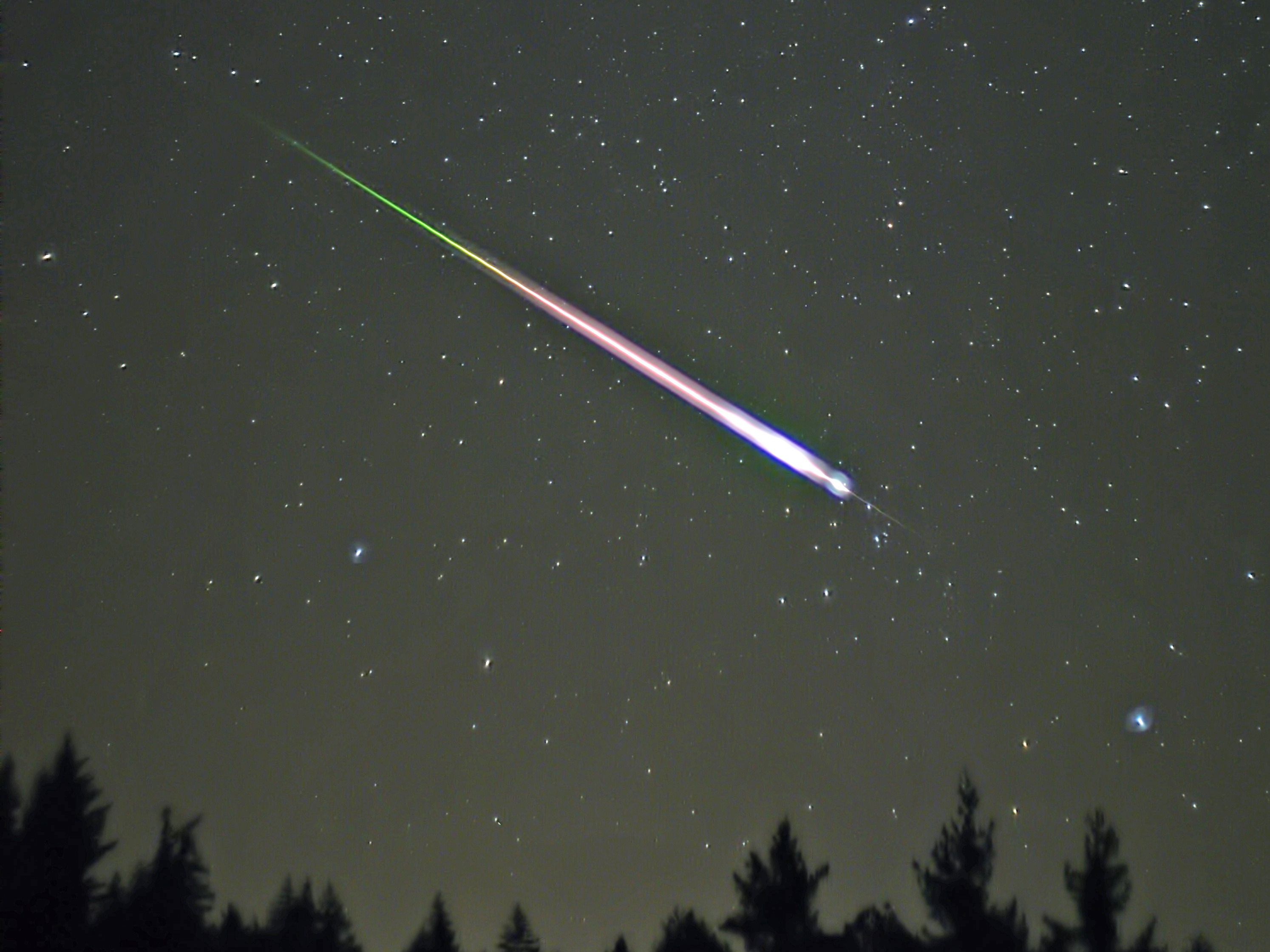
In March, a chunk of rock and metal appeared over Lake Erie, flew at supersonic speed over northern Ohio, and then blew up in a deafening explosion. Over the next week, at least four other fireballs appeared over North America: one above Texas, two over California, and one that flew across Michigan. None caused any significant damage on the ground, but all were seen and heard by hundreds of people.
This surge of bright meteors did not just hit America. In Europe, an object flew at speed over Luxembourg and Germany on March 8, exploded just before it reached the Rhine, and sent a fragment of rock into someone’s bedroom. A few days later, another bright fireball was seen above France, this time heading towards the border with Spain.
Is something unusual going on? Such a spate of fireballs seems out of the ordinary. And statistics seem to back up the idea that something has changed. According to the American Meteor Society, there were more big meteor strikes in the first quarter of 2026 than in any other recent year.
Most of this increase – the numbers for which are based on witness reports – came in the month of March. Although reports in January and February were slightly higher than normal, the Meteor Society says, it was only towards the end of February that they really started to pick up.
This may partially be explained by a seasonal pattern in appearances. For reasons that aren’t entirely clear, the number of fireballs tends to increase during the spring months of the Northern Hemisphere. Possibly, NASA says, a patch of debris happens to lie in the part of the solar system we traverse at that time of the year.
But it may also be something to do with the solar antiapex, the point in the sky away from which the Sun is travelling. In the spring months this point reaches a zenith in the northern sky, and this seems to be linked to a peak in the number of meteors we see here on Earth.
The real difference, according to the Meteor Society data, is not just the number of meteors seen, but their size. The strikes that came this year seem to have been bigger than average, and large enough to punch deep into the atmosphere and explode with a loud boom.
The Origins of a Fireball
Despite some patterns in how their numbers vary over the year, meteors can come from any direction at any time. All are lumps of rock or ice that were, until they encountered our planet, drifting quietly through the solar system. Most are tiny. Every day about ten metric tons of dust falls upon our world, but others are larger, measuring anything from a few centimetres across to several metres.
Whenever one of these objects draws too close to the Earth, it begins to fall. Since the Earth’s gravitational field extends far into space, anything that encounters the outer atmosphere will already have been accelerating towards the planet for some time. The force of this attraction means it must hit those outer layers of air at a speed greater than twenty-four thousand miles per hour.
At this immense speed, air molecules cannot get out of the way of the incoming meteor. Instead they begin to pile up, forming a region of increasing air pressure directly in front of its passage. As pressure increases, so does temperature, and soon all that heat begins to eat away at the rock and ice.
Small objects disintegrate rapidly. But big ones can survive the initial heat and begin to punch through the thicker, lower layers of the atmosphere. As they do, hot air begins to break into the interior of the rock, starts to attack its internal structure, and eventually rips the object apart. When the end comes, it is sudden. The kinetic energy of the meteor is converted into heat, and it detonates with force.
The result is a hot shock wave. Witnesses to big meteor fireballs – those in Chelyabinsk in 2013, or that in Tunguska in 1908, for example – described flashes of light as bright as the Sun and a wave of intense heat. Some were burned, as if they had stood in bright sunlight for many hours.
The event in Ohio released energy equivalent to almost four hundred tonnes of TNT. The meteor over Chelyabinsk exploded with the force of half a megaton of TNT – dozens of times more powerful than the nuclear explosion in Hiroshima. Tunguska, in 1908, released more than ten megatons, the equivalent of a large thermonuclear bomb.

Is Something Going On?
Fortunately, these kinds of big impact are rare. Events like Tunguska – probably caused by an asteroid or comet measuring about fifty metres across – happen only once every few centuries. Meteors like Chelyabinsk – twenty metres across – arrive once every few decades.
The Earth is big, and most of it is empty. When a big strike does happen, it is far more likely to be over some remote region than over a metropolis. Last year, one of the biggest fireballs occurred over the Pacific Ocean, some four hundred and fifty nautical miles south-west of Mexico. Another exploded over the central Indian Ocean, eight hundred nautical miles south of India.
Both of these events were much bigger than those seen over Ohio or Luxembourg earlier this year, but since there were very few people around to see them, they passed almost entirely without comment. In many cases, indeed, these fireballs are spotted not by people, but by radar systems or by satellites looking for lightning strikes. But these methods are imperfect, and many impacts, even quite big ones, probably pass entirely unnoticed.
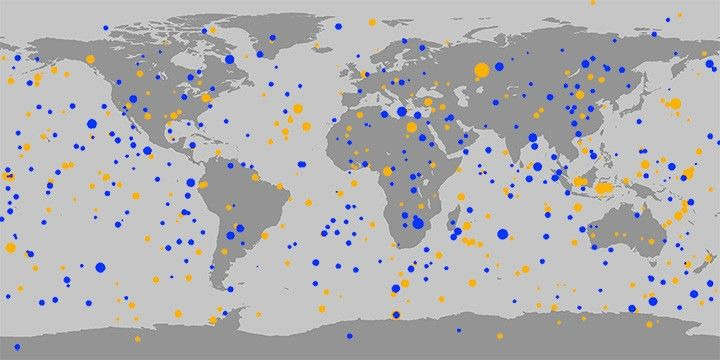
This, then, is the main reason why the early part of 2026 has seen an uptick in fireball numbers. By random chance, more strikes have happened over populated areas, and in an age where cameras are now everywhere, more people have captured footage of them streaking through the sky. This randomness probably also explains why this year’s meteors have been larger and more obvious than usual.
Indeed, in the longer run, this year is unlikely to look like much of an outlier. Meteors have always hit the Earth, and people throughout recorded history have reported the occasional flash of light and rain of stones coming from the sky. They rarely hurt people, and those that are big enough to do so are fortunately rare and more likely to explode over the oceans than over land.
This year’s spike in fireballs is nothing to worry about. Instead, if you see one, appreciate you are almost certainly witnessing the demise of an ancient piece of the solar system, one that had survived for billions of years, until it happened to fall upon our blue world.
Read More
The Myth and Mystery of The Tunguska Impact

Suddenly... the sky was split in two and high above the forest the w…
The Moth and The Aurora: The Work of Étienne Léopold Trouvelot

In the 1860s, the American Civil War cut off the supply of cotton to the textile mills of New England. The solution, Étienne Léopold Trouvelot thought, might be found in moths. With the right kind he could produce silk, and with this he could alleviate the shortage.


Interesting! I had meant to look into if there were actually more fireballs this year, because I had thought it might just be media attention being more. I see at least a couple fireballs fizzing across the sky every year--not big enough to actually explode or anything exciting like that, but big enough to come in low and be audible before they disappear. But I'm always looking up, whereas I don't know if other people really even pay attention to the sky at all. Nothing beats the time when I was driving home one night through the dark forest and one just tore across the sky right down the path of the road I was taking. It was amazing--kind of glad there was no one else on the road because I was so enthralled I wasn't paying attention!
One thing I'm not clear on is why the spring anthelion point (I think?) causes more fireballs? What makes them cluster there in particular?
Interestingly it seems NASA and/or meteor experts are actually saying this year's fireball increase is notable and can't be put down to coincidence or 'more recording devices and cameras' alone, there is a definite surge compared to previous years. I do think that growing population and spreading urban areas have an effect re: a higher number of people who could see them, and there are now doorbell cameras that spot them when you're sleeping. Fireballs over the ocean may go unnoticed, but fireballs over land with more development and people living on it than in the past will get noticed.