
The Week in Space and Physics: The Life of a Giant Star
On the changing nature of an extreme star, Isaacman's new approach to Artemis, a new view of comet 3I/Atlas, and more evidence in support of panspermia
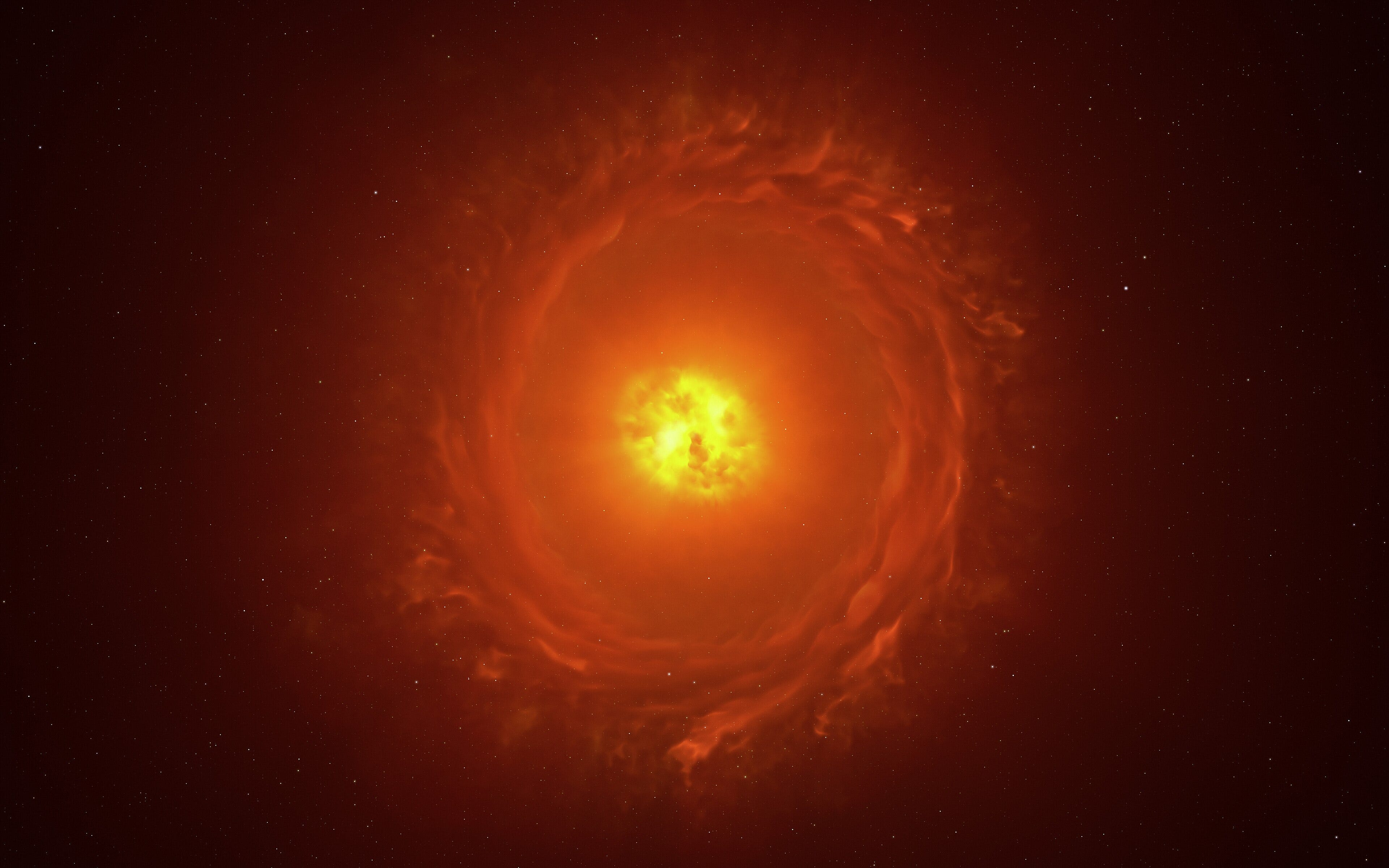
Of all the known stars, WOH G64 is surely one of the most extreme. It is enormous. Were it placed at the centre of the solar system, it would consume all the planets out to the orbit of Jupiter. If it were instead at the distance of Alpha Centauri, it would shine in the sky almost as brightly as the full moon. Even across such a span of space, its light would still be strong enough to cast shadows at night.
Such big stars do not live long. WOH G64 is probably about five million years old. Some time in the past few hundred thousand years it became a red supergiant: that is, it ran short of hydrogen fuel, switched to burning heavier elements such as helium, and swelled to its present brobdingnagian size.
Over the last decade, however, it seems to have undergone another change. Around 2011, the star started to dim. It then reversed course, and dramatically brightened between 2013 and 2014. At the same time, it became hotter, shrank, and changed colour, shifting from red to yellow.
That was a potentially significant change. Very big stars like this one can sometimes evolve into what astronomers call a yellow supergiant. These are rare: in our galaxy there are only about two dozen of them. Partly this is because big stars are uncommon. But it is also because they don’t live long – yellow supergiants are hot, bright, and highly unstable.
Yet over the past year, WOH G64 seems to have calmed down. It has cooled, and its colour has shifted back to a more reddish hue. It has also become less bright, and might have once again swelled in size. If it was a yellow supergiant, it doesn’t seem to have been one for long.
In an attempt to understand what is going on, Gonzalo Muñoz-Sanchez at the University of Athens has studied the data we have on this star. He reckons we might have been fooled in the past. Instead of a single star, he says, we might be looking at a binary system in which a small hidden star is orbiting a much larger giant.
These two stars are close, and this means the smaller one can pull material out from the larger one. That could be creating a thick blanket of gas around the partners, something that might glow red and look rather like a vast red supergiant. But at times – and this may have happened over the past two decades – some kind of disturbance may hit this blanket.
When that happens, the true nature of the star is revealed to our telescopes. In the place of a vast supergiant, we see a smaller and yellower star. Its brightness fluctuates as its partner moves around it, and for a few years the star thus seems to radically alter in nature. Afterwards, as the gas blanket recovers, the system goes back to its previous reddish appearance.
Astronomers are uncertain about what the future holds for this system. It is certainly dying. Within the next few thousand years it might explode in a dramatic supernova. That, since the aftermath would be easily visible to the naked eye, would be a spectacular event. But it is also possible that a stranger fate might await it: one day the star might simply vanish, and implode silently into a black hole.
NASA Rethinks Artemis
NASA has shaken up its approach for returning to the Moon. The move comes at the behest of Jared Isaacman, the newly appointed head of NASA, who is keen to reform and accelerate the work of the space agency.
He has identified NASA’s moon rocket, the SLS, as a key issue. It costs a lot of money and is hard to get off the ground. Last time it flew, in 2022, engineers spent months troubleshooting problems. The issues seem to be repeating this year: NASA wants to launch the SLS to send humans around the Moon, yet it is once again struggling with fluid leaks as the rocket prepares for lift-off.
To solve this, he says, NASA needs to fly the rocket more often. That would give engineers more experience working with it, and would allow for more opportunities to perfect the complexities of launching it. To that end, he wants to launch the rocket four times over the coming three years.
The next launch should come in the next few weeks. That will be Artemis II, a mission that will send astronauts on a loop around the Moon. Nothing has changed there. But Artemis III – which was supposed to support the first lunar landing in five decades – will now only reach Earth orbit. Engineers will use the mission to practice docking the Orion capsule with either SpaceX’s or Blue Origin’s lunar lander, a step that will be needed before crews can head to the surface.
In 2028, Isaacman wants the agency to try for two Moon landings, both of which would put human boots on the regolith. Yet it remains to be seen if America’s space industry can meet the challenge. The SLS has been delayed many times before, and neither SpaceX nor Blue Origin have yet shown they can get a human lander anywhere close to the Moon.
Even so, Isaacman’s approach is probably the best chance America has of landing an astronaut on the Moon this decade. 2028 may still be too ambitious a goal. But his revised plans signal a willingness to consider other options, and to put industry – including SpaceX – on notice.
JUNO Spots 3I/ATLAS
Back in November, the interstellar comet 3I/Atlas reached its closest point to the Sun. Unfortunately for us, the comet then lay on the far side of our star and so was hidden from view of our telescopes.
Luckily, however, Europe’s JUICE spacecraft was positioned for a better view. It is nearly three years into its eight-year-long voyage to Jupiter, and in November it also lay behind the Sun. Operators thus took the opportunity to direct its cameras to study the comet.
But as JUICE was behind the Sun, it was unable to immediately send the data it collected back to Earth. Instead it stored it onboard. When it emerged, earlier this year, it transmitted the photos and measurements it collected back to mission control.
ESA has now released the first of these images. They show the comet as seen from a distance of sixty-six million kilometres, and reveal it to be surrounded by an egg-shaped halo of gas. Behind it streams a faint tail of particles, making it look rather like any other comet approaching the Sun would.
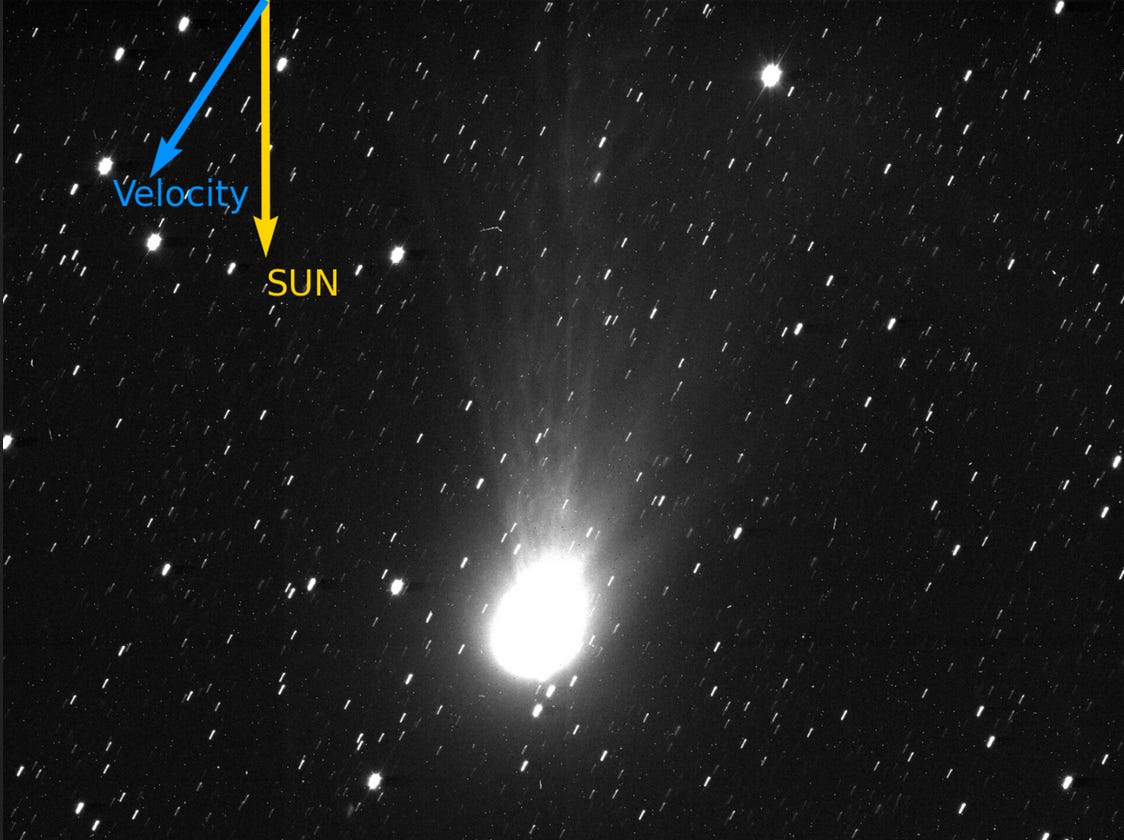
Researchers will now study the rest of the data JUICE sent back. Later in March they will meet to discuss what they have found – and what the observations can tell us about what the comet is made of and where it might have come from.
3I/Atlas itself is now approaching Jupiter. It should make its closest approach to that planet on March 16. Afterwards it will fly onwards and begin to fade from view. But the simple fact it has traversed the distance from Mars to Jupiter in mere months hints at its impressive speed: JUICE will take another five years to cover the same distance.
Life and Asteroid Impacts
Sixty-six million years ago, an asteroid at least six miles wide smashed into a shallow sea close to what would one day become North America. It left a crater eighteen miles deep, and blasted a trillion tons of rock and dust upwards. Much of that fell back to Earth, set everything on fire, and contributed to the extinction of the dinosaurs.
Yet some of that rock escaped our planet. Over the next few million years, pieces of Earth fell on Mars, or burned in the thick atmosphere of Venus. A fraction of it even reached the moons of Jupiter and Saturn, and there it likely plunged into the deep oceans that lie under their icy surfaces.
It is all but certain that some living creatures were blasted into space along with all that debris. Since experiments on the International Space Station have shown that some hardy bacteria can be revived after spending years exposed to the vacuum of space, it seems likely that some lifeforms survived this initial ordeal.
Now, an experiment has found that some of those same bacteria are also capable of surviving intense shocks and pressure waves. That came as a bit of a surprise, the scientists conducting the experiment said. The shocks were expected to rupture the cell walls of these creatures and so kill them. Instead the experiment found that almost all of them survived.
This lends even more weight to theories of panspermia, the idea that life has emigrated between the planets. And since Earth rocks surely lie at the bottom of oceans on Titan, Europa, and Enceladus, it strengthens the idea that we may soon find evidence of thriving colonies of bacteria elsewhere in the solar system.
Read More
Data Centres In Orbit Are Just As Crazy As You Think

America’s billionaires are suddenly obsessed with the idea of buildin…
The Bold Insanity of Artemis II: America Prepares to Return to the Moon

If NASA keeps the schedule, the moment of lift-off will …
The Mysterious Origins of the Third Interstellar Comet

Three weeks ago, a robotic telescope in Chile spotted a comet moving …