
The Week in Space and Physics: What Can Solar Twins Tell Us?
On solar twins, the absence of alien radio signals, a new baryon, and a new discovery on an old asteroid
The hottest stars are blue. These are the beasts of the galaxy, massive stars that can be seen from incredible distance. But they do not live long: they burn their fuel furiously, and die young. Scattered all around them, and far outnumbering them, are smaller, redder stars. These, the red dwarfs, are almost immortal. They burn their fuel so slowly that they will endure for trillions of years to come, and will only face death in that future epoch when the cosmos begins to fade into darkness.
Somewhere between these two extremes lie stars like our Sun. It is a G-type star, a class that puts it alongside stars like Alpha Centauri, Tau Ceti, and 51 Pegasi. These stars are not especially big or bright, though they are considered to be stable and most will survive for about ten billion years before they run short on fuel.
Studying other G-type stars can tell us about the past and future of our Sun. Those that are most like our Sun – especially in terms of mass, colour, and chemical makeup – are known as solar twins. Though they were probably not born together with our star, they will follow a similar path through life.
Until recently, only a dozen or so solar twins were known. But thanks to the Gaia Space Telescope, we now have a map charting the positions and properties of more than a billion stars in the Milky Way. By searching this map, a team of researchers based in Japan and France say they have identified more than six thousand solar twins.
Each burns with a temperature within two hundred degrees of that of our Sun. Each also has a similar surface gravity, a detail which implies they have more or less the same mass and density. And each is made of a similar set of chemical elements, and so emits light with the same characteristics as our star does.
This catalogue has a lot of potential. If we know where the solar twins are, we can watch them and see how they behave. This can offer insight into rare events: for example, there are hints that the Sun occasionally unleashes gigantic flares. Since this happens once every few hundred years, our odds of catching one are small. But if we can watch many Sun-like stars, those odds suddenly become far better.
It can also allow us to trace the history of the galaxy and of our solar system. Analysis of the ages of these solar twins shows two separate groups. One is relatively young, and formed about two billion years ago. But the other is older, and matches the age of the Sun: these stars formed between four and six billion years ago.
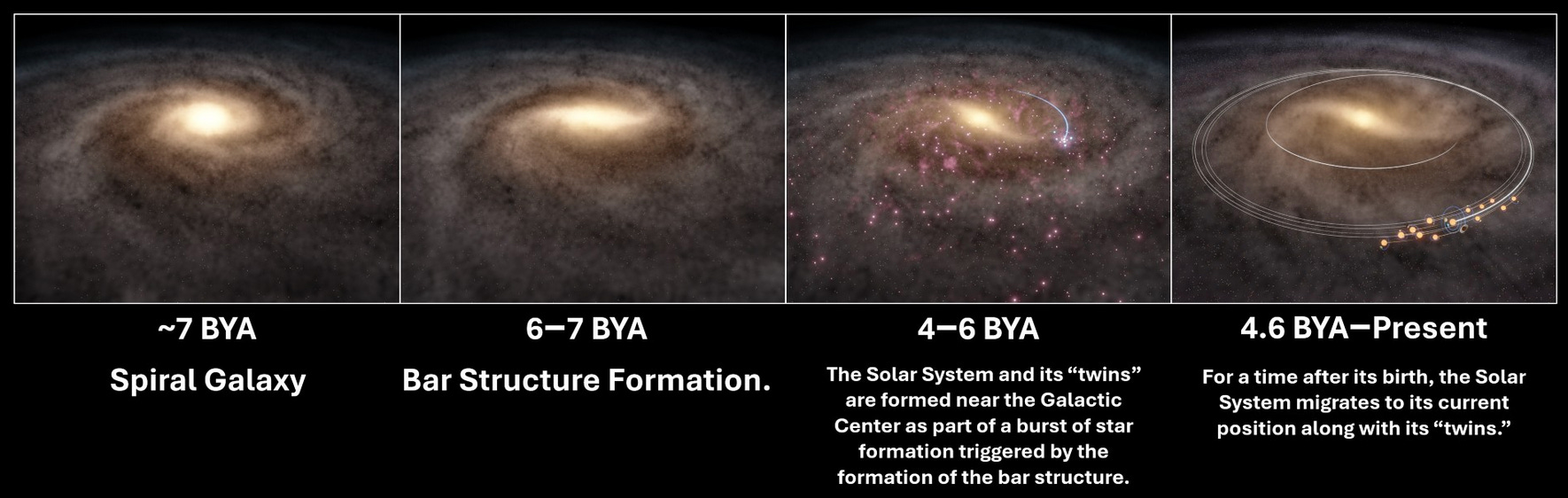
Many of the stars in this second group appeared to have moved outwards from the centre of the galaxy. The Sun was probably part of this vast stellar migration: it seems to have formed about ten thousand light-years closer to the galactic core than its current distance, and then drifted outwards at some point.
The reasons why this migration took place are still unknown. But the researchers behind the analysis suspect it has something to do with the bar that stretches across the centre of the Milky Way. The formation of this bar could have sparked the birth of new stars, they say, including our own. Afterwards, its presence could have helped push these new stars outwards.
The centre of the galaxy is probably hostile to life: it is crowded, chaotic, and often hit by powerful events like supernovae. Our star’s outward migration brought it into a calmer neighbourhood. We might owe our very existence to that long-ago voyage across the galaxy.
The Great Silence in The Heavens
It has been almost one hundred and twenty years since the first human words were transmitted by radio. In theory, those words – a short speech, a song, and a wish for a Merry Christmas – are still out there somewhere, marking the forefront of a bubble of sound coming from our planet. In practice, of course, that early signal is now so distant and dilute that even the most sensitive receiver would have trouble hearing it.
Yet the idea remains. Our radio signals have been leaking out into space for more than a century, and anyone out there listening could pick up the sounds of our world. The same may be true in reverse: one day we could pick up a radio message coming from another intelligence, another civilization out there in the stars.
This formed the basis for SETI, a long search for artificial radio signals coming from space. But, despite a decades-long hunt, this search has found nothing. There appears to be a Great Silence in the heavens, a dearth of noise that makes some wonder if we are alone.
But there may, according to a new paper, be a good reason for this silence. It points out that any radio signal leaving Earth must first pass through a region of space shaped by the Sun. This can be a turbulent place: it has shifting magnetic fields, the everlasting solar wind, and the occasional passage of a big solar storm. All this alters the radio signals passing through it.
The result, the authors say, is a broadening of narrow radio signals. Those focused around a single frequency – as artificial ones tend to be – will be weakened, and the ratio of signal to noise will fall. Any observer would then struggle to distinguish these signals from natural ones.
This is not just a theoretical possibility. The study also looked at the radio signals coming from distant probes, including those sent by Pioneer and Voyager. All showed signs of distortion, and saw this worsen when the Sun was more active than normal.
Such effects do not make it impossible to detect radio signals coming from other star systems. But it does mean we might have been looking for the wrong thing – and that by modifying our search parameters, we might stand a better chance of spotting the long-sought-after message from the stars.
A Charming Proton
Every atom is made of a collection of quarks and electrons. The electrons fly alone, forming a hazy cloud around a central nucleus. The quarks cluster in this nucleus, and combine to form protons and neutrons.
There are six kinds of quark, though only two of them – the up and down quarks – appear in atoms. Protons are made of a group of two up quarks and a single down quark; neutrons are the reverse, containing a single up paired with two downs.
The other kinds of quark – the charm, the strange, the top, and the bottom – are seen more rarely. Indeed, the last of them, the top quark, was only discovered in 1995. But as with the up and down quarks, these can also combine into larger particles. When these particles contain three quarks, as protons and neutrons do, they are called baryons.
About eighty such baryons are now known. But almost all are still dominated by up or down quarks, and have only one of the more exotic flavours. Last week, however, CERN announced the discovery of a new baryon, one made of two charm quarks and one down quark.
This makes it look something like a proton, just with the up quarks replaced by the heavier charms. The discovery was not unexpected – its existence is allowed for by the known laws of physics, although it is not thought to be particularly stable. But this is at least an opportunity to study another particle, and to see if it acts as our laws of physics say it should.
Nucleobases on Asteroids
Last week, researchers announced they had found all the essential components of DNA in a sample brought back from the asteroid Ryugu. This includes the five nucleobases found in all DNA and RNA molecules, each of which is thought to have played a key role in the origins of life on Earth.
These kinds of molecules have been found on asteroids before – samples of Bennu collected by Osiris-REx contained some of them, as did some meteorites that were examined after they fell to Earth. This discovery is not therefore something completely new, but it does strengthen the picture we already had.
Because these molecules seem to be widespread on asteroids, it suggests they can form easily through chemical reactions taking place in space. After the Earth formed, it may have been impacts of asteroids like Ryugu that brought the ingredients of life to our planet. And if that was the case here, it should have been the same on many other worlds.
Read More
The Strange Problem With Red Supergiants

Giant stars are supposed to die in big and dramatic explosions. They run short on fuel, their cores collapse under immense gravitational pressure, and then they blow up. In 2023, we saw this happen i…
Data Centres In Orbit Are Just As Crazy As You Think

America’s billionaires are suddenly obsessed with the idea of buildin…
The Myth and Mystery of The Tunguska Impact

Suddenly... the sky was split in two and high above the forest the w…
For a while now I've wondered about the circumstances necessary for intelligent life to evolve, and I speculate that at least six conditions with odds of just 1 in 10,000 might be necessary. Right star, right planet, big iron core with lots of heat, maybe a big moon, maybe gas giants in the outer system for shielding, etc. If true, or even close, it would imply the odds of intelligent life are on the order of 1:10²⁴. Compared to 10¹¹ stars in the Milky way or even the 10²² stars in the visible universe.
If this speculation is at all accurate, we may be alone here. Intelligent life in the universe might be rare and extraordinary.
Love this concept of stellar twins, thanks for the writeup. I wonder whether the distribution of matter around these stars is similar to that of our solar system, or whether there are multiple paths to get to a star like ours.
The new SETI information is fascinating. Sagan's idea of civilizations beaming our first signal back at us was incredibly sticky, but also impossible... something he probably knew as he wrote it.
You may like this essay I did a few months ago on that idea...
https://astrodermatologist.substack.com/p/most-kernels-pop-alone?r=6n71ui